Frequently Asked Questions
The answers provided below are based on answers previously given to customers' questions.
Greece pairs some of the oldest monuments in Europe with a coastline so broken by bays and islands that you are rarely far from the sea. A first visit usually starts on the mainland among ancient temples and theaters, then heads out by ferry to whitewashed island villages, pine-backed beaches and harbors full of fishing boats. Each region keeps its own rhythm: busy and historic around the capital, slow and sunny on the islands, mountainous and monastic in the north. Most tours here are private or small-group outings, about half include hotel pickup, and many are built around cruise ship calls, so short port days are easy to fill. Almost all can be canceled for free, which leaves room to change course when ferries or weather shift.
The capital region is where Greek history feels closest. Above the city rises the Acropolis, its marble temples visible from almost every rooftop, and the Acropolis Museum below holds the sculptures that once decorated them. The Panathenaic Stadium (Panathinaiko Stadio), built entirely of marble, still hosts ceremonies linked to the modern Olympic Games. A guide makes a real difference at these sites, explaining what stood where and why it mattered.
Private sightseeing and cultural outings are the usual choice here, along with bus and minivan trips that reach farther afield. A favorite drive heads west to the Corinth Canal, a narrow cut through solid rock with sheer walls on either side. Shore excursions and port transfers also begin here for travelers arriving by cruise ship.
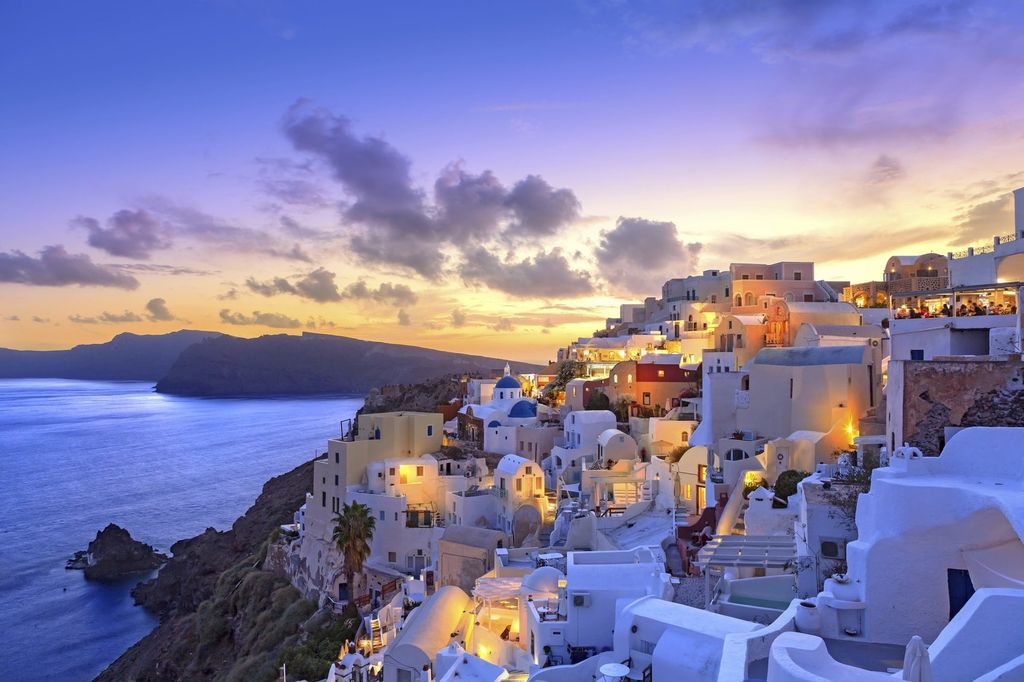
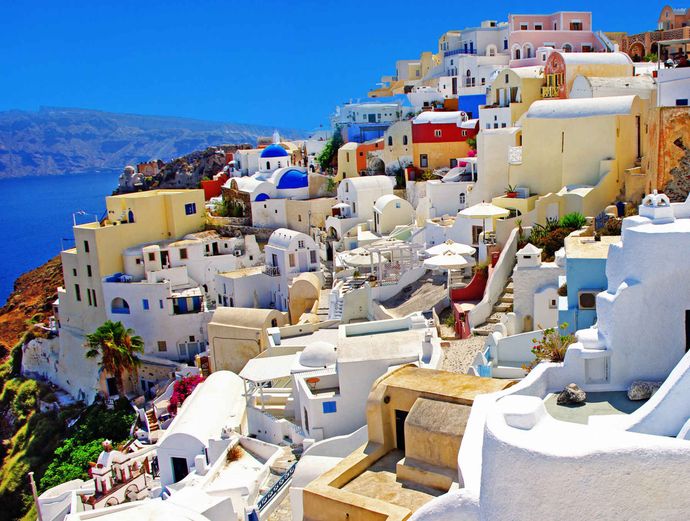
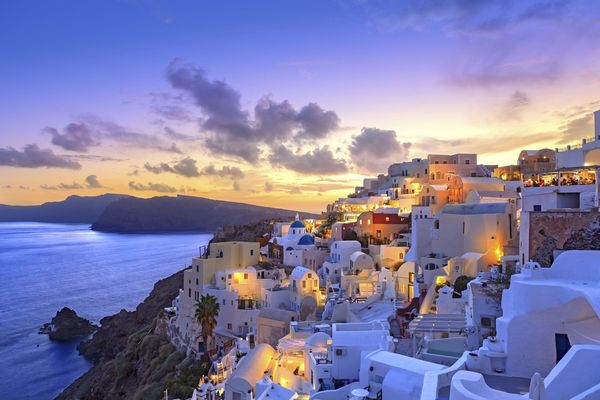
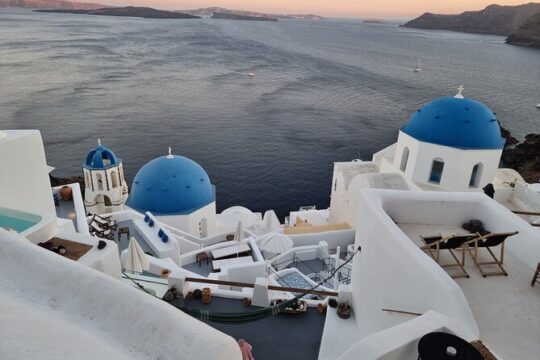
Picture whitewashed cubes, blue domes and windmills on bare brown hills, and you are picturing the Cyclades. Cruise ships call at these islands often, so shore excursions and port transfers make up a large share of what visitors book, alongside half-day and private sightseeing tours. On the volcanic island at the southern end of the chain, the clifftop village of Oia draws crowds at sunset, the Monastery of Profitis Ilias (Moni Profitou Iliou) sits on the highest point with views over the whole caldera, and Perissa Beach and the Red Beach show off black and red volcanic sand.
Paths are steep and the sun is strong, so a private driver who knows the back roads can stretch a short port call a long way.
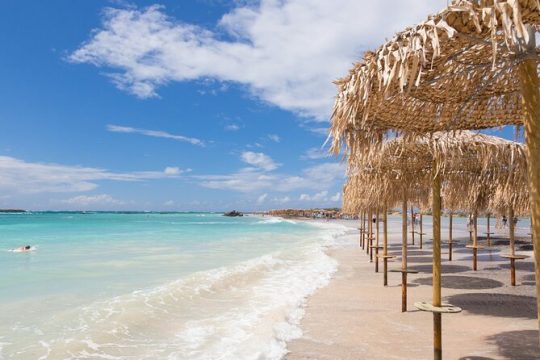
Crete feels like a small country of its own, with high mountains, deep gorges and a long southern shore facing Africa. History runs deep: the Palace of Knossos was the heart of the Minoan civilization, and its restored rooms and painted walls give a vivid picture of that world. On the far western tip, Balos Beach and Lagoon spreads pale sand and shallow turquoise water between two headlands, while the fortress island of Spinalonga carries the memory of its years as a leper colony.
Distances are large, so full-day bus and minivan tours suit the island well, and outdoor activities such as hiking and jeep trips reveal its wilder side. The old town of Rethymno (Rethimno), with its Venetian harbor and narrow lanes, rewards an unhurried afternoon.
Green rather than white, the islands on the western side of Greece are covered in olive groves and cypress trees, with Italian influence showing in their architecture. Many visitors arrive by cruise ship, so port transfers, shore excursions and half-day tours lead the bookings. Paleokastritsa, with its monastery above a string of coves, and Paleokastritsa Beach just below are favorite stops, and the Blue Caves glow an intense blue when sunlight reaches the water inside.
On a neighboring island, Myrtos Beach (Paralía Mirtos) curves beneath tall white cliffs and is one of the most photographed beaches in the country. Minivan tours and private outings help you string several of these places into one day.
Close to the Turkish coast, this island group mixes medieval knights' castles, Italian-era buildings and sandy bays. Above the whitewashed village of Lindos, the Acropolis of Lindos crowns a rocky headland, and the climb repays you with views over two bays. Kallithea Springs, an elegant old spa of domes and colonnades, sits right by the sea, and Anthony Quinn Bay is a small emerald cove named after the actor who fell for it while filming.
Shore excursions and port transfers are the main bookings, with day trips, half-day tours and minivan outings rounding out the choice.
The largest region of the country stretches across the north, from a lively seafront city to mountains and lakes inland. On the waterfront promenade stands the White Tower (Lefkos Pyrgos), Aristotelous Square opens wide toward the sea, and the Church and Crypt of Ayios Dimitrios honors the city's patron saint with layers of Byzantine history. Food is a highlight too, shaped by centuries of trade across the Balkans.
Private, cultural and heritage tours lead the way, and day trips often head inland to Meteora, where monasteries perch on towering rock pillars. Bus and minivan tours make that long drive comfortable.
Joined to the rest of the mainland only by a narrow isthmus, the Peloponnese holds an astonishing number of ancient sites. Mycenae, with its Lion Gate and royal tombs, was the seat of the kings in Homer's stories, and the Theatre of Epidaurus is famous for acoustics so clear that a whisper on stage reaches the top row. Several outings here also take in the Acropolis and the Panathenaic Stadium (Panathinaiko Stadio), so the two regions combine easily on a longer trip.
Cultural and private tours suit history lovers best, and shore excursions serve cruise passengers arriving at the region's ports. Bus and minivan trips handle the winding roads between sites.
Naxos is the largest and greenest island of its group, with farming villages, marble quarries and long sandy beaches. Its strength is time on the water: boat tours, sailing trips and cruises head out to swim in quiet coves and visit neighboring islands. One favorite outing crosses to the Antiparos Cave, a vast cavern full of stalactites reached down a long stairway, while Faneromeni Beach is a calm stretch of sand for an easy afternoon.
Private and half-day tours let you explore the mountain villages inland at your own pace.
Beyond the busiest regions, Greece has many smaller corners worth a day or more of your time.
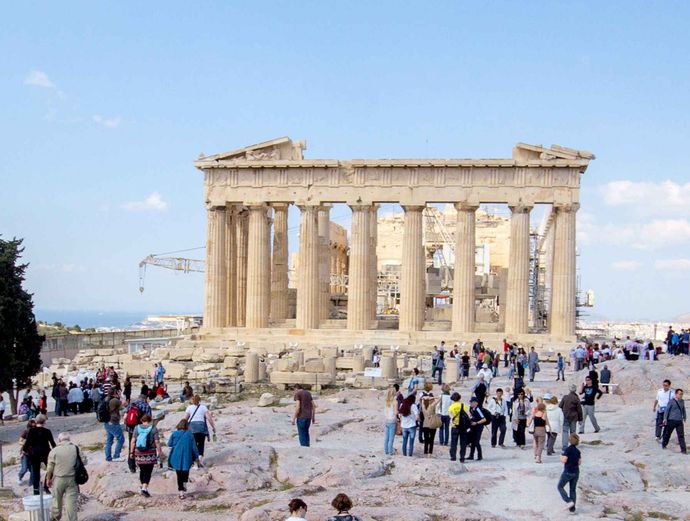
#1The Acropolis is the rocky hilltop in the heart of Athens crowned by the ruins of temples from ancient Greece, led by the Parthenon. It is the most famous monument of the classical world, and people come to stand among the marble buildings that shaped Western ideas of architecture and democracy.People lived and worshipped on the rock long before the classical era, and it served as a citadel and sacred ground for the city. After the Persians wrecked its older temples, the statesman Pericles led a grand rebuilding program in the 5th century BC. The Parthenon, dedicated to the goddess Athena, was designed by the architects Ictinus and Callicrates, with sculpture overseen by Phidias. In later centuries the hill held a church, a mosque and an Ottoman garrison, and an explosion during a Venetian siege in the 17th century tore open the Parthenon. Restoration work has gone on for generations, and cranes and scaffolding are part of the scene.You enter through the Propylaea, the monumental gateway that was meant to prepare visitors for what lay beyond. The small Temple of Athena Nike stands on a bastion to one side. The Parthenon dominates the summit, its columns subtly curved and tapered so they appear perfectly straight from a distance. Opposite stands the Erechtheion, with its famous porch held up by carved maidens, the Caryatids. The figures on site are copies, and the originals are kept safely indoors nearby.From the edges of the rock, the view takes in the whole city, out to Lycabettus Hill and the sea. On the slopes below lie the Theatre of Dionysus, where Greek drama took shape, and the Odeon of Herodes Atticus, still used for performances. A guide brings the myths, politics and building methods behind the stones to life.
More
#2The Palace of Knossos is the largest Bronze Age archaeological site on Crete, just south of Heraklion, and the center of the ancient Minoan civilization. People come to walk through its partly restored rooms, courtyards and colorful frescoes, and to see the place tied to the myths of King Minos and the Minotaur.The Minoans built a vast palace here in the Bronze Age, on a hill that had been settled for thousands of years before. It was rebuilt after earthquakes and grew into a sprawling complex of royal quarters, workshops, shrines and storerooms around a great central court. Its maze of rooms and corridors may have inspired the Greek legend of the Labyrinth, built by Daedalus for King Minos to hold the Minotaur, a creature half man and half bull. The palace was eventually destroyed by fire, and its ruins lay buried for centuries.The British archaeologist Arthur Evans excavated Knossos in the early 20th century and made a bold choice: he rebuilt parts of the palace in concrete, painted columns and added copies of frescoes. His reconstructions help visitors picture the palace at its height, though archaeologists have long debated how accurate they are, and they have become part of the site's story in their own right.Walking through the ruins, look for the Throne Room, with its stone throne and painted griffins, the Grand Staircase descending through several levels, and the tall clay storage jars, or pithoi, that once held oil and grain. Copies of famous frescoes, such as the leaping dolphins, the charging bull and the Prince of the Lilies, show the Minoans' love of nature and color. The distinctive red columns, wider at the top than the bottom, are a Minoan signature. A guide makes sense of the many layers and separates myth from evidence.
More
#3The Agora of Athens is the ancient heart of the city, a broad archaeological park below the Acropolis where Athenians once met to trade, debate, vote and worship. Travelers come to walk where democracy took shape, see one of the best-preserved Greek temples anywhere and explore a museum of daily life in the ancient city.For centuries the Agora was the center of public life in Athens. Citizens gathered here to shop, hear the news and argue about politics, while buildings around the open square housed the council, the courts and the officials who ran the city. Socrates questioned passersby in its colonnades, and Zeno taught in the Painted Stoa on its northern edge, which is how his followers came to be called Stoics. The Panathenaic Way, the route of the city's greatest religious procession, cut across the square on its way up to the Acropolis.On a low rise at the western side stands the Temple of Hephaestus, a Doric temple of the fifth century BC that still has its columns and much of its roof, partly because it later served as a church. Across the site, the long Stoa of Attalos, first built as a gift from a king of Pergamon, was rebuilt in the 20th century and now holds the site museum. Its finds bring ordinary Athenians close: pottery shards scratched with the names of politicians voted into exile, a stone device for choosing jurors at random, a water clock that timed speeches in court, and coins and kitchenware.Elsewhere among the olive trees lie the foundations of the council house and the round Tholos, a small Byzantine church with frescoes, and statues of giants and tritons that once fronted a concert hall. Much of this was uncovered in the 20th century, after a whole neighborhood built over the ruins was cleared to let archaeologists dig.
More
#4The Odeon seats about 5,000 people on stone and marble tiers, so wear shoes with good grip. It suits history lovers, music fans and anyone building an Acropolis area day around the sights nearby. A non-slip wooden ramp runs from the artists' entrance to the first row of seats, and there is an accessible restroom. Performances are held after dark in the open air, so bring a light layer for the evening.
More
#5The Parthenon stands at the top of the Acropolis hill, so expect a steady uphill walk on worn marble that can be slippery. Plan about two to three hours for the Acropolis, and longer if you add the nearby Acropolis Museum. There is little shade on the hilltop, so bring a hat, sunscreen and water. Security checks apply at the entrance, so carry only a small bag and leave bulky items behind. Visitors with reduced mobility should contact the site staff before arriving to arrange lift access.
More
#6Plaka is the old neighborhood at the foot of the Acropolis, between Syntagma and Monastiraki squares. Cars are largely banned, so the narrow lanes are shared by walkers, shoppers and diners. Cobblestones and steps make it hard for wheelchairs and strollers, especially in upper Plaka and Anafiotika. Wear comfortable shoes, since the uneven stone is tiring over a full day. Anafiotika is a residential area, so keep your voice down and do not enter open doorways.
More
#7The Acropolis Museum in Athens is a modern glass-and-concrete museum at the foot of the Acropolis, built to hold the sculptures and everyday objects found on the sacred rock and its slopes. People come to see the Parthenon sculptures that remain in Greece, the original Caryatids and the view up to the temple itself.For more than a century the finds had crowded a small museum on the hilltop, and Greece wanted a building that could display them properly and make the case for reuniting the Parthenon sculptures held in London. After an international competition, the Swiss-born architect Bernard Tschumi designed the new museum with the Greek architect Michael Photiadis, and it opened early in the 21st century in the Makrygianni district. Digging the foundations uncovered an ancient neighborhood, so Tschumi raised the building on pillars above the ruins rather than bury them.Inside, a gently rising glass ramp suggests the climb up the sacred rock, leading past finds from the slopes to the Archaic gallery, where korai, smiling marble maidens offered to Athena, stand in natural light beside the Moscophoros, a young man carrying a calf on his shoulders. Nearby, five of the six Caryatids from the Erechtheion stand together on a balcony. Later galleries follow the hill into Roman and early Christian times, showing how long the rock stayed at the center of Athenian life.The top floor is the Parthenon Gallery, a glass hall turned to match the temple's alignment, with the Acropolis in full view through the windows. The frieze and metopes run around it in their original order, with the surviving marbles shown beside pale plaster casts of the pieces held abroad, a quiet argument that the set belongs together. A guide can read the frieze's procession scene by scene and connect what you see indoors with the ruins on the hill above.
More
#8The Temple of Athena Nike is the small marble temple perched on a bastion at the southwest corner of the Acropolis in Athens, beside the monumental entrance gateway. Dedicated to Athena as the goddess of victory, it is the smallest temple on the hill and one of the most graceful, and visitors come to admire its slender Ionic columns and its position above the city.The temple was built in the second half of the 5th century BC, during the great building program that also produced the Parthenon, and it is usually credited to the architect Kallikrates. Its plan is simple: a small inner room with a row of four Ionic columns at each end. Inside stood a wooden cult statue of Athena holding a helmet and a pomegranate. Later writers called the goddess here Wingless Victory, and a story grew that the Athenians had shown her without wings so she could never leave their city.Look up at the frieze, which shows gods gathered on one side and battle scenes on the others, among them Greeks fighting Persians. A marble parapet, added a little later around the edge of the bastion, carried reliefs of winged Victories leading animals to sacrifice and setting up trophies. The best-known panel, a Victory bending to loosen her sandal, now stands in the Acropolis Museum, and casts replace much of the sculpture on the temple itself.The temple has had a turbulent life. In the late 17th century the Ottomans took it apart to build a gun battery on the bastion, and it vanished for well over a century. After Greek independence, its blocks were found inside the fortifications and the temple was pieced back together, and it has been dismantled and rebuilt more than once since then. From its edge the view runs west over the city toward the sea, and legend says King Aegeus stood watch here for the returning ship of his son Theseus.
More
#9The Theatre of Dionysus is the ancient open-air theater on the south slope of the Acropolis in Athens, often called the birthplace of Greek drama. Many plays by Aeschylus, Sophocles, Euripides and Aristophanes had their first performances here, and visitors come to walk among the stone seats and imagine the festivals that shaped Western theater.The theater grew out of the sanctuary of Dionysus Eleuthereus, god of wine and revelry, whose temple foundations lie just below. Every spring Athens honored him with the City Dionysia, a festival at which playwrights competed with new tragedies and comedies before the assembled citizens. At first the audience sat on the bare hillside and on wooden benches, facing a simple circle of beaten earth where the chorus sang and danced.In the 4th century BC the statesman Lycurgus rebuilt the theater in stone, with curving tiers of seats climbing the slope and room for many thousands of spectators. The front row holds a line of carved marble thrones reserved for priests and officials, and the grandest, at the center, belonged to the priest of Dionysus. In Roman times the theater was remodeled again, and a raised stage was added whose front is carved with reliefs from the myths of the god.Much of the upper seating has gone, but enough survives to give a strong sense of the space, with the Acropolis rock rising behind and the city spreading out below. Looking down into the orchestra, it is easy to picture masked actors and packed crowds hearing lines that are still performed around the world. The theater also belongs to the wider landscape of the south slope, with the sanctuary of Asclepius and the Stoa of Eumenes leading west toward the Odeon of Herodes Atticus. A guide brings the plays and politics of ancient Athens back into the stone.
More
#10The Panathenaic Stadium in Athens is a horseshoe-shaped arena built entirely of white marble, the only stadium in the world made that way. Known to Athenians as the Kallimarmaro, or beautiful marble, it hosted the first modern Olympic Games and still welcomes visitors who come to sit in its stands and walk its ancient track.Footraces were run here long before any seats were built, during the Panathenaic Games held in honor of Athena. In the fourth century BC the statesman Lykourgos gave the course a proper stadium, set into a natural ravine between two hills, and in the second century AD the wealthy Athenian Herodes Atticus rebuilt it in Pentelic marble with seating for some 50,000 people. Once the old spectacles were banned in late antiquity, the stadium was abandoned and much of its marble was taken away for other buildings.Its revival came in the 19th century. After excavations uncovered the old outline, the businessman George Averoff paid for a full restoration in marble that closely followed the Roman plan, just in time for the first modern Olympics, when the stadium staged the opening and closing ceremonies and events from athletics to wrestling. It returned to the Olympic stage when Athens hosted the Games again, serving as the finish line for the marathon, and the Olympic flame is handed over here to each new host country.Walking in, you face tier upon tier of marble benches wrapped around a long, narrow track that bends sharply at the curved end. Look for the ancient herms, stone pillars topped with carved heads that turned up during the excavations, the statue of Averoff by the entrance, and the view toward the Acropolis from the highest rows. Runners in the Athens Classic Marathon still cross the finish line on this track. With a guide, the empty arena fills with stories of victors, cheering crowds and the revival that brought the Olympics home.
More
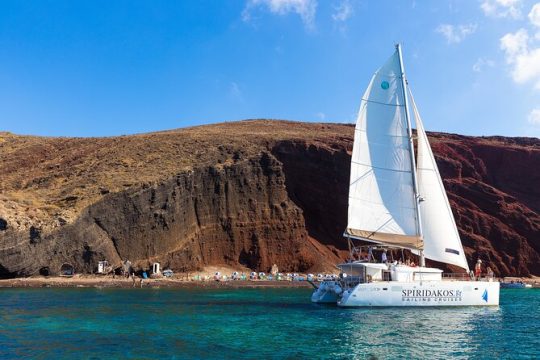
#11Red Beach is a small cove on Santorini's southern shore, close to Akrotiri, where towering cliffs of deep red volcanic rock rise behind a narrow strip of sand. Visitors come for one of the most unusual landscapes in the Aegean, where dark sand and pebbles meet clear blue water beneath a wall of color.The color is a gift of the volcano. Santorini is built from layer upon layer of lava, ash and pumice left by successive eruptions, and along this stretch of coast iron-rich rock has weathered into shades of rust, brick and crimson streaked with black. The beach itself is a mix of red and black grains and pebbles worn from those cliffs, giving the shore the same burnt tones. The cliffs are soft and crumbling, and rockfalls have reshaped the cove over time.The cove lies just beyond ancient Akrotiri, a Bronze Age town buried by the great eruption that shaped the island's caldera. Volcanic ash preserved its paved streets, multi-story houses and vivid wall paintings so well that it is often compared with Pompeii. Many of its frescoes, with scenes of ships, flowers and young fishermen, are now displayed in museums in Fira and Athens. Together, the beach and the excavation show two sides of the same story: the raw power of the volcano and the people who lived in its shadow.The view from the sea is just as memorable, with the red wall rising sheer above the water and the pale cliffs of White Beach a short way along the same coast. The contrast between the two, one red and one white, shows how varied Santorini's volcanic rock can be. A guide can read the cliffs for you, explaining which eruptions laid down each band of color.
More
#12The Temple of Olympian Zeus, also called the Olympieion, is the ruin of a colossal ancient temple in central Athens, a short walk southeast of the Acropolis. Once the largest temple in Greece, it took centuries to complete, and visitors come to stand beneath its surviving Corinthian columns, which still tower over the open site beside Hadrian's Arch.In the 6th century BC the sons of the tyrant Peisistratus began an enormous Doric temple here in local limestone. Work stopped when the tyranny fell, and for centuries the democratic city left it unfinished, perhaps seeing such a huge project as arrogance. In the 2nd century BC the Seleucid king Antiochus IV revived the project with the Roman architect Cossutius, switching to marble columns in the Corinthian style, but work halted again at the king's death.The Roman general Sulla, who sacked Athens in the 1st century BC, carried some of the unfinished columns off to Rome for a temple on the Capitoline Hill. Only in the 2nd century AD did the emperor Hadrian, a devoted admirer of Greek culture, complete the temple, more than six centuries after work began. Inside stood a colossal statue of Zeus in gold and ivory beside a statue of Hadrian himself, and more than 100 columns, each over 17 meters tall, ringed the building.The temple was damaged when raiders sacked Athens in the 3rd century, wrecked by an earthquake, and quarried for building stone through the Middle Ages, and one column was even blown up with gunpowder to make plaster for a mosque in the Ottoman period. Of the original forest of columns, 15 still stand, and a 16th lies where a storm threw it down in the 19th century, its drums spread across the ground like a fallen stack of coins. A guide can help you picture the full temple and its lost statues.
More
#13The arch is a single marble gateway, so most visitors spend only 10 to 20 minutes looking at it and taking photos. It stands beside busy Amalias Avenue, so watch for traffic when you cross to get a closer view. The shade is limited here, so bring water and a hat in summer. It pairs well with the nearby Temple of Olympian Zeus.
More
#14The Erechtheion is reached through the Acropolis, so plan it as part of a wider visit of about two to three hours. Paths are uneven rock and worn stone, so wear sturdy shoes with good grip. The site is only partly accessible, and the lift for visitors with reduced mobility runs with trained staff and stops in strong wind or heavy weather. The six figures on the Caryatid Porch are copies, with most of the originals kept in the Acropolis Museum. Bring water and sun protection, since shade on the rock is limited.
More
#15The Propylaea is the grand marble gateway at the western end of the Acropolis in Athens, the entrance every visitor passes through on the way to the Parthenon. Built in the golden age of classical Athens, it is admired as a masterpiece in its own right, a clever piece of design that turns a steep, awkward slope into a ceremonial approach.The gateway was commissioned in the 5th century BC as part of the building program led by Pericles, soon after the main structure of the Parthenon was in place. Its architect, Mnesicles, faced a hard problem: the ground rises sharply, so he split the building into levels and set a broad central passage between rows of columns, wide enough for the processions, sacrificial animals and chariots of the city's great festival. Work stopped when war broke out with Sparta, and the gateway was never finished. Visitors can still spot the rough lifting bosses left on some blocks, a clue that the masons simply put down their tools.Look closely at the columns and you will see two orders working together: sturdy Doric columns face outward, while slimmer Ionic columns line the passage inside. Most of the structure is gleaming Pentelic marble, set off by bands of dark gray stone from Eleusis. The north wing once held paintings and is known as the Pinakotheke, one of the earliest picture galleries on record, and on the bastion to the south stands the small Temple of Athena Nike.The gateway's later life was eventful. In the Middle Ages it was turned into a bishop's residence and then a palace for the Florentine dukes who ruled Athens, and under Ottoman rule it served as a garrison headquarters and gunpowder store until lightning set off an explosion in the 17th century that wrecked part of it. Restorers have since pieced much of it back together. Each chapter left its mark on the stones.
MoreA day in Greece usually starts early, with a guided visit to a temple, theater or museum before the heat builds, followed by a long lunch and a slower afternoon by the sea. Many travelers book a mix of private sightseeing on the mainland and short outings timed to a cruise stop on the islands. Half-day and full-day trips are the norm, and the pace suits couples, families and first-time visitors who want history and beaches on one trip.
Late spring and early autumn are the sweet spots, with a warm sea, full ferry schedules and thinner crowds at the ancient sites. July and August bring the most heat and the busiest days, especially in the Cyclades Islands and the Dodecanese, where the summer meltemi wind can also stir up the sea. Winter stays mild on Crete and in Athens, a good time for museums and ruins, while Macedonia turns cold and many island hotels close.
Ferries are the backbone of island travel, while domestic flights save time on longer hops. On the mainland, guided minivan tours take care of the driving between sites. Book ferries and summer tours ahead, since popular sailings fill early, and lean on free cancellation to adjust later. Carry a hat, sunscreen, water and sturdy shoes for uneven marble paths, plus a scarf to cover your shoulders in monasteries. Leave a spare day between island hops in case a ferry runs late, and plan ancient sites for the morning while it is cooler.

The answers provided below are based on answers previously given to customers' questions.