Early Access! Black Friday 17HRS 43MIN 58SEC Up to 20% off gift cards BLACK FRIDAY
GIFT CARD SAVINGS
$100 – $249SAVE 5% $250 – $499SAVE 10% $500 – $999SAVE 15% $1,000+SAVE 20% Shop gift cards Discount applied automatically at checkout. Each card keeps its full value.
Top activities
Top landmarks
Cruise ship visitors
Trip ideas
Nearby places
Black Friday
Early Access! Black Friday 17HRS 43MIN 58SEC
UP TO 20% OFF GIFT CARDS
$100–$249(save 5%) $250–$499(save 10%) $500–$999(save 15%) $1,000+(save 20%)
Shop gift cards Discount applied automatically at checkout. Each card keeps its full value.
Thessaloniki

Cool things to do in Thessaloniki

Welcome to Thessaloniki

Thessaloniki is Greece's second city, a busy port on the Thermaic Gulf where Roman arches, Byzantine churches and Ottoman markets sit side by side with a lively waterfront. You can spend a morning walking the old center, a long afternoon on the promenade, and then head out on a full day to some of the most famous sites in the country. Most outings here start early, more than half can be booked as private trips, and travellers rate them very highly, so it is an easy place to plan a varied stay.

Walking the old city and its museums

The White Tower (Lefkos Pyrgos) is the city's symbol and a natural place to begin, with the seafront stretching out on both sides. From there, guided walks usually climb inland to Aristotelous Square, the grand open space that runs down to the water, then on to the Church and Crypt of Ayios Dimitrios, dedicated to the city's patron saint. Food lovers tend to linger at the Bezesteni Market, a covered hall from the Ottoman era with stalls and small shops close by. Shorter walks of two to four hours suit a first visit, and they pair well with time in the Archaeological Museum of Thessaloniki or the Museum of Byzantine Culture, which together tell the long story of the region.

Day trips to Meteora and beyond

A large share of what you can book here is a day out of town, lasting from four or five hours to a full day. The most popular run is to Meteora, where monasteries sit on top of tall rock pillars above the plain of Thessaly. Other long trips head south to Delphi and its museum, the ancient sanctuary on the slopes of Mount Parnassus. A few longer itineraries go as far as Athens, taking in the Acropolis, the Acropolis Museum and the Corinth Canal over several days. These journeys involve many hours on the road, so check the driving time against the time you will actually spend on site.

Private, group and shore options

Private trips with a driver or guide make up the larger part of the choice, which suits couples, small families and anyone who wants to set the pace. Group trips by bus or minivan are the simpler option for solo travellers. About a third of outings are set up near the cruise port, so passengers with a single day ashore can still see the city or reach a nearby site. Many include pickup from your hotel, and a fair number are marked as suitable for children.

  • Confirm the pickup point, whether hotel or ship, before you pay.
  • Look for free cancellation, which nearly every trip here offers.
  • Ask whether entry tickets to monasteries and museums are included.
  • Bring covered shoulders and knees for church and monastery visits.

Shaping your days

Give the city itself at least one unhurried day: a morning walk, lunch near the market, and an evening stroll along the waterfront as the lights come on. Then add one long trip, most often Meteora, which needs an early start. If you have more time, a second day out to Delphi or a multi-day route south lets you link northern Greece with the classical sites without changing hotels too often.

Read more
Top 14 attractions in Thessaloniki
Aristotelous Square#1
4.7 (504)

Aristotelous Square

Aristotelous Square is the grand main square of Thessaloniki, opening onto the seafront of Greece's second city at the foot of Aristotelous Street. Lined with arcaded buildings and busy cafes, it is where locals meet, celebrate and watch the city go by. Its open side faces the Thermaic Gulf, giving wide views across the water.The square was born from disaster. A great fire swept through Thessaloniki during the First World War and destroyed about two-thirds of the city, and the French architect Ernest Hébrard was asked to draw up a new plan for the center. His design set a broad public space on a straight axis climbing from the sea toward the older heart of town. Hébrard looked to Byzantine and Western architecture rather than Ottoman styles, hoping to stress the city's Byzantine past, and this square shows that vision more clearly than any other place.Building took decades. The square opened in the years after the fire, but most of its stately facades went up in the middle of the 20th century, simpler than the original drawings because money was short. The twelve buildings that frame it are listed monuments, and the northern side was carefully restored in the early 21st century. Two landmarks anchor its sides: the Electra Palace, one of the city's grandest hotels, and the Olympion, a much-loved cinema that hosts the Thessaloniki International Film Festival.Life here follows the rhythm of the city. Friends linger over coffee under the arcades, couples stroll down to the water's edge, and the whole space fills for concerts, gatherings and public celebrations. From the seaward end, the matching facades frame a long view up Aristotelous Street toward the hills of the upper town. A guide adds the human side, with stories of the merchants, families and cafe regulars who have made the square the city's meeting place.

More
White Tower (Lefkos Pyrgos)#2
4.7 (525)

White Tower (Lefkos Pyrgos)

The White Tower is a round stone tower on the waterfront of Thessaloniki, the main city of northern Greece. Once part of the city's sea walls, it has become the symbol of Thessaloniki and now holds a museum about the city's history, and visitors come for its story, its exhibits and the view from the roof.The tower was built by the Ottomans in the 15th century, not long after they captured the city, to replace an older Byzantine fortification that guarded the eastern end of the harbor walls. It served as a fortress, a garrison and later a prison, and it became known for executions carried out there. That grim reputation earned it the name Tower of Blood. In the late 19th century, the tower was whitewashed, and according to a popular story a prisoner painted it in exchange for his freedom. The new color stuck, and so did the name.The rest of the city walls along the sea were torn down in the same era to open up the waterfront. After Thessaloniki became part of Greece in the early 20th century, the tower was adopted as an emblem of the city. Its plain whitewash eventually wore away, but the name remained, and the tower still appears on souvenirs, logos and postcards.Inside, a spiral path climbs past rooms that tell the story of Thessaloniki from its founding in ancient times through its Roman, Byzantine, Ottoman and modern eras. Exhibits use objects, images and sound to describe the many communities who have lived here, including Greeks, Jews, Turks and others. From the roof, the view sweeps across the Thermaic Gulf and, on clear days, toward Mount Olympus. Along the promenade nearby, a statue of Alexander the Great and a sculpture of umbrellas draw walkers. A guide brings the city's many layers into view.

More
Acropolis#3
4.8 (65,226)

Acropolis

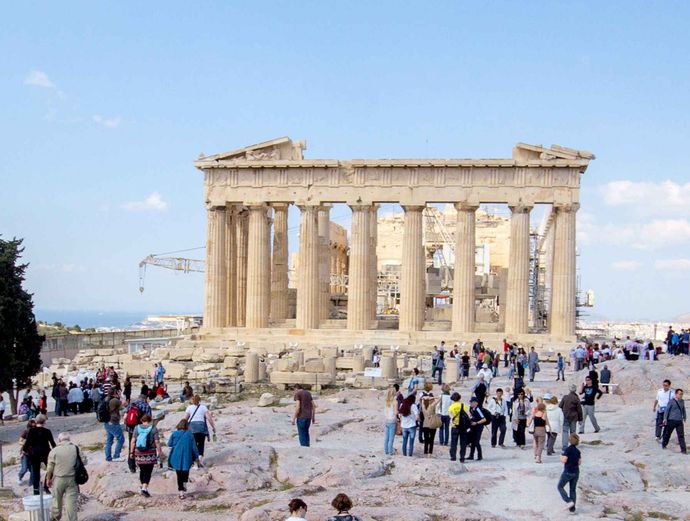
The Acropolis is the rocky hilltop in the heart of Athens crowned by the ruins of temples from ancient Greece, led by the Parthenon. It is the most famous monument of the classical world, and people come to stand among the marble buildings that shaped Western ideas of architecture and democracy.People lived and worshipped on the rock long before the classical era, and it served as a citadel and sacred ground for the city. After the Persians wrecked its older temples, the statesman Pericles led a grand rebuilding program in the 5th century BC. The Parthenon, dedicated to the goddess Athena, was designed by the architects Ictinus and Callicrates, with sculpture overseen by Phidias. In later centuries the hill held a church, a mosque and an Ottoman garrison, and an explosion during a Venetian siege in the 17th century tore open the Parthenon. Restoration work has gone on for generations, and cranes and scaffolding are part of the scene.You enter through the Propylaea, the monumental gateway that was meant to prepare visitors for what lay beyond. The small Temple of Athena Nike stands on a bastion to one side. The Parthenon dominates the summit, its columns subtly curved and tapered so they appear perfectly straight from a distance. Opposite stands the Erechtheion, with its famous porch held up by carved maidens, the Caryatids. The figures on site are copies, and the originals are kept safely indoors nearby.From the edges of the rock, the view takes in the whole city, out to Lycabettus Hill and the sea. On the slopes below lie the Theatre of Dionysus, where Greek drama took shape, and the Odeon of Herodes Atticus, still used for performances. A guide brings the myths, politics and building methods behind the stones to life.

More
Acropolis Museum#4
4.7 (36,841)

Acropolis Museum

The Acropolis Museum in Athens is a modern glass-and-concrete museum at the foot of the Acropolis, built to hold the sculptures and everyday objects found on the sacred rock and its slopes. People come to see the Parthenon sculptures that remain in Greece, the original Caryatids and the view up to the temple itself.For more than a century the finds had crowded a small museum on the hilltop, and Greece wanted a building that could display them properly and make the case for reuniting the Parthenon sculptures held in London. After an international competition, the Swiss-born architect Bernard Tschumi designed the new museum with the Greek architect Michael Photiadis, and it opened early in the 21st century in the Makrygianni district. Digging the foundations uncovered an ancient neighborhood, so Tschumi raised the building on pillars above the ruins rather than bury them.Inside, a gently rising glass ramp suggests the climb up the sacred rock, leading past finds from the slopes to the Archaic gallery, where korai, smiling marble maidens offered to Athena, stand in natural light beside the Moscophoros, a young man carrying a calf on his shoulders. Nearby, five of the six Caryatids from the Erechtheion stand together on a balcony. Later galleries follow the hill into Roman and early Christian times, showing how long the rock stayed at the center of Athenian life.The top floor is the Parthenon Gallery, a glass hall turned to match the temple's alignment, with the Acropolis in full view through the windows. The frieze and metopes run around it in their original order, with the surviving marbles shown beside pale plaster casts of the pieces held abroad, a quiet argument that the set belongs together. A guide can read the frieze's procession scene by scene and connect what you see indoors with the ruins on the hill above.

More
Archaeological Museum of Thessaloniki#5
4.8 (47)

Archaeological Museum of Thessaloniki

The Archaeological Museum of Thessaloniki is the main showcase for the ancient past of Greek Macedonia, set in the center of Greece's second city. Its galleries run from prehistoric villages to the Roman age, and visitors come above all for its dazzling gold work and for the Derveni krater, a bronze masterpiece of ancient metalwork.The museum's modernist building was designed by the architect Patroklos Karantinos and opened after the Second World War, and it counts as a landmark of modern Greek architecture in its own right. A wing added later first displayed the royal finds from Vergina, which have since moved to their own museum at the site. The collection of about 50,000 objects comes mostly from Thessaloniki and its surroundings but reaches across ancient Macedonia, and the galleries were reorganized early in the 21st century.The Gold of Macedon galleries hold jewelry, wreaths and ornaments from cemeteries such as Sindos and Derveni, including gold diadems, Medusa heads, and a gold mask and bronze helmet from a warrior's grave at Sindos. Pride of place goes to the Derveni krater, a large bronze mixing bowl for wine, covered with figures of Dionysus, Ariadne and dancing followers. The same tombs yielded the Derveni papyrus, a charred scroll often described as the oldest surviving book in Europe.Beyond the gold, the central rooms show sculpture from the Archaic period to late antiquity, parts of an Ionic temple from the 6th century BC, finds from the palace of the Roman emperor Galerius and the reconstructed facade of a Macedonian tomb. Floor mosaics from Roman houses, including a figure personifying Winter, add color. The prehistoric galleries, with finds from Neolithic and Bronze Age settlements around the city, show how far back life here reaches. A guide can link these objects to the city's monuments outside, from the Rotunda to the Roman forum.

More
Bezesteni Market#6
4.9 (58)

Bezesteni Market

If you are looking for things to do in Thessaloniki we have 1 Tours and Activities to Experience Bezesteni Market. Check out our verified traveler reviews and photos of Bezesteni Market tours and other things to do in Thessaloniki, and book securely when you find the perfect one. Learn the best ways to see famous Bezesteni Market and explore the most popular things to do in Thessaloniki.

More
Church and Crypt of Ayios Dimitrios#7
4.8 (245)

Church and Crypt of Ayios Dimitrios

The Church and Crypt of Ayios Dimitrios is the great basilica of Thessaloniki's patron saint, a five-aisled Byzantine church raised over the place where Saint Demetrius was martyred. People come for its rare early Christian mosaics, its deep meaning for the city's faithful and the shadowy crypt beneath the church.Demetrius was a Christian officer in the Roman army who, according to tradition, was put to death in the early fourth century in a bath complex on this very spot. A small chapel rose over the ruins, and in the fifth century it gave way to a grand basilica that drew pilgrims from across the Byzantine world. After a fire in the seventh century it was rebuilt on the same plan, and under Ottoman rule it served as a mosque for more than four centuries. When a great fire swept Thessaloniki in the early 20th century, the basilica was gutted and had to be largely rebuilt.The mosaics that survived the flames are among the most precious of their age. Panels on the piers near the sanctuary show Demetrius standing with the church's founders and with young children, gentle images of the saint as guardian of his city. Below, the crypt was rediscovered only after the great fire. It preserves parts of the Roman baths and a marble fountain where pilgrims once gathered the fragrant oil said to flow from the saint's tomb, along with sculpture and finds from the site.In the church above, the saint's relics rest in a silver reliquary, where believers light candles and pray. The basilica is one of Thessaloniki's monuments on the UNESCO World Heritage list, and for locals it remains the church most closely tied to the city's identity. A guide helps you read the Roman, Byzantine and Ottoman layers in its walls.

More
Corinth Canal#8
4.8 (10,692)

Corinth Canal

The Corinth Canal is a narrow, sheer-sided waterway cut through the Isthmus of Corinth, the slim neck of land joining the Peloponnese to mainland Greece. It links the Gulf of Corinth with the Saronic Gulf, and people stop to peer down its towering rock walls and watch boats slip through the deep channel far below.The idea is ancient. In the 7th century BC, Periander, ruler of Corinth, considered digging a channel but instead built the Diolkos, a paved stone track on which ships were hauled across the isthmus on wheeled platforms, and stretches of it survive near the western end. Centuries later the emperor Nero broke ground himself with a golden spade in the 1st century AD and put prisoners to work on the cutting, but the project was abandoned after his death.Modern engineering finally finished the job in the late 19th century. An international company led by the Hungarian István Türr began the excavation, with his countryman Béla Gerster as engineer, and when it ran out of money a Greek company completed the work. The canal spared ships a long and difficult voyage around the Peloponnese, but it proved too narrow for many of the larger vessels that came after, and its steep walls have needed repair work many times since. Retreating German forces wrecked it during the Second World War, and it had to be cleared before it could reopen.The canal mainly serves yachts, small cruise ships and sightseeing boats, often pulled through by tugs. The real spectacle is the cut itself, a straight slot of layered rock so even it looks almost carved by hand. At each end a bridge sinks beneath the water to let vessels pass and then rises again. A guide can bring the long story of the isthmus to life, from rival ancient ports to the canal's modern troubles.

More
Delphi#9
4.6 (13,042)

Delphi

Delphi is the ancient sanctuary of Apollo on the slopes of Mount Parnassus in central Greece, once home to the most famous oracle of the classical world. Travelers come to walk among its temples, treasuries, theater and stadium, spread across a mountainside high above a valley of olive groves, and to see the finds in its museum.The ancient Greeks believed Delphi was the center of the world. In myth, Zeus released a pair of eagles from opposite ends of the earth, and they met here, at a spot marked by a carved stone called the omphalos, or navel. Pilgrims, kings and city-states traveled from across the Greek world to consult the Pythia, a priestess who spoke for Apollo, about wars, new colonies, laws and private troubles. Grateful cities filled the sanctuary with statues and small treasuries, and the Pythian Games brought athletes and musicians together in competition.As Christianity spread, the oracle fell silent, the sanctuary was abandoned and a village grew on top of the ruins. In the 19th century French archaeologists moved the village to a new site and uncovered what lay beneath. Following the Sacred Way uphill, you pass the rebuilt Treasury of the Athenians, then reach the foundations and standing columns of the Temple of Apollo, the theater above it and, at the very top, the stadium. Below the main site lie the Castalian Spring, where pilgrims purified themselves, and the sanctuary of Athena Pronaia with its graceful round Tholos.The museum holds the treasures found on the site, above all the bronze Charioteer, a lifelike figure with inlaid eyes, along with the winged Sphinx of the Naxians and a marble omphalos. Together, the ruins, the museum and the setting form a UNESCO World Heritage Site.

More
Delphi Archaeological Museum#10
4.7 (11,084)

Delphi Archaeological Museum

The museum holds finds from the sanctuary of Delphi across fourteen rooms on two levels, including the bronze Charioteer, the Sphinx of Naxos and the statues of Cleobis and Biton. Plan on an hour or more here, and longer if you also visit the archaeological site, since one ticket covers both. There is a ramp, a lift, braille signs, tactile material and accessible toilets, so the museum suits visitors with limited mobility. Inside you will find a cafeteria and a gift shop. Last admission is 20 minutes before closing, and hours change by season.

More
Meteora#11
4.7 (12,278)

Meteora

Meteora is a cluster of giant rock pillars rising above the plain of Thessaly in Greece, with Orthodox monasteries perched on their summits. The name means suspended in the air, and visitors come to see the monasteries, their painted chapels and the extraordinary landscape of sheer gray towers above the town of Kalabaka.The pillars formed from layers of sandstone and conglomerate laid down by ancient rivers, then lifted and carved by earthquakes, wind and water over vast stretches of time. Hermits began living in caves and crevices in the rock as early as the 11th century, seeking solitude for prayer. In the 14th century a monk from Mount Athos named Athanasios founded the Great Meteoron on one of the highest rocks, and others followed. At their peak the rock tops held many monastic communities, and a handful remain active, home to small groups of monks and nuns. The whole area is a World Heritage Site.For centuries the only way up was by removable wooden ladders or in nets hauled up by rope and windlass, a ride monks are said to have trusted entirely to God, replacing the rope, the story goes, only when the Lord let it break. Steps were cut into the rock in the 20th century, and some of the old winch houses can still be seen.Inside, the monasteries are richly decorated. The Great Meteoron holds a museum of manuscripts, icons and old monastic tools, Varlaam keeps a huge barrel once used to store water, and the small church of St. Nicholas Anapafsas is covered in frescoes by the Cretan painter Theophanes. Rousanou clings to a narrow ridge, while Holy Trinity, seen in a James Bond film, sits alone on its spire. A guide can explain the daily rhythm of prayer and work for those who still live here.

More
Museum of Byzantine Culture#12
4.5 (31)

Museum of Byzantine Culture

If you are looking for things to do in Thessaloniki we have 1 Tours and Activities to Experience Museum of Byzantine Culture. Check out our verified traveler reviews and photos of Museum of Byzantine Culture tours and other things to do in Thessaloniki, and book securely when you find the perfect one. Learn the best ways to see famous Museum of Byzantine Culture and explore the most popular things to do in Thessaloniki.

More
Panathenaic Stadium (Panathinaiko Stadio)#13
4.7 (35,632)

Panathenaic Stadium (Panathinaiko Stadio)

The Panathenaic Stadium in Athens is a horseshoe-shaped arena built entirely of white marble, the only stadium in the world made that way. Known to Athenians as the Kallimarmaro, or beautiful marble, it hosted the first modern Olympic Games and still welcomes visitors who come to sit in its stands and walk its ancient track.Footraces were run here long before any seats were built, during the Panathenaic Games held in honor of Athena. In the fourth century BC the statesman Lykourgos gave the course a proper stadium, set into a natural ravine between two hills, and in the second century AD the wealthy Athenian Herodes Atticus rebuilt it in Pentelic marble with seating for some 50,000 people. Once the old spectacles were banned in late antiquity, the stadium was abandoned and much of its marble was taken away for other buildings.Its revival came in the 19th century. After excavations uncovered the old outline, the businessman George Averoff paid for a full restoration in marble that closely followed the Roman plan, just in time for the first modern Olympics, when the stadium staged the opening and closing ceremonies and events from athletics to wrestling. It returned to the Olympic stage when Athens hosted the Games again, serving as the finish line for the marathon, and the Olympic flame is handed over here to each new host country.Walking in, you face tier upon tier of marble benches wrapped around a long, narrow track that bends sharply at the curved end. Look for the ancient herms, stone pillars topped with carved heads that turned up during the excavations, the statue of Averoff by the entrance, and the view toward the Acropolis from the highest rows. Runners in the Athens Classic Marathon still cross the finish line on this track. With a guide, the empty arena fills with stories of victors, cheering crowds and the revival that brought the Olympics home.

More
Parthenon#14
4.7 (43,505)

Parthenon

The Parthenon stands at the top of the Acropolis hill, so expect a steady uphill walk on worn marble that can be slippery. Plan about two to three hours for the Acropolis, and longer if you add the nearby Acropolis Museum. There is little shade on the hilltop, so bring a hat, sunscreen and water. Security checks apply at the entrance, so carry only a small bag and leave bulky items behind. Visitors with reduced mobility should contact the site staff before arriving to arrange lift access.

More

Good to know Thessaloniki

Thessaloniki has the easy rhythm of a university town by the sea. Mornings go to sightseeing, afternoons slow down for long lunches, and the evenings stay busy late in the tavernas and bars. Most travelers book a guided city walk and one or two long drives into the Greek countryside, often with a private driver. It suits food lovers, history fans and couples who like a real, lived-in city more than a resort.

Spring, from April to June, is warm and green, ideal for walking the city and touring mountain monasteries. Summer is hot and humid, with July and August best spent near the sea, heading out early and resting at midday. September and October bring softer heat and clear skies for long day trips. Winter is cool, sometimes damp and windy, but museums are quiet and the cafe culture carries on indoors.

Thessaloniki Airport sits southeast of the center, with buses and taxis into town, trains link the city to Athens, and cruise ships berth right beside downtown. The center runs long and narrow along the bay, so the waterfront is easy to walk, and buses and a newer metro line help with the rest. For mountain trips, a tour with a driver avoids long rental drives on unfamiliar roads. Start long trips early to beat the heat and traffic. Carry water, a hat and sun protection in summer, plus a scarf or light layer for church visits.

Thessaloniki
Peak season Jun – Sep
Local Currency Euro (€)
Weather now
Time Zone EET (+2)
Attractions 14
Tours 176
Reviews 3,729

Frequently Asked Questions

The answers provided below are based on answers previously given to customers' questions.

Activity name

Discover Thessaloniki