Hungary attractions
More things to do in the country
 #46
Ban Jelacic Square (Trg Bana Jelacica)
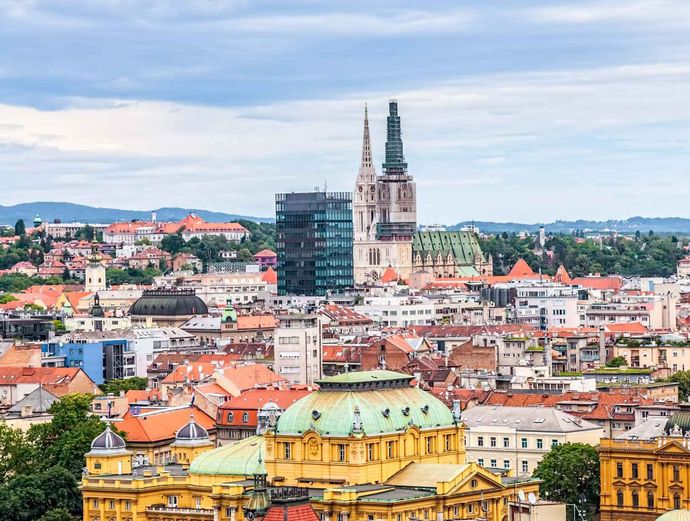
Ban Jelačić Square is the busy central square of Zagreb, the Croatian capital, watched over by a bronze equestrian statue of the 19th-century governor Josip Jelačić. It is where the city gathers for celebrations, protests and open-air concerts, and nearly every visit to Zagreb passes through it at some point.The square began in the 17th century as a marketplace called Harmica, a name tied to a customs duty once collected here, and it became the commercial hub as Zagreb spread south from its hilltop settlements. It honors Josip Jelačić, the ban, or governor, who abolished serfdom in Croatia during the revolutions that swept Europe in the 19th century. His statue by the Austrian sculptor Anton Dominik Fernkorn was unveiled later that century, but the communist authorities took it down after the Second World War and renamed the square. As Croatia moved toward independence near the end of the 20th century, both the statue and the name came back.Water sits at the heart of a favorite local legend. The Manduševac fountain recalls the story of a thirsty ban who asked a girl named Manda to scoop water from a spring on this spot, a request said to have given Zagreb its name, and visitors still toss coins into the basin. Around the edges, handsome facades house banks, shops and cafe terraces, the twin spires of the cathedral rise above the rooftops, and the trams that clang through set the square's steady rhythm.Part of its charm is that the square belongs to residents first. Office workers cross it at a brisk pace, friends linger over coffee on the terraces, and when Croatia's national teams triumph, it fills with flags and singing fans. A guide can reveal the stories hidden in plain sight, from the statue's exile to the meaning of the old market name.
More #47
Banska Stiavnica
If you are looking for things to do in Hungary we have 1 Tours and Activities to Experience Banska Stiavnica. Check out our verified traveler reviews and photos of Banska Stiavnica tours and other things to do in Hungary, and book securely when you find the perfect one. Learn the best ways to see famous Banska Stiavnica and explore the most popular things to do in Hungary.
More #48
Belgrade Fortress
If you are looking for things to do in Hungary we have 17 Tours and Activities to Experience Belgrade Fortress. Check out our verified traveler reviews and photos of Belgrade Fortress tours and other things to do in Hungary, and book securely when you find the perfect one. Learn the best ways to see famous Belgrade Fortress and explore the most popular things to do in Hungary.
More #49
Bled Castle (Blejski Grad)
Bled Castle crowns a steep cliff above Lake Bled in northwestern Slovenia, looking down on the town, the water and the little church on the island. Written records make it the oldest castle in the country, and people climb up for its museum, its painted chapel and one of the classic views of the Julian Alps.Its recorded story begins in the early 11th century, when the Holy Roman Emperor Henry II gave the estate to the bishops of Brixen in South Tyrol. The bishops held it for around eight centuries, governing from far away while local stewards ran the land, and the castle grew with the times. A plain Romanesque tower is the oldest part, and later builders added Gothic towers, stronger walls and Renaissance wings around the courtyards.The castle is laid out on two levels. Over the drawbridge and through the gate, the lower courtyard holds the old outbuildings, and a stairway climbs to the upper courtyard with the residence and the chapel. The chapel dates from the 16th century and was repainted around the turn of the 18th century with illusionist frescoes that play tricks with depth on its walls. The museum rooms trace the lake's story from its earliest settlers through the bishops' rule to the town's growth as a resort.Smaller workshops bring old crafts back to life, among them a printing room where a replica press turns out pages the old-fashioned way, and a cellar devoted to local wine. From the terraces, the eye runs across the lake to the island, the wooded shore and the peaks beyond. A guide adds tales of the bishops and of the people who kept the castle running. On a still morning the castle's reflection lies across the water, the picture that has carried Bled's name far beyond Slovenia.
More #50
Bran Castle (Dracula's Castle)
Bran Castle stands on a rocky outcrop above the village of Bran in Transylvania, central Romania, guarding a mountain pass southwest of Brașov. Known around the world as Dracula's Castle, it is really a medieval fortress turned royal home, and visitors come for its towers, winding rooms and the legend wrapped around it.The castle was built in the late 14th century by the Saxon townspeople of Brașov, who were given the right to fortify the site. It controlled the road through the pass between Transylvania and Wallachia, serving as both a defensive stronghold and a customs post where traders paid duties on goods crossing the mountains. For centuries it remained a working fortress overlooking the valley.Its second life began after the First World War, when the people of Brașov gave the castle to Queen Marie of Romania. She loved it, restored it as a summer residence and filled it with furniture, art and folk objects, turning the cold fortress into a warm, personal home. After the Second World War the communist government seized it, and it later opened as a museum. In the early 21st century it was returned to the queen's descendants, who now run it.The Dracula connection comes from fiction rather than history. Bram Stoker never visited, but the castle on its crag fits the image of his vampire's home so well that the label stuck, and the real Vlad the Impaler has only a loose link to the area. Inside, narrow staircases, including a hidden passage between floors, connect whitewashed rooms with heavy wooden furniture, ceramic stoves and royal belongings, arranged around a small inner courtyard with a well. From the windows and the upper rooms you look out over the village, the valley and the forested peaks. A guide sorts the facts from the vampire stories.
More #51
Bratislava Castle (Bratislavsky Hrad)
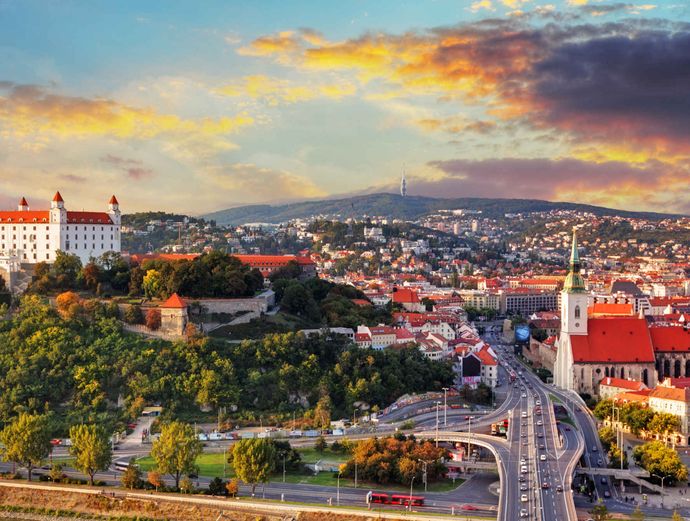
Bratislava Castle is the broad white fortress that crowns a rocky hill above the Danube in Slovakia's capital, a rectangular palace with a tower at each corner. People climb up for wide views over the Old Town, the river and the countryside toward Austria and Hungary, and for exhibitions of the Slovak National Museum inside.The hill has drawn settlers since prehistoric times, from Celts and Romans to the Slavs of Great Moravia, who raised a stone palace and a large basilica on the summit. The castle first appears in writing early in the 10th century, and under the first Hungarian kings it became one of the kingdom's central fortresses. In the 15th century King Sigismund rebuilt it in Gothic style, and the gate named after him is the best-preserved piece of that work. After the Ottomans overran much of Hungary in the 16th century, the town, then called Pressburg, became the kingdom's capital, and the castle was remodeled in Renaissance style.For about two centuries the Crown Tower, the largest of the four, guarded the Hungarian crown jewels. Early Baroque rebuilding completed the castle's four corner towers, and under Maria Theresa it became a royal residence with a grand staircase and formal gardens. Its glory ended in the early 19th century, when soldiers quartered there started a fire that gutted the palace and spread into the town. The ruin stood for well over a century before restoration after the Second World War returned the main building to its Baroque look.Inside, the Slovak National Museum displays finds from the hill's long past, including the Venus of Moravany, a small prehistoric figurine, in its treasury. Outside, a bronze statue of the Great Moravian ruler Svatopluk rides through the main courtyard, a restored Baroque garden lies beside the palace, and the Slovak parliament meets on the castle grounds. A guide can bring each layer of that history into focus.
More #52
Bratislava Old Town (Stare Mesto)
Bratislava Old Town, or Staré Mesto, is the compact historic core of Slovakia's capital, spread between the Danube and the hill crowned by Bratislava Castle. Visitors come for its pastel palaces, Gothic cathedral and cafe-filled squares, and for the playful bronze figures that turn up on its street corners.For centuries the town was better known by its German name, Pressburg, or its Hungarian one, Pozsony. After the Ottomans took Buda in the 16th century, it became the capital of the Kingdom of Hungary, and for nearly three centuries Hungarian monarchs, Maria Theresa among them, were crowned in St. Martin's Cathedral. The Hungarian parliament met here, nobles built town palaces to be near the action, and in the Primate's Palace France and Austria signed the peace that followed Napoleon's victory at Austerlitz. The city took the name Bratislava after the First World War and became the capital of independent Slovakia near the end of the 20th century.Brass crowns set into the pavement trace the old coronation route, past St. Martin's, whose spire is topped by a gilded copy of the Hungarian crown, and through lanes lined with Baroque mansions. Michael's Gate, the last of the medieval town gates, guards the northern approach, while the Main Square gathers the Old Town Hall and a Renaissance fountain. Inside the pink Primate's Palace, the Hall of Mirrors and a rare set of 17th-century English wall hangings reward a look. Then there are the bronze characters: Čumil, a workman grinning from a manhole, a Napoleonic soldier leaning on a bench and a gentleman doffing his top hat.Small as it is, the Old Town carries the mingled heritage of the Slovaks, Hungarians, Germans and Jews who shared the city for centuries. A guide can untangle those threads and explain how one small town answered to three different names.
More #53
Budapest City Park (Városliget)
If you are looking for things to do in Hungary we have 18 Tours and Activities to Experience Budapest City Park (Városliget). Check out our verified traveler reviews and photos of Budapest City Park (Városliget) tours and other things to do in Hungary, and book securely when you find the perfect one. Learn the best ways to see famous Budapest City Park (Városliget) and explore the most popular things to do in Hungary.
More #54
Budapest History Museum (Castle Museum)
If you are looking for things to do in Hungary we have 3 Tours and Activities to Experience Budapest History Museum (Castle Museum). Check out our verified traveler reviews and photos of Budapest History Museum (Castle Museum) tours and other things to do in Hungary, and book securely when you find the perfect one. Learn the best ways to see famous Budapest History Museum (Castle Museum) and explore the most popular things to do in Hungary.
More #55
Budapest Pinball Museum
The Budapest Pinball Museum is a hands-on collection of pinball machines and arcade games in the Újlipótváros neighborhood of Budapest, where the exhibits are meant to be played. It draws families, couples and anyone nostalgic for the flashing lights and rattling bells of an old arcade.Rather than keeping its machines behind ropes, the museum sets them to free play, so the history of the game is told through your own hands on the flipper buttons. The collection runs to well over a hundred machines, and walking through it traces the game's evolution from parlor toy to digital showpiece. The oldest pieces are bagatelle games, the tabletop ancestors of pinball, where balls were shot up a sloping board studded with pins. From there the rooms move on to the first tables with flippers, which turned a game of chance into a game of skill, and then to electronic machines with ramps, sound effects and elaborate artwork.Part of the fun is seeing how each era mirrors its time, from hand-painted backglasses to tables themed on films and pop culture. Arcade cabinets and other coin-operated games stand alongside the pinball tables, so a visit swings between old mechanical play and the video games that later took over. Many players end up returning to a favorite table, chasing a higher score while bumpers thump and lights blink all around.Újlipótváros, the museum's home, is a residential part of Pest known for its modernist apartment blocks from the years between the world wars. It is an easy place to lose track of time, and a cheerful contrast to the grand baths and palaces that fill most Budapest itineraries. Design fans will notice how the artwork, lights and sounds changed with each new generation of technology.
More #56
Cantacuzino Castle (Castelul Cantacuzino)
Cantacuzino Castle is a grand Neo-Romanian mansion in Busteni, a mountain town in Romania's Prahova Valley, built for one of the country's richest aristocrats. Visitors come for its carved and painted interiors, its leafy grounds and the sweeping view from its terrace across to the Bucegi Mountains.The castle was commissioned by Prince Gheorghe Grigore Cantacuzino, a statesman so wealthy he was nicknamed the Nabob. It replaced an old hunting lodge the family used on the road to Brasov, and an inscription in the courtyard explains that he built it to honor his ancestors and shelter his descendants. The architect Grigore Cerchez, a leading figure of the Neo-Romanian style, blended local traditions with European grandeur. In the communist era the castle was nationalized and used as a sanatorium, and its walls were painted over. After it was returned to the family, restoration uncovered the original decoration, and the house opened to the public as private property. It has since appeared as a filming location for the Netflix series Wednesday.Inside, the rooms show a mix of materials gathered from across Europe: Venetian murals, stained glass made with Murano glass, Italian glazed pottery, carved oak doors and coffered oak ceilings. A staircase rises without visible support, held only by the walls, and marble stairs lead to the upper levels. A gallery of murals painted on Cordoba leather shows life-size portraits of the Wallachian branch of the Cantacuzino family, and the ballroom displays the coats of arms of related noble families. Outside, the courtyard holds fountains, sculptures, a hunting tower and a small wooden church, while an art gallery upstairs hosts changing exhibitions.The castle offers a window into aristocratic life in the Carpathians. A guide brings the family history and the meaning of the heraldry to life.
More #57
Cesky Krumlov State Castle
Cesky Krumlov State Castle is a vast castle and chateau complex on a rocky rise above the Vltava River in the town of Český Krumlov, in southern Bohemia, second in size among Czech castles only to Prague Castle. Visitors come for its painted tower, its richly furnished state rooms, a sprawling Baroque garden and a rare Baroque theater that keeps its original stage machinery.The castle began as a Gothic fortress built in the 13th century by the lords of Krumlov. Early in the 14th century it passed to the powerful Rosenberg family, who spent nearly three centuries turning it into a lavish Renaissance residence, and their emblem, a red five-petaled rose, still appears across the town. The Eggenbergs and then the Schwarzenbergs followed, adding Baroque grandeur, and the Schwarzenbergs held the estate until the middle of the 20th century, when it passed to the state.The round castle tower, painted in Renaissance style with colorful murals and mock marbling, is the symbol of the town. Bears live in the old moat near the entrance, a tradition reaching back to the 16th century and linked to the Rosenbergs' claim of kinship with the Orsini family of Rome, whose name recalls the Italian word for bear. A dramatic bridge of stacked arches, the Cloak Bridge, spans a deep ravine to join the castle to its garden, and inside, the Masquerade Hall is painted with a lively carnival crowd.The Baroque theater, built in the 17th century and refurbished by the Schwarzenbergs in the 18th, is among the best preserved of its kind anywhere, with its painted scenery, costumes and wooden stage machinery still intact. Out in the garden, the elegant Bellarie summer house and an open-air theater with a revolving auditorium add further surprises. A guide brings the ambitions and rivalries of the great families to life, room by room.
More #58
Charles Bridge (Karluv Most)
You can cross the bridge on your own at any hour, since it is open around the clock. A guided walking tour adds the story behind the Baroque statues and the old royal coronation route, and often links the bridge with the Old Town and Lesser Town. Early morning and evening walks feel calmer, and river cruises show the bridge from the water. The bridge is pedestrian only, so you cross entirely on foot over a cobbled surface. Allow 30 to 45 minutes to cross and look at the statues, and longer if you climb a bridge tower for the view. The Old Town Bridge Tower has a viewing platform about 47 meters up that looks over the historic center. The cobbles are uneven, which makes strollers and wheelchairs harder to push. It gets crowded, so keep bags closed and stay aware of your belongings while you walk.
More #59
Designer Outlet Parndorf
Designer Outlet Parndorf is a large outlet shopping center in the village of Parndorf, in Austria's Burgenland region east of Vienna. More than 160 designer and premium brands share one site, selling their collections below regular store prices, and many visitors from the capital make it a full day of shopping and a relaxed meal.An outlet center works differently from a regular mall. Fashion houses and lifestyle labels use their stores here to sell items from earlier seasons, surplus stock and lines made for outlet shelves, usually at a reduced price. Stock changes with the seasons, so no two visits look quite the same. That idea has made Parndorf a familiar name for shoppers across eastern Austria and the neighboring countries, and the center runs under the McArthurGlen banner, a group that operates outlet villages in many parts of Europe.Walking from store to store, you pass a mix of fashion, sportswear, shoes and accessories, from international luxury labels to familiar everyday names. Because the brands sit side by side, it is easy to compare styles, sizes and fits without crossing a city. Restaurants and cafes are spread among the shops, so a coffee break or a sit-down lunch fits easily between stores, and many people treat the outing as a social day as much as a shopping trip.Parndorf itself is a small community on the open plain between Vienna and Lake Neusiedl, in Austria's easternmost state, a region better known for wine, wide fields and lakeside villages than for big-city retail. That contrast is part of the charm, since the rows of storefronts sit in quiet farming country. A guide can share stories of this border region and its wine villages on the way, which turns a shopping run into a small taste of rural Austria.
More #60
Devin Castle (Devinsky Hrad)
Devín Castle is a dramatic ruined fortress on a cliff high above the confluence of the Danube and Morava rivers, on the western edge of Bratislava. Among the most treasured historic sites in Slovakia, it draws visitors for its river views, its romantic ruins and a story that runs from Roman times to the Iron Curtain.People have lived on this rock since prehistoric times, and the Romans kept a military post here on the edge of their empire. In the 9th century it was a stronghold of Great Moravia, one of the earliest Slavic states, and in the Middle Ages it grew into a border castle of the Kingdom of Hungary. Napoleon's troops blew it up in the early 19th century, yet the ruins soon took on new meaning when young leaders of the Slovak national revival gathered here and adopted the castle as a symbol of their people's past.The best-known sight is the Maiden Tower, a slender lookout perched on a separate pinnacle of rock above the water, wrapped in legends of a young woman who leapt from it rather than lose her love. Paths climb through the lower and middle castle to the summit, past the foundations of a Great Moravian church and traces of Roman buildings, while exhibits show finds from generations of excavation. From the top the view runs across the Morava into Austria and far along the Danube.During the Cold War the castle lay inside the closely guarded border zone of the Iron Curtain, and some who tried to flee across the rivers to Austria lost their lives. A memorial called the Gate of Freedom, near the riverbank below, honors them. A guide can connect the castle's many chapters into a single story of borders and belonging.
More #61
Dubrovnik Ancient City Walls
Dubrovnik's city walls are the great stone ramparts that enclose the whole Old Town of Dubrovnik, on Croatia's southern Adriatic coast. A walk along the top is the classic way to see the city, with orange rooftops, bell towers and narrow lanes on one side and the open sea on the other. They rank among the best-preserved city defenses in Europe.The walls grew over several centuries, from the early Middle Ages to the 17th century, while the Republic of Ragusa, as the city was then known, turned trade and diplomacy into wealth and independence. The biggest works came in the 15th century, when the advance of the Ottomans pushed the city to thicken its walls and add new towers and forts. No enemy army ever broke through, and the word Libertas, the republic's motto, still sums up what they protected.The round Minčeta Tower, designed in part by the Renaissance architect Michelozzo, marks the highest point of the circuit and gives the widest view over the town. On the harbor side, St. John's Fortress guarded the old port and holds a maritime museum, while Bokar Tower watches the western approach from the sea. Just outside the walls, Fort Lovrijenac stands on its own sea cliff, with a Latin inscription over its gate warning that freedom is not to be sold for all the gold in the world. Along the way, the route looks down into courtyards, monastery cloisters and the Stradun, the town's main street, paved in polished limestone.The walls were damaged by shelling during the war that followed the breakup of Yugoslavia and were carefully restored afterward. Fans of Game of Thrones will recognize stretches of wall that stood in for King's Landing. A guide can name the towers one by one and show how each was placed to cover its neighbors.
More #62
Dubrovnik Cruise Port
If you are looking for things to do in Hungary we have 5 Tours and Activities to Experience Dubrovnik Cruise Port. Check out our verified traveler reviews and photos of Dubrovnik Cruise Port tours and other things to do in Hungary, and book securely when you find the perfect one. Learn the best ways to see famous Dubrovnik Cruise Port and explore the most popular things to do in Hungary.
More #63
Dubrovnik Old Town
Dubrovnik Old Town is the walled medieval city on the Adriatic coast of southern Croatia, a UNESCO World Heritage Site ringed by massive stone ramparts. People come to walk its polished limestone streets, circle the walls above red-tiled roofs and see the churches, palaces and squares of a former maritime republic.For centuries this was the Republic of Ragusa, a small but wealthy city-state that lived by trade and diplomacy. Its ships sailed across the Mediterranean, and its leaders kept their freedom by balancing the great powers around them, from Venice to the Ottoman Empire. The republic was known for forward-looking public institutions, including a quarantine system, an orphanage and an early ban on the slave trade. A devastating earthquake in the 17th century destroyed much of the city, which was rebuilt in the more uniform Baroque style seen along the main street. The republic finally came to an end under Napoleon in the early 19th century.In the late 20th century the Old Town was shelled during the Croatian War of Independence, and careful restoration has since repaired the damage. Stradun, the main street, runs between the city gates, its paving worn smooth by countless feet. Along the way you pass Onofrio's Fountain, the Franciscan Monastery with one of the oldest working pharmacies in Europe, the Rector's Palace where the republic's elected leader lived during his short term, and the Sponza Palace, once the customs house.Above it all, the walls wrap around the city with towers and forts, including the round Minčeta Tower at the highest point. Their views take in the old harbor, the green island of Lokrum and the steep hills behind. Many corners will look familiar to fans of television fantasy. A guide explains how the republic thrived and how the city rose again.
More #64
Dürnstein
Dürnstein is a small wine town on the Danube in Austria's Wachau valley, known for its blue and white abbey tower and the ruined castle on the rock above it. People come to walk its old lanes, climb to the ruin where an English king was once held prisoner, and taste the wines of the surrounding terraces.The town is named for that castle, whose name joins old German words for dry and stone. Its most famous guest came against his will in the late 12th century. Richard the Lionheart, heading home from the Third Crusade, was seized by Duke Leopold V of Austria, whom he had insulted at Acre by throwing down the duke's banner. Richard was held here before being handed over to Emperor Henry VI, and a later legend tells of his minstrel Blondel singing outside castle after castle until the king sang back. Swedish troops wrecked the fortress in the middle of the 17th century, and it has stood as a ruin ever since.Down by the water, the abbey tells a gentler story. Canons Regular founded it in the early 15th century, and in the 18th century it was remade in full Baroque style to plans by Joseph Munggenast, Jakob Prandtauer and Matthias Steinl. Its slender blue and white tower became the emblem of the whole valley, and the church beneath it is richly decorated in the same style. Emperor Joseph II dissolved the community, and the abbey passed to the canons of Herzogenburg.Around the town, terraced vineyards climb the slopes of the Wachau, a stretch of the Danube listed by UNESCO for its landscape of vines, villages and river. Growers here are known for dry Grüner Veltliner and Riesling, and the local apricots turn up in jams, brandies and pastries along the main street. A guide brings the lanes and the hill to life, linking the captive king to the stones that remain.
More #65
Eger
If you are looking for things to do in Hungary we have 3 Tours and Activities to Experience Eger. Check out our verified traveler reviews and photos of Eger tours and other things to do in Hungary, and book securely when you find the perfect one. Learn the best ways to see famous Eger and explore the most popular things to do in Hungary.
More #66
Esztergom
If you are looking for things to do in Hungary we have 14 Tours and Activities to Experience Esztergom. Check out our verified traveler reviews and photos of Esztergom tours and other things to do in Hungary, and book securely when you find the perfect one. Learn the best ways to see famous Esztergom and explore the most popular things to do in Hungary.
More #67
Evangelical Church (Biserica Evanghelica Bistrita)
The Evangelical Church of Bistrița is a large Gothic church on the central square of Bistrița, a historic town in northern Transylvania, Romania. Its soaring stone tower, described as the tallest medieval tower in the country, rises above the old town, and visitors come for the architecture, the carved woodwork inside and the view from the top.The church was raised by the Transylvanian Saxons, German-speaking settlers who founded and ran many of the region's trading towns in the Middle Ages, on the foundations of an earlier place of worship. It began as a Romanesque basilica and was later reshaped into a Gothic hall church, with aisles rising to the same height as the nave. Then a Renaissance makeover led by Petrus Italus, an architect from Lugano in Switzerland, transformed the west front, and the building is now seen as a key example of the shift from Gothic to Renaissance architecture in Transylvania.Overhead, ribbed star vaults span the nave, and the galleries along the sides are fronted by balustrades with fine Renaissance detail. The greatest treasure is the set of carved wooden choir stalls, regarded as a masterpiece of Transylvanian Renaissance furniture, while a rococo organ adds a lighter, later flourish. The church still serves a Lutheran congregation, a living link to the Saxon community that built it.The tower is the church's signature, rising about 75 meters and visible from much of the town. Fire swept through the roof and badly damaged the tower early in the 21st century, and a long restoration brought both back. From the upper levels the view takes in the red roofs of the old center, the arcaded merchant houses around the square and the green hills of northern Transylvania. A guide can add the stories of the Saxon traders whose wealth paid for so ambitious a church.
More #68
Franciscan Church and Monastery
The Franciscan Church and Monastery is a medieval friary just inside the western gate of Dubrovnik's walled Old Town, where the main street, Stradun, begins. People come for its quiet Romanesque cloister, a pharmacy that has served the city since the Middle Ages and a museum and library holding treasures the friars gathered over the centuries.The friars first lived outside the city walls, then moved inside for safety early in the 14th century and began building the complex that stands here. The pharmacy they founded around that time is among the oldest in Europe still in business, and its counter sells remedies and creams to this day. The church suffered badly in the great earthquake of the 17th century and was rebuilt in Baroque style, but its late Gothic south portal survived, crowned by a Pietà carved by local masters. The friars' Dominican counterparts built their own monastery at the opposite end of town, by the eastern gate.The cloister is the heart of the visit. Slender paired columns ring a garden courtyard, and each capital is carved with its own design, from human heads and animals to twisting leaves, so it pays to walk the arcade slowly. The museum shows old pharmacy jars and mortars alongside reliquaries, paintings and liturgical objects, while the library guards manuscripts and some of the earliest printed books, collected by the friars over generations.Outside, the monastery's tall bell tower rises over the start of Stradun, with Onofrio's great domed fountain just across the square. Near the entrance, a small carved stone face juts from the wall, and passers-by try to stand on it while facing the wall, an old Dubrovnik challenge said to bring good luck. A guide can help you read the cloister capitals one by one and spot small details that most visitors walk straight past.
More #69
Grassalkovich Palace (Grasalkovicov Palac)
Grassalkovich Palace (Grasalkovicov Palac) is an elegant Rococo palace in Bratislava and the official residence of the President of Slovakia. Set on a busy square just beyond the Old Town, it draws visitors for its graceful facade, its past as a stage for music and court balls, and the formal garden behind it.The palace was completed in the middle of the 18th century for Count Antal Grassalkovich, a Hungarian noble and close friend of Empress Maria Theresa. As head of the Royal Hungarian Chamber, he needed a home in Pressburg, as Bratislava was then called, when the city served as capital of the Kingdom of Hungary. Andreas Mayerhoffer designed it as a summer palace in the late Baroque manner, set within a French garden.Music filled its halls. Grassalkovich kept his own orchestra, Joseph Haydn premiered some of his works here, and the count hosted glittering balls for the Habsburg court, including the wedding of one of Maria Theresa's daughters, when Haydn led the orchestra. Tradition also holds that the Slovak national leader Ľudovít Štúr first declared his love for Adela Ostrolúcka at a ball in these rooms. The 20th century was harder: the palace housed the president of the wartime Slovak state, then a postwar government body, and under communism it became a busy children's center that left its interiors badly worn. Restored after the Velvet Revolution, it became the presidential seat late in the century.The garden, once far larger, survives as a public park with statues of the Bratislava-born composer Johann Nepomuk Hummel and of Empress Maria Theresa. Inside, the Great Hall, where visiting leaders sign the guestbook, and the Golden and Green Salons serve for state occasions. On the main staircase, sculptures of the four seasons greet guests. A guide can connect the palace's aristocratic beginnings with its role in modern Slovakia.
More #70
Gödöllo Royal Palace (Gödölloi Királyi Kastély)
If you are looking for things to do in Hungary we have 9 Tours and Activities to Experience Gödöllo Royal Palace (Gödölloi Királyi Kastély). Check out our verified traveler reviews and photos of Gödöllo Royal Palace (Gödölloi Királyi Kastély) tours and other things to do in Hungary, and book securely when you find the perfect one. Learn the best ways to see famous Gödöllo Royal Palace (Gödölloi Királyi Kastély) and explore the most popular things to do in Hungary.
More #71
Hallstatt Skywalk
The Hallstatt Skywalk is a viewing platform high on the salt mountain above Hallstatt, the lakeside village in Austria's Salzkammergut. It juts out from the cliff to give a bird's-eye view down onto the rooftops, church spires and the deep blue Hallstätter See, ringed by the peaks of the Dachstein range.Its other name, the World Heritage View, explains the attraction. Below lies the heart of the Hallstatt-Dachstein Salzkammergut cultural landscape, protected by UNESCO for the way people have shaped this valley over thousands of years. The wealth behind it all came from salt. Miners have worked the mountain beneath the platform since prehistoric times, and the finds from a vast ancient cemetery in the high valley were so rich that archaeologists named a whole era of European prehistory, the Hallstatt culture, after the village.The platform stands beside the Rudolfsturm, a stone tower built in the 13th century to guard the salt works, which now holds a restaurant. The Skywalk itself is a modern steel walkway that pushes out past the edge of the rock face, so the village and the lake seem to drop away beneath your feet. From here the boats on the water look like toys, and the mountains across the lake rise straight from the shore.The high valley behind the platform is worth a wander too. Paths lead past the old miners' buildings, information boards on the prehistoric burial ground and the entrance to the salt mine, where tunnels hold traces of Bronze Age mining, including one of the oldest wooden staircases in Europe. The village below, squeezed between lake and cliff, has drawn painters and photographers for generations. A guide brings to life the miners, the salt trade and the people buried on the mountain long before the Romans.
More #72
Historic Center of Vienna
The Historic Center of Vienna is the old Innere Stadt, the compact heart of the Austrian capital, where Gothic spires, Baroque palaces and imperial buildings crowd the streets within the Ringstrasse. Listed by UNESCO as a World Heritage Site, it draws travelers to St. Stephen's Cathedral, the Hofburg, its famous coffeehouses and a musical heritage few cities can match.Vienna's story begins with Vindobona, a Roman military camp on the Danube frontier. In the Middle Ages the Babenberg dukes and then the Habsburgs made the town their seat, and for more than six centuries the Habsburgs governed their growing realm from the Hofburg. Stout walls held off two Ottoman sieges, until Emperor Franz Joseph ordered them torn down in the 19th century to make way for the Ringstrasse, a broad boulevard of grand public buildings, museums and parks.Within this small area you can walk from the Gothic nave and patterned tile roof of St. Stephen's Cathedral to the sprawling Hofburg, with its imperial apartments, treasury and Spanish Riding School. Narrow lanes open onto broad spaces such as the Graben, with its Baroque plague column, and Am Hof, while palaces built for noble families now hold museums and galleries. Mozart lived and composed in a house just behind the cathedral, and the city's coffeehouse tradition lives on in wood-paneled rooms where people linger over newspapers and cake.Music runs through the district. Haydn sang as a choirboy at St. Stephen's, Beethoven lodged in a house on the old city ramparts, and the State Opera and the Golden Hall of the Musikverein still carry the classical tradition forward. What makes the center special is how closely everything sits together, so a short stroll can cross several centuries of architecture. A guide can connect these layers and explain how an imperial capital grew into a modern city.
More #73
Hofburg Imperial Palace (Hofburg Wien)
You can explore the Imperial Apartments and the Sisi Museum on your own, with an audio guide to set the pace. A guided tour of the apartments adds the stories behind the rooms and the people who lived in them. Many visitors pair the palace with a walk through the Habsburg quarter of the old city or a trip to Schönbrunn Palace, and some multi-site passes cover both. The Imperial Apartments and the Sisi Museum are entered through the Michaelerkuppel, under the large dome facing Michaelerplatz. Luggage, selfie sticks and dogs are not allowed inside, and flash photography is prohibited. Ramps, wheelchair rails and an elevator reach all exhibition areas, and wheelchairs can be borrowed free at the turnstile in exchange for ID. The rails do not suit very heavy or three-wheeled wheelchairs, so speak to the museum staff before your visit. Day tickets have fixed admission times, and the wider Hofburg also holds a library, a church and several museums if you want more time.
More #74
House of Music (Haus der Musik)
If you are looking for things to do in Hungary we have 9 Tours and Activities to Experience House of Music (Haus der Musik). Check out our verified traveler reviews and photos of House of Music (Haus der Musik) tours and other things to do in Hungary, and book securely when you find the perfect one. Learn the best ways to see famous House of Music (Haus der Musik) and explore the most popular things to do in Hungary.
More #75
House of Terror Museum (Terror Háza Múzeum)
The House of Terror Museum stands on Andrássy Avenue in central Budapest, in the building where two dictatorships interrogated, tortured and killed their prisoners. It traces the years of Nazi-backed and Soviet-backed rule in Hungary, and visitors come to understand how ordinary people lived through decades of fear and repression.In the final phase of the Second World War the building served as the headquarters of the Arrow Cross, Hungary's Nazi party, whose members used its cellars during their brief, brutal hold on power. After the war the communist political police moved in, and the address became a byword for arrests, beatings and disappearances. The secret police later left the building, which passed through other uses before it was turned into a museum at the start of the 21st century. From the outset its presentation has drawn debate among historians, and it remains one of the most talked-about museums in the city.The building announces itself from the street, with a black metal frame along the roof that casts the word TERROR onto the facade in sunlight, and a wall of photographs of victims along the pavement. Inside, a Soviet tank stands in the central courtyard beneath a towering wall of portraits. Rooms on the upper floors use film, sound and staged settings to show forced labor camps, show trials, the deportation of Jews and the crushing of the revolution against Soviet rule.The visit ends with a slow elevator ride down into the basement, where reconstructed cells show where prisoners were held and questioned. The quiet of these narrow rooms makes a strong contrast with the elegant boulevard outside. A final hall lists the names and faces of the people who carried out the persecution. A knowledgeable guide can connect these rooms to the lives of the families who lived through the dictatorships.
MoreDiscover Hungary
Luxury & Special Occasions
Prices from $3
Cultural & Theme Tours
Prices from $3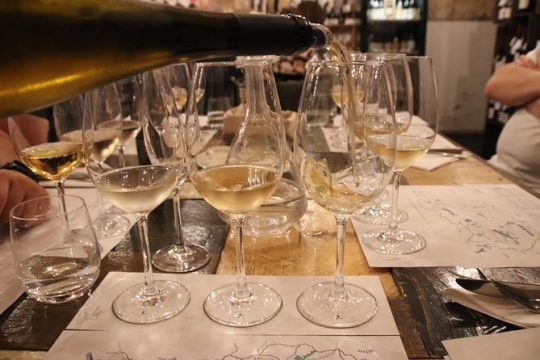
Walking & Biking Tours
Prices from $3
Tours & Sightseeing
Prices from $3
Food, Wine & Nightlife
Prices from $3
Cruises, Sailing & Water Tours
Prices from $10
Sightseeing Tickets & Passes
Prices from $6
Holiday & Seasonal Tours
Prices from $3
Shows, Concerts & Sports
Prices from $21
Private & Custom Tours
Prices from $3
Shopping & Fashion
Prices from $33
Shore Excursions
Prices from $3
Buda Castle (Budai Vár)
Prices from $3
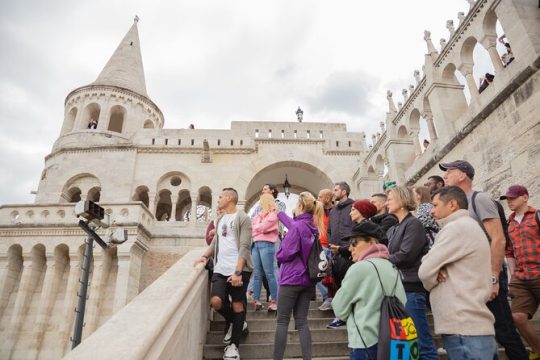
Fisherman’s Bastion (Halaszbastya)
Prices from $3
House of Parliament (Országház)
Prices from $3
Chain Bridge (Széchenyi Lanchid)
Prices from $3
Matthias Church (Mátyás Templom)
Prices from $3
Budapest Danube River
Prices from $3
Danube Promenade
Prices from $3
Central Market Hall (Nagycsarnok)
Prices from $3
Gellért Thermal Bath and Spa
Prices from $12
Elisabeth Bridge (Erzsébet Híd)
Prices from $3
Gellért Hill (Gellert-Hegy)
Prices from $11
Dohány Street Synagogue
Prices from $3




Hungary Event Calendar
View all events
Christmas activities in Hungary
Fri, Dec 25, 2026
Hanukkah in Hungary
Dec 4–12, 2026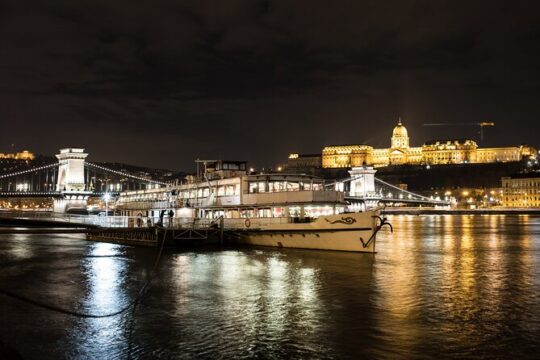
New Year’s Eve in Hungary
Thu, Dec 31, 2026
Christmas Eve in Hungary
Thu, Dec 24, 2026
New Year’s Day long weekend in Hungary
Jan 1–3, 2027
Valentine's Day in Hungary
Sun, Feb 14, 2027
Easter in Hungary
Sun, Mar 28, 2027
Good Friday in Hungary
Fri, Mar 26, 2027