Early Access! Black Friday 08HRS 24MIN 18SEC Up to 20% off gift cards BLACK FRIDAY
GIFT CARD SAVINGS
$100 – $249SAVE 5% $250 – $499SAVE 10% $500 – $999SAVE 15% $1,000+SAVE 20% Shop gift cards Discount applied automatically at checkout. Each card keeps its full value.
Early Access! Black Friday 08HRS 24MIN 18SEC
UP TO 20% OFF GIFT CARDS
$100–$249(save 5%) $250–$499(save 10%) $500–$999(save 15%) $1,000+(save 20%)
Shop gift cards Discount applied automatically at checkout. Each card keeps its full value.
Nafplio

Cool things to do in Nafplio

Welcome to Nafplio

Nafplio is a graceful harbor town on the Argolic Gulf, and it makes a superb base for the ancient heart of the Peloponnese. Its Venetian lanes, seafront promenade and hilltop fortresses are lovely on their own, yet most visitors also use the town as a springboard to the great theater at Epidaurus, the royal citadel of Mycenae and the narrow cut of the Corinth Canal. Travelers rate the outings here very highly, and nearly every one can be canceled without charge if your plans shift, so you can book early with confidence.

Ancient sites within easy reach

The classic excursion from Nafplio pairs the Theatre of Epidaurus with Mycenae. At Epidaurus you can sit on the upper rows and hear a coin drop on the stage below, a famous test of its acoustics. At Mycenae you walk through the Lion Gate and down into the beehive tombs of a Bronze Age kingdom. Many guides add a stop at the Corinth Canal, where the sheer rock walls fall straight to the water. Further afield, longer days head west to Ancient Olympia and its Archaeological Museum, or south to the Byzantine hillside town of Mystras, with its frescoed churches and palace ruins.

A few outings also run north to Athens for the Acropolis, the Parthenon and the Acropolis Museum, sometimes with a glance at the Academy of Athens or Omonoia Square on the way through the city. Food and wine outings round things out, and a visit to the Museum of the Olive and Greek Olive Oil explains how the region's groves have shaped daily life for centuries.

Private drivers or small groups

Just over half of the options here are private, which suits couples, families with older children and anyone who wants to set their own pace among the ruins. Shared minivan trips keep things simple for solo travelers and first-timers. More than half include hotel pickup, and about half are marked as suitable for kids. Very few are listed as wheelchair accessible, and ancient sites tend to mean uneven stone paths and steep steps, so ask about access before booking if anyone in your party has limited mobility.

Arriving by ship

Nearly half of the experiences work for cruise passengers, with port transfers and shore excursions timed around a day in harbor. If your ship anchors off Nafplio, a half-day loop to Epidaurus or Mycenae fits well. Check the return time against your all-aboard hour, and favor guides who know the tender schedule.

Shaping your days

Almost every outing starts in the morning, which is wise: the sites are cooler and calmer early, and the light on the stone is softer. About half run between four and eight hours, enough for two major sites with lunch in a village taverna. Roughly a quarter are full days, mostly for Olympia, Mystras or Athens, and a smaller share are short trips of two to four hours. Afternoon and evening options are fewer, often built around wine tastings or dinner.

  • Bring a hat, water and shoes with grip for rocky ground.
  • Keep one evening free for a stroll along the harbor.
  • Pair a long day with a slower one in town.

With two or three days, you can see the ancient highlights and still climb the steps to Palamidi for the view over the bay.

Read more
Top 14 attractions in Nafplio
Academy of Athens#1
4.8 (24,642)

Academy of Athens

On your own, a short stop on Panepistimiou lets you take in the facade, the sculpture and the neighboring buildings. A guided walking tour of central Athens usually places the Academy within the story of the three neoclassical buildings known as the Athenian Trilogy, and links it with nearby squares and other landmarks from the 19th century capital. A guide also explains the architects, the donors and the sculpture. The Academy is a working institution, and the interior is not usually open to the public, so most visitors admire the building from outside. A stop for photos and a look at the facade takes about 15 to 30 minutes. Statues of Athena and Apollo stand on tall columns by the entrance, and seated figures of Socrates and Plato flank the stairs. The exterior is reachable from Panepistimiou Avenue without steps, which suits wheelchairs and strollers. The University and the National Library stand right next door, so it pairs well with a short walk along the street.

More
Acropolis#2
4.8 (65,228)

Acropolis

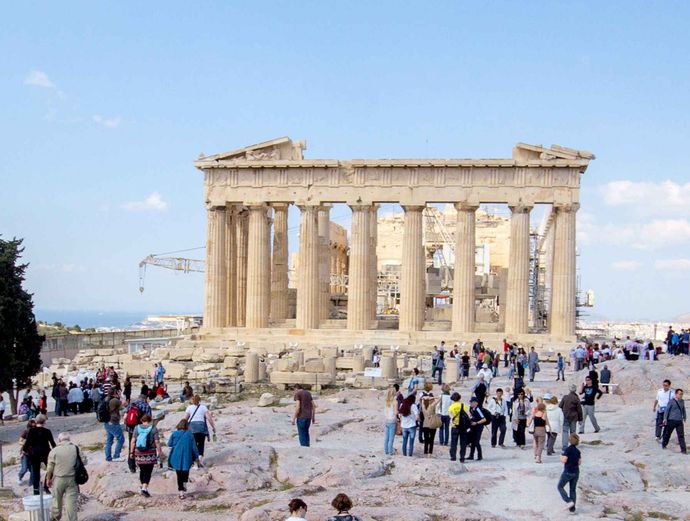
The Acropolis is the rocky hilltop in the heart of Athens crowned by the ruins of temples from ancient Greece, led by the Parthenon. It is the most famous monument of the classical world, and people come to stand among the marble buildings that shaped Western ideas of architecture and democracy.People lived and worshipped on the rock long before the classical era, and it served as a citadel and sacred ground for the city. After the Persians wrecked its older temples, the statesman Pericles led a grand rebuilding program in the 5th century BC. The Parthenon, dedicated to the goddess Athena, was designed by the architects Ictinus and Callicrates, with sculpture overseen by Phidias. In later centuries the hill held a church, a mosque and an Ottoman garrison, and an explosion during a Venetian siege in the 17th century tore open the Parthenon. Restoration work has gone on for generations, and cranes and scaffolding are part of the scene.You enter through the Propylaea, the monumental gateway that was meant to prepare visitors for what lay beyond. The small Temple of Athena Nike stands on a bastion to one side. The Parthenon dominates the summit, its columns subtly curved and tapered so they appear perfectly straight from a distance. Opposite stands the Erechtheion, with its famous porch held up by carved maidens, the Caryatids. The figures on site are copies, and the originals are kept safely indoors nearby.From the edges of the rock, the view takes in the whole city, out to Lycabettus Hill and the sea. On the slopes below lie the Theatre of Dionysus, where Greek drama took shape, and the Odeon of Herodes Atticus, still used for performances. A guide brings the myths, politics and building methods behind the stones to life.

More
Acropolis Museum#3
4.7 (36,842)

Acropolis Museum

The Acropolis Museum in Athens is a modern glass-and-concrete museum at the foot of the Acropolis, built to hold the sculptures and everyday objects found on the sacred rock and its slopes. People come to see the Parthenon sculptures that remain in Greece, the original Caryatids and the view up to the temple itself.For more than a century the finds had crowded a small museum on the hilltop, and Greece wanted a building that could display them properly and make the case for reuniting the Parthenon sculptures held in London. After an international competition, the Swiss-born architect Bernard Tschumi designed the new museum with the Greek architect Michael Photiadis, and it opened early in the 21st century in the Makrygianni district. Digging the foundations uncovered an ancient neighborhood, so Tschumi raised the building on pillars above the ruins rather than bury them.Inside, a gently rising glass ramp suggests the climb up the sacred rock, leading past finds from the slopes to the Archaic gallery, where korai, smiling marble maidens offered to Athena, stand in natural light beside the Moscophoros, a young man carrying a calf on his shoulders. Nearby, five of the six Caryatids from the Erechtheion stand together on a balcony. Later galleries follow the hill into Roman and early Christian times, showing how long the rock stayed at the center of Athenian life.The top floor is the Parthenon Gallery, a glass hall turned to match the temple's alignment, with the Acropolis in full view through the windows. The frieze and metopes run around it in their original order, with the surviving marbles shown beside pale plaster casts of the pieces held abroad, a quiet argument that the set belongs together. A guide can read the frieze's procession scene by scene and connect what you see indoors with the ruins on the hill above.

More
Ancient Olympia#4
4.7 (3,448)

Ancient Olympia

Ancient Olympia is the sanctuary of Zeus in the western Peloponnese of Greece, where the original Olympic Games were held for more than a thousand years. Visitors come to walk through the ruins of temples, training grounds and the old stadium, and to see the finds in the museum beside the site.Olympia was never a city. It was a sacred grove where two rivers meet, where people gathered to honor Zeus, and from the 8th century BC athletes from across the Greek world came here every four years to compete. A sacred truce let them travel safely, and winners earned an olive wreath and lasting fame at home. The Games continued under Roman rule until a Christian emperor banned pagan festivals late in the 4th century AD. Earthquakes and floods then buried the sanctuary under deep layers of silt, which helped preserve it until excavations brought it back to light in the 19th century.The ruins spread out under pine and olive trees. The great Temple of Zeus once held a huge gold and ivory statue of the god by the sculptor Phidias, counted among the Seven Wonders of the ancient world, and its fallen column drums still lie where they toppled. Nearby, the older Temple of Hera is where the Olympic flame is lit for each modern Games. You can trace the workshop where Phidias made his statue, the colonnaded exercise grounds, and a row of bases for bronze statues paid for by fines on athletes caught cheating. A vaulted stone tunnel leads into the stadium, where the original track and the earth banks for spectators survive.The archaeological museum holds some of the finest sculpture in Greece, including the carved figures from the Temple of Zeus, a winged Victory and the marble Hermes attributed to Praxiteles. A guide can bring the sanctuary to life with the rules, rituals and scandals of the ancient contests.

More
Archaeological Museum of Olympia#5
4.7 (2,876)

Archaeological Museum of Olympia

You can explore the museum on your own with the printed museum guide, though the finds mean more with context. A guided tour explains how the sanctuary worked, who competed and where each sculpture and bronze once stood. Many itineraries pair the museum with the archaeological site in Ancient Olympia, so you see the objects first and then the ruins they came from. The museum holds finds from the ancient sanctuary and the site of the Olympic Games, including sculpture, bronzes and terracottas. Last admission is 20 minutes before closing, so arrive with time to spare. The museum has a ramp, a lift and an accessible toilet, and there is a museum shop and parking. A printed museum guide is available on site if you explore on your own.

More
Corinth Canal#6
4.8 (10,693)

Corinth Canal

The Corinth Canal is a narrow, sheer-sided waterway cut through the Isthmus of Corinth, the slim neck of land joining the Peloponnese to mainland Greece. It links the Gulf of Corinth with the Saronic Gulf, and people stop to peer down its towering rock walls and watch boats slip through the deep channel far below.The idea is ancient. In the 7th century BC, Periander, ruler of Corinth, considered digging a channel but instead built the Diolkos, a paved stone track on which ships were hauled across the isthmus on wheeled platforms, and stretches of it survive near the western end. Centuries later the emperor Nero broke ground himself with a golden spade in the 1st century AD and put prisoners to work on the cutting, but the project was abandoned after his death.Modern engineering finally finished the job in the late 19th century. An international company led by the Hungarian István Türr began the excavation, with his countryman Béla Gerster as engineer, and when it ran out of money a Greek company completed the work. The canal spared ships a long and difficult voyage around the Peloponnese, but it proved too narrow for many of the larger vessels that came after, and its steep walls have needed repair work many times since. Retreating German forces wrecked it during the Second World War, and it had to be cleared before it could reopen.The canal mainly serves yachts, small cruise ships and sightseeing boats, often pulled through by tugs. The real spectacle is the cut itself, a straight slot of layered rock so even it looks almost carved by hand. At each end a bridge sinks beneath the water to let vessels pass and then rises again. A guide can bring the long story of the isthmus to life, from rival ancient ports to the canal's modern troubles.

More
Museum of the Olive and Greek Olive Oil (Mouseio Elias kai Ellinikou Ladiou)#7
4.9 (232)

Museum of the Olive and Greek Olive Oil (Mouseio Elias kai Ellinikou Ladiou)

The Museum of the Olive and Greek Olive Oil in Sparta tells the story of the tree that has shaped Greek life for thousands of years, from fossil leaves to engine-driven presses. Set in a converted industrial building in the heart of olive country, it appeals to cooks, history buffs and travelers who want to understand Greece through its signature crop.The museum belongs to a Greek cultural foundation that runs a network of museums on traditional crafts and industries, and it opened in the early 21st century in the old home of the Sparta power company, an industrial building from between the two world wars. Only the main northern facade survived the rebuilding, folded into a crisp modern design that nods to the site's industrial past, and the result won a leading Greek architecture prize. Wide views open over a neighboring olive grove toward the Taygetos mountains, so the subject of the museum is never out of sight.The displays follow the olive through time. They open with fossilized olive leaves from Santorini, tens of thousands of years old, and copies of Linear B tablets from the 14th century BC that mention olive oil. Later sections show how oil fed, groomed and lit Greek households, and how the tree entered myth, religion and art, from Athena's gift to Athens to the olive wreaths of Olympic champions. On the ground floor, replicas of prehistoric, Hellenistic and Byzantine presses stand near a wooden double press with a winch from Xirokambi and an animal-driven press from Lefkada, while models show water, steam and diesel power taking over the work.Soap gets a corner of its own, from the cauldron families once used at home to the vats of industrial soap works, a reminder that oil was never just for cooking. With Laconia's groves all around, a guide can link what you see inside with the trees, mills and kitchens of the countryside.

More
Mycenae#8
4.7 (4,240)

Mycenae

Mycenae is the ruined Bronze Age citadel on a hill above the village of Mykines in the northeastern Peloponnese. It was once the seat of a powerful kingdom that gave its name to a whole civilization, and people come to walk through the Lion Gate, stand among royal tombs and see where Greek legend and archaeology meet.In the second millennium BC, Mycenae controlled much of southern Greece, trading across the Aegean and building palaces, roads and fortifications on a scale the mainland had never seen. Later Greeks believed the walls had been raised by the Cyclopes, because the limestone blocks seemed too large for human hands. Homer made the city the home of Agamemnon, the king who led the Greeks to Troy, and the tragic poets told of his murder on his return. The citadel declined at the end of the Bronze Age and was largely abandoned, its stones left to the hillside.Excavations by Heinrich Schliemann in the 19th century brought Mycenae back into view. Inside Grave Circle A he found shaft graves filled with gold, including the famous funeral mask he believed belonged to Agamemnon, though it is far older than any Trojan War. Most of those finds went to the National Archaeological Museum in Athens, while a smaller museum beside the site shows pottery, figurines and objects from daily life.Walking the site, you pass beneath the Lion Gate, its two carved lions facing each other above the entrance, among the oldest monumental sculpture in Europe. The path climbs past the grave circle to the remains of the palace at the summit, with views across the Argolid plain. Below the walls, the Treasury of Atreus hides a great corbelled dome of fitted stone that went unmatched in size for more than a thousand years. A guide helps turn foundations and fallen stone into a picture of the court that once ruled here.

More
Mystras (Mistras)#9
4.9 (316)

Mystras (Mistras)

Mystras is a ruined Byzantine town spread over a steep hillside above the Eurotas valley, just west of modern Sparta in Greece's Peloponnese. People come to explore its frescoed churches, monasteries and palace, climb to the crusader castle on the summit and walk the lanes of a city that was once a beacon of Byzantine learning.The story begins in the 13th century, when William of Villehardouin, the Frankish prince of Achaea, built a castle on the hilltop. Within a few years he had to hand it over to the Byzantines, and a town grew on the slopes below as people moved up from the plain. Mystras became the seat of the Despotate of the Morea, governed by members of the imperial family, and in the 14th and 15th centuries it flourished as a center of art and scholarship where the philosopher Gemistos Plethon taught. The last Byzantine emperor, Constantine XI, was proclaimed here shortly before Constantinople fell, and after long Ottoman and Venetian rule the town emptied out once modern Sparta was built in the 19th century.The hillside is a UNESCO World Heritage Site, and its churches hold some of the finest late Byzantine frescoes anywhere, full of movement and color. Look for the Metropolis of Saint Demetrios, the Peribleptos monastery with its vivid wall paintings, and the Pantanassa convent with its graceful arcades and bell tower. Higher up stands the vast Palace of the Despots, a rare surviving Byzantine palace, and from the castle walls the view sweeps over the plain, with the Taygetos range rising behind.Moving from church to church past wildflowers and broken walls, you get a rare feel for what a Byzantine city was like. A guide helps decode the saints and scenes on the walls and explains how this hillside briefly carried the hopes of a fading empire.

More
Omonoia Square (Plateia Omonoias)#10
4.1 (2,978)

Omonoia Square (Plateia Omonoias)

Omonoia Square (Plateia Omonoias) is one of the main squares of central Athens, a broad plaza where six major streets meet at the northern edge of the old downtown. Its name means concord, and people come to feel the everyday pulse of the city, admire the restored fountain and look up at the grand neoclassical hotels around it.The square was laid out in the 19th century, soon after Athens became the capital of modern Greece, and it was first called Palace Square because the land was set aside for a royal residence. The palace was eventually built elsewhere, at Syntagma, and the square was renamed in honor of King Otto, the country's first king. After Otto was deposed, rival political leaders met here and swore an oath to end their hostilities, and the square took its present name in memory of that pact.Over the following century Omonoia became a social hub and a gateway to the city. Hotels and cafes gathered around it, the railway to Piraeus was dug beneath it, and successive redesigns added platforms, fountains and sculptures, including a well-known figure of a runner. Two of the most admired buildings, the Bageion and Megas Alexandros hotels, stand on either side of Athinas Street, the latter designed by Ernst Ziller. A major reconstruction brought back the historic fountain and laid new paving, giving the square a fresh start.Omonoia's real draw is the life that flows through it. Shoppers, office workers and families from many backgrounds cross paths here, and when Greece celebrates a sporting triumph, fans pour into the square to cheer. The Pentakiklon, a sculpture of five rings, has been restored to move with the flow of water, adding a playful touch to the stone and traffic. Spending a little time here reveals a side of Athens that its ancient sites alone never show.

More
Panathenaic Stadium (Panathinaiko Stadio)#11
4.7 (35,633)

Panathenaic Stadium (Panathinaiko Stadio)

The Panathenaic Stadium in Athens is a horseshoe-shaped arena built entirely of white marble, the only stadium in the world made that way. Known to Athenians as the Kallimarmaro, or beautiful marble, it hosted the first modern Olympic Games and still welcomes visitors who come to sit in its stands and walk its ancient track.Footraces were run here long before any seats were built, during the Panathenaic Games held in honor of Athena. In the fourth century BC the statesman Lykourgos gave the course a proper stadium, set into a natural ravine between two hills, and in the second century AD the wealthy Athenian Herodes Atticus rebuilt it in Pentelic marble with seating for some 50,000 people. Once the old spectacles were banned in late antiquity, the stadium was abandoned and much of its marble was taken away for other buildings.Its revival came in the 19th century. After excavations uncovered the old outline, the businessman George Averoff paid for a full restoration in marble that closely followed the Roman plan, just in time for the first modern Olympics, when the stadium staged the opening and closing ceremonies and events from athletics to wrestling. It returned to the Olympic stage when Athens hosted the Games again, serving as the finish line for the marathon, and the Olympic flame is handed over here to each new host country.Walking in, you face tier upon tier of marble benches wrapped around a long, narrow track that bends sharply at the curved end. Look for the ancient herms, stone pillars topped with carved heads that turned up during the excavations, the statue of Averoff by the entrance, and the view toward the Acropolis from the highest rows. Runners in the Athens Classic Marathon still cross the finish line on this track. With a guide, the empty arena fills with stories of victors, cheering crowds and the revival that brought the Olympics home.

More
Parliament Building (Vouli)#12
4.8 (20,025)

Parliament Building (Vouli)

Most people see the Parliament from the outside on their own, as part of a stroll around Syntagma Square and the nearby National Garden. A guided walking tour of central Athens adds the story of the building as a former royal palace and ties it to sights within walking distance. Some guided routes can be timed to the guard ceremony, where a guide can explain the uniforms and rituals. The building is the seat of the legislature, so most visitors enjoy it from the outside rather than going in. Ceremonial Evzones guard the Tomb of the Unknown Soldier, and watching them takes only a few minutes. The Grand Change of the Guard at Syntagma Square is a larger ceremony, so check its schedule if you want to see it. Plan about 30 to 45 minutes for the building, the guards and a walk around the square.

More
Parthenon#13
4.7 (43,508)

Parthenon

You can walk the Acropolis on your own, but a guide helps you read the ruins. Guided walking tours explain the story of Athena, the building of the Parthenon and the other temples on the hilltop. Early morning small-group visits avoid the biggest crowds. Many tours continue to the Acropolis Museum or combine the hill with Plaka, the Ancient Agora and other nearby sights. The Parthenon stands at the top of the Acropolis hill, so expect a steady uphill walk on worn marble that can be slippery. Plan about two to three hours for the Acropolis, and longer if you add the nearby Acropolis Museum. There is little shade on the hilltop, so bring a hat, sunscreen and water. Security checks apply at the entrance, so carry only a small bag and leave bulky items behind. Visitors with reduced mobility should contact the site staff before arriving to arrange lift access.

More
Theatre of Epidaurus#14
4.7 (3,964)

Theatre of Epidaurus

The Theatre of Epidaurus is widely considered the finest surviving theater of ancient Greece, set in the green hills of the Peloponnese within day-trip reach of Athens. Famous for its remarkable acoustics and graceful proportions, it belongs to the Sanctuary of Asklepios, a UNESCO World Heritage site, and it still stages performances of ancient drama.The theater was built in the late 4th century BC, and the ancient traveler Pausanias credited it to Polykleitos the Younger. It served a sanctuary rather than a city. Epidaurus was the most celebrated healing center of the Greek world, devoted to Asklepios, god of medicine, and the sick traveled from far away in search of a cure. Festivals of music and drama were held in the god's honor, and the theater gave them a suitably grand stage.What sets the theater apart is its design. Tiers of limestone seats rise in a sweeping curve around a perfectly round orchestra, with room for about 14,000 spectators once an upper section was added in a later century. The shape and angle of the seating carry sound with uncanny clarity, so a coin dropped or a match struck at the center can be heard far up the slope, a trick guides love to demonstrate. Researchers have long puzzled over why, and one theory holds that the ridged rows of seats filter out low background noise while letting actors' voices through.Around the theater lie the remains of the wider sanctuary, including the temple of Asklepios, a mysterious round building known as the tholos, a great guest house for pilgrims, baths and a stadium, while a small museum displays finds from the site. After centuries of silence, the theater returned to its original purpose in the 20th century, and modern audiences now sit on the ancient seats to watch tragedies that were first heard in antiquity.

More

Good to know Nafplio

Nafplio is a place to slow down between big sightseeing days. Most visitors book a long morning outing to the ancient sites of the Argolid, often with a private driver, and are back in town for a late lunch.

Evenings go to the old town lanes and the waterfront, with dinner outdoors as the light fades. Many guides collect you from your hotel, so days start easily.

It suits couples, history lovers and families with older children, and makes a calmer base than Athens for touring the region.

Spring brings wildflowers among the ruins and comfortable temperatures for climbing steps and walking stony paths. Book popular outings a few days ahead.

Summer is hot, dry and busy. Start sightseeing early, then keep the afternoon free for a swim in the gulf and a long rest in the shade.

Fall keeps the sea warm and the light soft, and crowds thin out by October. Winter is mild and quiet, good for the ancient sites if you can live with some rain, cooler evenings and shorter days.

  • There is no airport, so most travelers fly into Athens and go on by car or intercity bus.
  • Cruise passengers usually come ashore by tender boat at the town quay.
  • The old town is small and easy on foot, and the long stairway to the Palamidi fortress is best climbed early.
  • For Epidaurus, Mycenae and the Corinth Canal, a guided outing with transport saves the planning.
  • Carry plenty of water, since the ancient sites offer little shade.
  • Ask whether site entry is part of your outing.
Nafplio
Peak season Jun – Sep
Local Currency Euro (€)
Weather now
Language(s) Greek, English
Time Zone UTC-2
Country Code +30
Attractions 14
Tours 60
Reviews 1,842

Frequently Asked Questions

The answers provided below are based on answers previously given to customers' questions.

Activity name

Discover Nafplio