Lazio attractions
More things to do in the region
 #16
Castel Romano Designer Outlet
Castel Romano Designer Outlet is a large open-air shopping village south of Rome, where more than 150 boutiques sell Italian and international designer labels at a discount. Shoppers come for fashion, shoes, leather goods and homeware in a setting styled like an ancient Roman town, with colonnades, piazzas and fountains.The outlet opened in the early 21st century in the countryside on the southern edge of Rome, one of a new generation of outlet villages that changed the way Italians and visitors shop for designer goods. Its designers drew on the architecture of ancient Rome, so the lanes are lined with columns, arches and warm ocher walls, more like a stage set of a classical town than a typical mall. It has grown into one of the largest outlet centers in the Rome area, drawing shoppers from the city and from far beyond.Walking its streets, you move between Italian fashion houses, international sportswear and denim brands, shoe and leather specialists, kitchen and home stores, and children's clothing, with plenty of spots to pause for an espresso, gelato or a plate of pasta. Fountains and small squares break up the shopping, and the open-air layout means you are often walking in the sunshine between stores. Many visitors come with a list of Italian labels in mind, since buying leather goods, tailoring and shoes close to where they are designed has its own appeal.Set among fields and woodland on the edge of the Roman countryside, the village feels a world away from the crowded lanes of the historic center, though the city's monuments are never far. For many visitors it makes a light-hearted break between days of ruins and museums. Fashion lovers often find pieces from Italian houses that are hard to track down at home.
More #17
Castel Sant'Angelo National Museum (Museo Nazionale di Castel Sant'Angelo)
Castel Sant'Angelo is a massive cylindrical fortress on the banks of the Tiber in Rome, close to the Vatican, that began life as the tomb of the Emperor Hadrian. Now a national museum, it draws visitors with its layers of history, its frescoed papal apartments and sweeping views over the city and St. Peter's from its rooftop terrace.Hadrian built the great drum in the 2nd century as a mausoleum for himself and his family, and several later emperors were laid to rest here too. As Rome's defenses tightened, it was absorbed into the city walls and turned into a fortress, and in the Middle Ages the popes claimed it as a stronghold and refuge. A fortified corridor, the Passetto, runs along the old walls to the Vatican, and during the Sack of Rome in the 16th century Pope Clement VII fled along it to shelter behind the castle's ramparts.Its name comes from a legend. At the end of the 6th century, as plague swept Rome, Pope Gregory the Great is said to have seen the Archangel Michael above the mausoleum, sheathing his sword as a sign that the epidemic was over. A bronze statue of the angel has crowned the summit since the 18th century. Inside, an ancient spiral ramp climbs through the core of the tomb, past the chamber that once held the imperial ashes, to courtyards, armories, prison cells and the Renaissance papal apartments, whose painted halls show how grandly the popes lived behind the walls.From the top terrace, the view takes in the domes and rooftops of the historic center and the broad avenue leading to St. Peter's. Opera lovers will recognize the battlements as the setting for the last act of Puccini's Tosca, whose heroine leaps from them to her death. A guide can bring the castle's prisoners, popes and plotters to life.
More #18
Catacombs of Rome (Catacombe di Roma)
The Catacombs of Rome are ancient underground burial grounds dug beneath the countryside along the Appian Way and other old roads outside the city walls. Early Christians buried their dead here for centuries, and visitors come to walk through narrow galleries lined with tombs and to see some of the earliest Christian art in the world.Roman law did not allow burials inside the city, so cemeteries grew along the roads leading out. From around the 2nd century, Christian communities began digging into the soft volcanic tufa beneath these roads, creating networks of tunnels on several levels. Jewish and pagan families used similar underground tombs. Martyrs and early popes were buried here, and after Christianity became legal, the catacombs turned into places of pilgrimage. In the early Middle Ages, the relics were moved into city churches, and the tunnels were slowly forgotten until explorers rediscovered them in the late 16th century. The word catacomb itself is thought to come from the name of the area around San Sebastiano.Inside, the corridors are lined with loculi, the rectangular niches where bodies were laid and sealed with tiles or marble. Small rooms called cubicula served as family tombs, often painted with frescoes. The art uses simple symbols: the Good Shepherd carrying a lamb, the fish, the anchor, the dove and figures praying with raised arms. At San Callisto, the Crypt of the Popes holds the tombs of several early bishops of Rome, and a nearby crypt honors St Cecilia, with a copy of a famous statue showing her as she was said to be found. At San Sebastiano, tradition links the site to the apostles Peter and Paul, and pilgrims scratched prayers to them on its walls.The galleries are quiet and dim, with the cool scent of earth. A guide explains the symbols and the faith of those buried below.
More #19
Church of Saint Ignatius of Loyola (Chiesa di Sant'Ignazio di Loyola)
You can walk in on your own and spend a few minutes under the ceiling fresco and the painted dome. A guided visit explains how the perspective trick works and why Jesuit churches were decorated this way. Guided walks of the historic center often pair it with other Counter-Reformation churches nearby, such as the Gesù, Sant'Andrea della Valle and the Chiesa Nuova. The church is an active parish run by the Jesuits, so dress modestly and keep quiet during Mass. Marble markers in the nave floor show the best spots to view Andrea Pozzo's painted dome illusion. The tombs of Saints Aloysius Gonzaga, Robert Bellarmine and John Berchmans are inside. Most visits take 20 to 30 minutes. The church is open daily from 9:00 to 23:30 with no midday break.
More #20
Circus Maximus (Circo Massimo)
The Circus Maximus, known in Italian as the Circo Massimo, is the long, grassy hollow that separates the Palatine Hill from the Aventine in Rome, where the ancient city once raced chariots. It was the largest stadium of the Roman world, and people come to walk the line of the old track and picture the roaring crowds that filled it.Racing on this spot goes back to Rome's earliest days. Tradition credits the city's Etruscan kings with the first wooden stands, and Julius Caesar later stretched the seating along almost the full length of the course. Augustus added a grand imperial box and shipped an Egyptian obelisk to stand on the central barrier; that same obelisk now rises in the Piazza del Popolo. After fires swept the wooden tiers, the emperor Trajan rebuilt the whole structure in stone, and at its height it could seat an estimated 150,000 spectators.The races were fierce, fast and loud. Chariots burst from twelve starting stalls, teams wore the colors of rival factions such as the Blues and the Greens, and officials counted the seven laps with giant sculpted eggs and bronze dolphins that were turned as each lap ended. The arena also staged animal hunts, religious processions and athletic games. After the empire faded, floods buried the track under several meters of silt, and over the centuries the ground held houses, market gardens, a stone quarry and even a gasworks.Little of the ancient building rises above the grass, which is why imagination matters here. At the southeastern end, excavations have uncovered stone seating, vaulted corridors and the foundations of the curved end, watched over by a small medieval tower. The rest of the field is a public park that hosts concerts and big celebrations, with views up to the palace ruins on the Palatine. A guide fills the empty field with charioteers, horses and cheering fans.
More #21
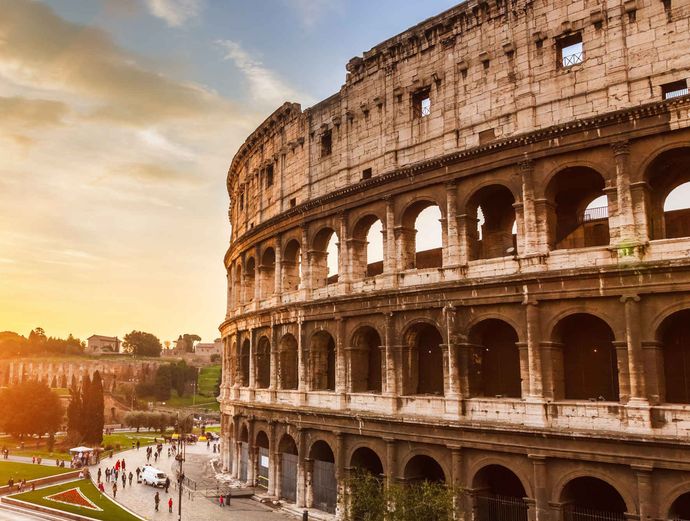
Colosseum
The Colosseum is the great oval amphitheater at the heart of ancient Rome, standing beside the Roman Forum and Palatine Hill. Begun under the Flavian emperors in the 1st century AD, it hosted gladiator fights and public spectacles for centuries, and it remains the largest amphitheater the Romans ever built and the best-known symbol of the city.Emperor Vespasian began the project on land where Nero's private palace, the Golden House, had included an ornamental lake, a gesture that handed the ground back to the people of Rome. His son Titus opened it with lavish games, and his younger son Domitian finished the work. Its proper name is the Flavian Amphitheater. The nickname Colosseum probably came from a colossal bronze statue of Nero that stood nearby. Crowds came to watch gladiators, wild animal hunts and executions, seated strictly by rank, with senators near the arena and ordinary people high above.When the games ended in late antiquity, the building began a long second life. Earthquakes brought down part of the outer wall, and for centuries its stone was carted off to build palaces and churches across the city. It held workshops and homes, served as a stronghold for a noble family, and was later honored by the popes as a place of remembrance for early Christian martyrs. The holes that pit its walls mark where iron clamps were pried out and melted down.Inside, you look down into the arena, where part of the floor has been rebuilt, and into the hypogeum below, a maze of passages, cages and lifts that raised animals and scenery up into view. The tiers of seating, the arched corridors and the tall travertine outer ring, still complete on its northern side, show how Roman builders moved huge crowds in and out with ease. A guide can bring the tunnels and arches to life with the stories of the people who fought, worked and watched here.
More #22
Column of Marcus Aurelius (Colonna di Marco Aurelio)
The Column of Marcus Aurelius (Colonna di Marco Aurelio) is a towering Roman monument wrapped in a spiral of carved battle scenes, rising from Piazza Colonna in central Rome. People stop to admire one of the few great ancient columns still standing in the city and to trace an emperor's wars on the Danube frontier in stone.The column went up late in the 2nd century, after the death of Marcus Aurelius, the philosopher emperor, and was commissioned by his son Commodus and the Senate. It celebrates his hard-fought campaigns against Germanic and Sarmatian tribes beyond the Danube, known as the Marcomannic Wars. Marcus Aurelius is remembered as much for his Meditations, partly written during these very campaigns, as for his victories. Its design borrows closely from Trajan's Column, finished decades before, though here the figures are cut more deeply, which gives them stronger shadows and more drama.The frieze circles the shaft 21 times in a band more than 110 meters long, showing the army crossing the Danube, councils of war, villages in flames and captives led away. The best-known scene is the rain miracle, when a sudden storm is said to have rescued Roman troops trapped in the land of the Quadi, with the rain shown as a great winged figure streaming water. Inside, a spiral stair of close to 200 steps climbs to the summit, lit by narrow slits in the carving.The bronze of the emperor that once crowned it had vanished by the 16th century, when Pope Sixtus V had Domenico Fontana restore the column and set a bronze St. Paul on top. During that work the base was recased in marble, and an inscription added then wrongly credits the column to Antoninus Pius. Standing nearly 40 meters tall with its pedestal, it gave Piazza Colonna its name.
More #23
Domus Augustana
If you are looking for things to do in Lazio we have 3 Tours and Activities to Experience Domus Augustana. Check out our verified traveler reviews and photos of Domus Augustana tours and other things to do in Lazio, and book securely when you find the perfect one. Learn the best ways to see famous Domus Augustana and explore the most popular things to do in Lazio.
More #24
Etruscan Necropolises of Cerveteri and Tarquinia (Necropoli Etrusche di Cerveteri e Tarquinia)
You can visit either necropolis on your own, but the tombs make more sense with someone explaining Etruscan burial customs and the meaning of the wall paintings. Guided day trips from Rome often cover Cerveteri, Tarquinia or both, with transport included. Tours that add the nearby archaeological museum help you see the finds that came from the tombs. Cerveteri and Tarquinia are separate sites in different towns, so pick one or plan a long day to see both. At Cerveteri you walk among large round tumuli along a main funerary road, and some lit tombs can be entered. Tarquinia is known for painted tombs, with wall scenes of banquets, dancing and daily life. Cerveteri has toilets and refreshment areas on site, and both sites are mostly outdoors, so bring sun protection and comfortable shoes. Both sites close on Mondays, and hours change with the season.
More #25
Florence Baptistery (Battistero di San Giovanni)
The Florence Baptistery, the Battistero di San Giovanni, is the striking octagonal church of green and white marble that stands in front of the cathedral in the heart of Florence. It is one of the city's oldest buildings, and visitors come for its glittering mosaic ceiling and its gilded bronze doors, which helped launch the Renaissance.Dedicated to John the Baptist, the city's patron saint, the Baptistery took its present form in the 11th and 12th centuries, and medieval Florentines believed it had once been a Roman temple to Mars. Generations of Florentines were baptized here, including the poet Dante, who wrote fondly of his beautiful San Giovanni. Its crisp geometric facing of colored marble, framed by pilasters and arches, is a classic of the Florentine Romanesque style.The doors tell the story of Florentine art. Andrea Pisano cast the south doors in the 14th century. Then, at the start of the 15th century, the city held a competition for a second pair, and the young goldsmith Lorenzo Ghiberti beat Filippo Brunelleschi, who went on to build the cathedral's dome. Ghiberti spent decades on the north doors and then on the east doors facing the cathedral, whose gilded panels of Old Testament scenes use perspective so masterfully that Michelangelo is said to have called them the Gates of Paradise.Inside, the dome glows with gold-ground mosaics from the 13th century, the work of Venetian and Florentine craftsmen. A towering figure of Christ presides over the Last Judgment, with the saved rising toward heaven on one side and a monstrous devil devouring sinners on the other, while bands of scenes tell the stories of Creation, Joseph, Christ and John the Baptist. Against one wall stands the tomb of the antipope John XXIII, carved by Donatello and Michelozzo. A guide helps decode the crowded imagery overhead.
More #26
Fontana dell'Acqua Paola
Many visitors see the fountain on their own in a short stop, but a guide adds the story of the aqueduct it marks, the marble reused from Roman ruins, and the Borghese dragons and eagles carved into it. Guided walks often link the Janiculum with Trastevere and San Pietro in Montorio, and sunset walks suit the views over Rome. Garden visits can be arranged for individuals or groups of up to 25. The fountain stands on Via Garibaldi, on the Janiculum Hill terrace, and its front can be seen from the street at any time. The garden behind the fountain opens by reservation only, so plan ahead if you want to go in. The approach from Trastevere is a steady uphill walk, so wear comfortable shoes. Most people make a short stop here and pair it with the Janiculum views and the nearby church of San Pietro in Montorio. A cannon on the Janiculum fires once at noon, so expect a loud bang if you are on the hill at midday.
More #27
Golden House of Nero (Domus Aurea)
Entry is through a guided visit only, so the choice is between a standard guided visit and a longer version with virtual reality that rebuilds the palace as it once stood. Themed guided sessions go deeper into the wall paintings and history. Many travelers pair it with the Colosseum and Roman Forum on the same day, since all three are close together. Entry is by guided visit on a timed slot, in small groups of up to 23 people, so reserve ahead. The underground rooms are damp and cool, so bring a light layer and wear sturdy, flat shoes. Allow about one to one and a half hours for the visit. Dogs are not allowed inside. Some visits use virtual reality headsets to show how the palace once looked, which adds a lot for first-time visitors.
More #28
Historic Center of Rome (Centro Storico di Roma)
The Historic Center of Rome (Centro Storico di Roma) is the ancient heart of the Italian capital, a dense web of streets, piazzas, churches and ruins where nearly three thousand years of history overlap. Visitors come to wander between landmarks such as the Pantheon and Piazza Navona, linger in its squares and see how each age of Rome built on the last.According to legend, Romulus and Remus founded the city in the 8th century BCE, and from its hills Rome grew to rule an empire that stretched around the Mediterranean. After the empire fell, the popes made Rome the center of the Catholic world, and Renaissance and Baroque builders layered palaces, churches, fountains and squares over the ancient city. The result is a district where a medieval lane can open onto an imperial column, and a Baroque church may stand on Roman foundations.The Pantheon, still crowned by its great unreinforced concrete dome after nearly two thousand years, is one of the best-preserved buildings of ancient Rome. Piazza Navona keeps the long oval shape of the Stadium of Domitian that once stood on the site, and Bernini's Fountain of the Four Rivers rises at its center. The columns of Trajan and Marcus Aurelius spiral with carved battle scenes, while Castel Sant'Angelo began as the tomb of the emperor Hadrian before serving the popes as a fortress.The whole district, together with the properties of the Holy See within it and the basilica of San Paolo Fuori le Mura, is a UNESCO World Heritage Site. Yet it is also a place where people live and work, with neighborhood bars, markets and artisans' shops tucked between the monuments. The Trevi Fountain, the Spanish Steps and Campo de' Fiori each add their own mood, from Baroque theater to everyday bustle. Wandering with no fixed plan, turning corners just to see what lies beyond, is one of the great pleasures of Rome.
More #29
Janiculum Hill (Gianicolo)
Janiculum Hill, or the Gianicolo, is a long green ridge on the west bank of the Tiber in Rome, rising above Trastevere. Locals and travelers climb it for one of the widest views over the city's domes and bell towers, and for its monuments to the fight for a united Italy.The hill takes its name from Janus, the two-faced Roman god of beginnings, who was said to have had a shrine here. It lay outside the original seven hills of the city and was later enclosed by walls. Its most famous moment came in the middle of the 19th century, when Giuseppe Garibaldi and his volunteers defended the short-lived Roman Republic here against French troops sent to restore papal rule. They lost, but the battle became a founding legend of modern Italy, and the hill was later turned into a memorial park to honor them.At the top, a large equestrian statue of Garibaldi looks out over the city from a terrace. Nearby, his wife Anita is shown on a rearing horse, holding a baby in one arm and a pistol in the other, and she is buried beneath the monument. The shaded avenue along the crest is lined with marble busts of the men who fought in the battle. Lower down the hill, the Fontana dell'Acqua Paola, which Romans call the Fontanone, is a grand marble fountain built by a pope in the 17th century to celebrate a restored aqueduct. Close by, the church of San Pietro in Montorio stands where tradition places the crucifixion of Saint Peter, and its courtyard holds Bramante's Tempietto, a small, perfectly round Renaissance temple. A lighthouse given to Rome by Italians in Argentina also stands on the ridge.A guide can tie the views below to the battle and the struggle that shaped this hill.
More #30
Lake Bracciano (Lago di Bracciano)
Lake Bracciano is a broad volcanic lake in the Lazio countryside northwest of Rome, ringed by the old towns of Bracciano, Anguillara Sabazia and Trevignano Romano. Romans escape here for clean water, quiet shores and long lakeside lunches, and travelers come for the towering castle above Bracciano.The lake fills a basin left by the volcanoes of the Sabatini district, long extinct, and it is fed mostly by underground springs. The Romans called it Lacus Sabatinus, and the emperor Trajan built an aqueduct that carried water from the springs around it to Rome, a line the popes later restored to feed fountains on the Janiculum. Off Anguillara, divers and archaeologists uncovered a Neolithic village now beneath the water, along with dugout canoes among the oldest found in the Mediterranean.The Orsini family raised the castle at Bracciano in the 15th century, and it later passed to the Odescalchi, who still own it. With round towers of dark volcanic stone, it is among the best-preserved Renaissance fortresses in Italy, and inside are frescoed halls, old armor and a walkway along the battlements high above the lake. Anguillara crowns a rocky spur above the water, its lanes climbing to a hilltop church, while Trevignano stretches along the northern shore beneath the ruins of its own fortress.The lake is still a reserve of drinking water for Rome, and strict protection keeps it among the cleanest in Italy. Its shores belong to a regional nature park that also takes in little Lake Martignano, an almost round crater lake nearby. Herons and grebes feed among the reeds, and from the hill towns the view stretches across blue water to gentle wooded slopes. A guide can connect the castle's tales of feuding noble families with the far older story of the lake itself.
More #31
Madama Palace (Palazzo Madama)
If you are looking for things to do in Lazio we have 3 Tours and Activities to Experience Madama Palace (Palazzo Madama). Check out our verified traveler reviews and photos of Madama Palace (Palazzo Madama) tours and other things to do in Lazio, and book securely when you find the perfect one. Learn the best ways to see famous Madama Palace (Palazzo Madama) and explore the most popular things to do in Lazio.
More #32
Montecassino Abbey (Abbazia di Montecassino)
Montecassino Abbey is the hilltop monastery above the town of Cassino in southern Lazio, founded by Saint Benedict and still home to a community of Benedictine monks. Pilgrims, history lovers and people tracing the Second World War come for its rebuilt basilica, its cloisters and the wide view over the Liri valley.Benedict came here in the 6th century and built his monastery over the remains of a pagan temple, and here he wrote the Rule that would shape monastic life across Western Europe. He and his twin sister, Saint Scholastica, are said to rest beneath the high altar.Its story is one of repeated ruin and return. It was sacked by the Lombards, burned by Saracen raiders and toppled by an earthquake in the 14th century, and each time the monks rebuilt, while their scriptorium made the abbey one of the great centers of learning in medieval Europe, where classical texts were copied and saved. The worst blow came in the Second World War, when the abbey stood above the German defensive line and Allied bombers reduced it to rubble during the long battle for Monte Cassino. Rebuilt after the war along its old lines, it was consecrated anew by the pope.The basilica glows with inlaid marble, gilding and painted vaults, and its medieval bronze doors, which survived the bombing, list the abbey's estates in silver letters. Visitors pass through a sequence of cloisters, one of them opening onto a terrace with a long view across the valley. The museum displays illuminated manuscripts, church silver and paintings, much of it carried to safety in Rome before the bombing. On the slope just below, a Polish military cemetery honors the soldiers who finally raised their flag over the ruins. For all its turbulent past, the summit has a deep calm, and the monks' daily round of prayer still sets its rhythm.
More #33
Montecitorio Palace (Palazzo Montecitorio)
You can see the palace's Baroque facade and the Egyptian obelisk in the piazza on your own at any time. To go inside, join one of the timed open-day group visits or ask about arranged group visits through the Chamber. Walking tours of central Rome often pass through the piazza and link it with the Pantheon, Piazza Colonna and the Trevi Fountain. The palace is the seat of Italy's Chamber of Deputies and is not open daily, so visits happen on special open days or as arranged group visits. Open-day visits run about once a month on a Sunday, in timed groups, so each person needs a ticket for a time slot. Arrive at the Piazza di Monte Citorio entrance ten minutes before your time, because groups that are late are not admitted. The visit covers the main chamber, the Transatlantico lounge and several ceremonial rooms. Bring a valid photo ID and expect security checks at the entrance.
More #34
Odescalchi Castle (Castello Odescalchi)
Most visitors see the castle on a guided visit of about an hour, which takes you through the reception halls, frescoed rooms, the weapons collection and the courtyards, with the history explained along the way. Private tours are available in several languages. Many people add a walk through the old town and a stroll along the lake, or combine the castle with a day trip from Rome or a stop at nearby Santa Severa castle. The castle suits history fans, families and anyone who likes lake views, and a guided visit takes about an hour. The route includes a spiral staircase, so it may not suit visitors with mobility difficulties. The private apartments are closed to visitors, so follow the route your guide sets through the halls and courtyards. Hours change with the season and the castle can close for private events, so check the schedule for your day. Wear comfortable shoes, because the old town climbs a hill to the castle and the visit covers courtyards and stairs.
More #35
Orvieto Cathedral (Duomo di Orvieto)
Orvieto Cathedral is the great Gothic church of Orvieto, a hill town in southwestern Umbria set on a cliff of volcanic rock. Travelers come for its glittering facade, among the richest in Italy, and for a chapel inside where Luca Signorelli painted one of the most powerful visions of the end of the world in Renaissance art.Building began in the late 13th century, when Pope Nicholas IV laid the first stone of a church meant to house a treasured relic. According to tradition, a priest celebrating Mass at nearby Bolsena who doubted that the bread became Christ's body saw blood fall from the host onto the altar cloth, and that stained linen, the Corporal of Bolsena, was brought to the pope in Orvieto. The work stretched over centuries under a long line of master builders, above all the Sienese architect and sculptor Lorenzo Maitani, who shaped the facade.The facade rises like a giant altarpiece, with gold mosaics, a rose window by Andrea Orcagna and marble reliefs on the lower piers that tell the Bible story from Creation to the Last Judgment. Inside, the walls change to bold bands of dark basalt and pale travertine, and light filters softly through thin alabaster panes. The Chapel of the Corporal keeps the relic, along with a shimmering medieval reliquary of enameled silver shaped like the cathedral's facade. Facing it across the transept, the San Brizio Chapel was begun by Fra Angelico and finished by Signorelli, whose crowded scenes of the Antichrist, the dead rising from their graves and the damned seized by demons are often said to have inspired Michelangelo.Look closely at the lowest carved panels, where Adam and Eve and the damned are cut almost at eye level, and at the bronze symbols of the four Evangelists above them. With a guide, the crowded panels turn into a readable picture book of medieval belief.
More #36
Palatine Hill (Palatino)
Palatine Hill (Palatino) is the most central of Rome's seven hills, looking down on the Roman Forum on one side and the Circus Maximus on the other, and legend names it as the spot where the city was born. Visitors come to wander through the ruins of imperial palaces, quiet gardens and terraces with sweeping views over the ancient heart of Rome.Roman tradition held that the she-wolf found the twins Romulus and Remus at the foot of this hill and that Romulus later founded his city on its summit, and archaeologists have indeed uncovered traces of Iron Age huts here. In the late Republic it became the most fashionable address in Rome, home to wealthy families and statesmen such as Cicero, and Augustus, the first emperor, chose to live here in a surprisingly modest house.Later emperors were far less restrained. Tiberius, Nero and above all Domitian spread vast palace complexes across the hill, and Domitian's residence, with its official wing, the Domus Flavia, and private quarters, the Domus Augustana, served as the seat of imperial power for centuries. The hill's Latin name, Palatium, gave the word palace to many European languages. Among the remains you can still trace grand halls, courtyards that once held fountains and a sunken garden shaped like a stadium.Look for the House of Livia and the House of Augustus, where delicate wall paintings in deep reds, yellows and blues have survived since antiquity. In the 16th century the Farnese family laid out gardens over part of the ruins, and their terraces still give one of the finest views down onto the Forum. From the southern edge you look down on the Circus Maximus, whose long grassy oval still traces the ancient chariot track. The Palatine Museum gathers statues, frescoes and finds from the excavations, and tall umbrella pines rise among the ruins.
More #37
Pantheon
The Pantheon is an ancient Roman temple in the heart of Rome's historic center, crowned by a vast concrete dome that has stood for nearly two thousand years. Now a church, it is the best-preserved great building of ancient Rome, and people come to stand beneath the dome and look up at the open circle of sky at its center.The first temple on the site was built by Marcus Agrippa, the friend and general of Emperor Augustus, and his name still runs in large letters across the front. That earlier building was lost to fire, and the Pantheon seen today was raised in the second century under Emperor Hadrian, who kept the original dedication. In the early Middle Ages, a pope turned the temple into a church dedicated to the Virgin Mary and the martyrs, and that new role saved it from the quarrying that stripped so many Roman ruins. Much later, a Barberini pope removed bronze from the porch, inspiring the Roman jibe "What the barbarians did not do, the Barberini did."The dome is the marvel. Its height from floor to oculus matches its width, so a perfect sphere would fit inside, and it remains the largest dome of unreinforced concrete in the world. Roman builders made the concrete lighter toward the top, mixing in volcanic stone, and cut rows of sunken coffers to reduce the weight. The oculus, the only window, sends a beam of sunlight sweeping slowly across the coffers like the hand of a giant sundial.Out front, a portico of tall granite columns shipped from Egypt leads to huge bronze doors. Inside, the floor of colored marble and porphyry keeps its ancient pattern, and Raphael lies here at his own request. A guide can point out the ancient details that survive among later additions.
More #38
Piazza Barberini
Most visitors see the square on their own as a short stop between the Trevi Fountain, the Spanish Steps and Via Veneto. A guided walking tour of central Rome adds the stories behind Bernini's Triton Fountain and the bees of the Barberini family, and links the square with nearby Baroque sights. Palazzo Barberini and its art collection are close by for a longer outing. The square is a busy traffic junction, so use the marked crossings and watch for buses. A stop at the fountain takes about 15 to 20 minutes, longer if you add nearby sights. It is an open public square with no entry rules or dress code, and it suits all ages.
More #39
Piazza del Campidoglio
Piazza del Campidoglio is the elegant square on top of the Capitoline Hill in Rome, designed by Michelangelo and framed by three palaces that house the city hall and the Capitoline Museums. Set high above the Roman Forum, it ranks among the most harmonious public spaces in Italy and makes a natural stop for anyone exploring ancient Rome.The Capitoline was the most sacred of Rome's seven hills, crowned in antiquity by the great Temple of Jupiter. By the Middle Ages the hilltop had become a rough, neglected place, and in the 16th century Pope Paul III asked Michelangelo to remake it, partly to impress the visiting emperor Charles V. The artist turned the square around so that it faced away from the ruins of the Forum and toward St. Peter's and the Rome of the popes.His plan shaped a trapezoid that tricks the eye, making the space seem wider and more balanced than it is. He reworked the facades of the Palazzo Senatorio, the city hall at the back, and the Palazzo dei Conservatori, and planned a twin Palazzo Nuovo opposite, though much was completed long after his death. The star-shaped pattern in the paving follows his design but was laid only in the 20th century. In the center rides a copy of the bronze Marcus Aurelius, an ancient statue that escaped being melted down because medieval Romans believed it showed Constantine.At the top of the Cordonata, the broad ramp of shallow steps leading up from below, ancient statues of the twins Castor and Pollux stand beside their horses. The Capitoline Museums inside count among the oldest public collections in the world and hold the bronze she-wolf that became the emblem of Rome. Behind the Palazzo Senatorio, terraces look straight down over the Forum. A guide can show how ancient, papal and civic Rome meet in this one small space.
More #40
Piazza del Popolo
Piazza del Popolo is easy to see on your own, but a guided walk explains the layout, the obelisk's journey from Egypt, and the church art most people pass without noticing. Walking tours often link the square with the Pincio terrace and the three streets that fan out toward central Rome. Themed tours can focus on the works by Raphael and Caravaggio inside Santa Maria del Popolo. The square is a pedestrian area, so it suits families and anyone who wants an easy stroll; most people spend 30 to 60 minutes here. Santa Maria del Popolo on the north side holds the Chigi Chapel designed by Raphael and Caravaggio's paintings in the Cerasi Chapel. The twin churches at the south end look identical from the square, but their domes differ in shape, a trick of perspective. The Pincio terrace above the square gives wide views, especially at sunset, but the way up is uphill.
More #41
Piazza della Bocca della Verità
You can queue for the photo and step into the basilica on your own in a short stop. A guided walk adds the legend of the mask, the film connection and the story of the ancient Forum Boarium around it. Many Rome walking tours link the piazza with the nearby Circus Maximus, the Aventine Hill and the Tiber Island for a fuller morning or afternoon. The Mouth of Truth is a large marble mask set into the porch wall of the Church of Santa Maria in Cosmedin. Visitors queue for the traditional photo with a hand placed in the mouth, so expect a line at busy times. The church is a place of worship, so keep your voice down and dress modestly if you go inside. The stop is short, and you can add a look inside the basilica if you have a little more time. The piazza is flat and open, which suits strollers and most mobility needs.
More #42
Piazza della Signoria
You can wander the square freely, but a guided walk helps you read the sculptures, the Neptune fountain and the plaque marking Savonarola's execution. Guided visits of Palazzo Vecchio take you through its interior, decorated by Vasari, and timed entry helps on busy days. Walking tours often join the piazza with the Uffizi, the Duomo and Ponte Vecchio. The square is a restricted traffic zone reserved for pedestrians, so you can wander freely among the statues. The statue of David in front of Palazzo Vecchio is a copy, and the original is in the Accademia Gallery. The Loggia dei Lanzi is an open-arched sculpture gallery at the edge of the square, with works by Cellini and Giambologna. A historic café on the square's edge offers a place to sit and look at the palace.
More #43
Piazza Navona
Piazza Navona is a long, oval square in the historic center of Rome, lined with Baroque palaces and churches and set with three fountains. It is one of the city's great public stages, and people come to admire Bernini's sculpture, linger at its cafés and watch street performers in a space still shaped by an ancient Roman stadium.In the first century the emperor Domitian built a stadium here for athletic contests, and the square still follows the outline of its track, with houses and palaces resting on the old stands. The Greek-style games, or agones, gave the place its medieval name, in agone, which slowly became Navona. For centuries it held the city's main market, and in the 17th century Pope Innocent X, whose family palace stood on the square, rebuilt it as a showcase of Baroque Rome. Until the 19th century, the square was flooded on summer weekends to create a shallow lake for carriages and crowds.The centerpiece is Bernini's Fountain of the Four Rivers, where four giant figures represent the Nile, the Ganges, the Danube and the Río de la Plata, great rivers of the four continents then known, beneath an ancient obelisk. Facing it rises the church of Sant'Agnese in Agone, with a curving facade by Bernini's rival Borromini. A favorite story says the Nile covers his face so he need not look at the church, but the fountain came first, and the veil really shows that the river's source was still unknown. At either end, the Fontana del Moro and the Fountain of Neptune complete the scene.The square is a gathering place for Romans and visitors alike, with artists selling paintings and sketches around the fountains and facades glowing warm ocher in the late light. A guide can explain how emperors, popes and rival artists each left their mark on this one long space.
More #44
Piazza Venezia
The square is easy to see on your own, since it sits at the center of Rome and the Vittoriano rises over it. A guided tour adds the story of the monument, the Tomb of the Unknown Soldier and Palazzo Venezia. Many walking tours join the square with the Capitoline Hill, the Roman Forum and the Pantheon, which are all a short walk away. Panoramic terrace visits can be added. Piazza Venezia is a major junction where Via del Corso and Via dei Fori Imperiali meet, so expect traffic and take care crossing. The square is open to everyone, while the monument's terrace and museums are separate visits with their own hours. The Altare della Patria holds the Tomb of the Unknown Soldier, so behave respectfully on its steps. The square is a short walk from the Roman Forum, the Capitoline Hill and the Pantheon, so it fits easily into a day of sightseeing.
More #45
Piazzale Giuseppe Garibaldi
You can visit on your own, since the square is part of a public park and free to wander. A guided walking tour can link the Janiculum with Trastevere's lanes and explain the Garibaldi monument and the story of the Roman Republic. Sunset and evening tours, or e-bike rides across Rome's hills, pair the view with other sights and save you the steep climb. The square is a free open-air viewpoint in a public park, so it suits families, couples and anyone short on time. Most visits take 30 to 60 minutes, longer if you wander the park paths and nearby churches. A cannon fires a blank shot every day at noon, so arrive a few minutes early for a spot near the monument. The climb from Trastevere is steady and uphill, and paths can be uneven, so wear comfortable shoes.
MoreDiscover Lazio
Luxury & Special Occasions
Prices from $10
Tours & Sightseeing
Prices from $10
Food, Wine & Nightlife
Prices from $6
Walking & Biking Tours
Prices from $10
Day Trips & Excursions
Prices from $30
Shore Excursions
Prices from $17
Air, Helicopter & Balloon Tours
Prices from $300
Cruises, Sailing & Water Tours
Prices from $25
Cultural & Theme Tours
Prices from $10
Holiday & Seasonal Tours
Prices from $162Kid Friendly
Prices from $33
Outdoor Activities
Prices from $25


Rome Civitavecchia Cruise Port (Civitavecchia Terminal Crociere)
Prices from $17
Ancient Ostia (Ostia Antica)
Prices from $325
Ancient Rome
Prices from $530
Ara Pacis Museum (Museo dell'Ara Pacis)
Prices from $100
Arch of Constantine (Arco di Costantino)
Prices from $146
Aventine Hill (Aventino)
Prices from $100
Ballarò Market (Mercato Ballarò)
Prices from $95
Basilica of Saint Paul Outside the Walls (Basilica di San Paolo Fuori le Mura)
Prices from $169
Basilica of Santa Maria in Trastevere (Basilica di Santa Maria in Trastevere)
Prices from $688
Basilica of Santa Maria Maggiore (Basilica Papale di Santa Maria Maggiore)
Prices from $30
Basilica of St. John Lateran (Basilica di San Giovanni in Laterano)
Prices from $289
Baths of Caracalla (Terme di Caracalla)
Prices from $289
Hanukkah in Lazio
Dec 4–12, 2026
New Year’s Eve in Lazio
Thu, Dec 31, 2026
New Year’s Day long weekend in Lazio
Jan 1–3, 2027
Rainy day activities in Lazio
3 tours & activities
Senior-friendly tours Lazio
27 tours & activities
Lazio Foodie Tours
30 tours & activities
Family-friendly Lazio Tours
113 tours & activities
The best tours and activities for culture lovers in Lazio
101 tours & activities
Top Day Trips from Lazio
50 tours & activities
Things to do in Lazio this summer
180 tours & activities
 From $2