Germany attractions
More things to do in the country
 #226
House of Parliament (Országház)
The House of Parliament, or Orszaghaz, is the seat of Hungary's National Assembly on the Pest bank of the Danube in Budapest. It is the largest building in the country and one of the grandest parliament buildings in the world, and people come to see its Gothic Revival spires, its golden halls and the Hungarian Holy Crown.The building was planned to celebrate a thousand years since the Magyar tribes settled the Carpathian Basin. Hungarian architect Imre Steindl won the design competition, drawing on London's Houses of Parliament for its Gothic style while adding a Renaissance style dome at the center. Construction took nearly two decades, and Steindl went blind and died before it was finished. The building has housed the country's lawmakers through kingdoms, wars, communist rule and the return to democracy, and it remains one of the strongest symbols of the nation.Inside, the grand staircase climbs under painted ceilings by Karoly Lotz, framed by gilded vaulting and columns of dark stone. The Dome Hall at the center of the building holds the Holy Crown of Hungary, the crown associated with St Stephen, the country's first king, displayed with the scepter, orb and sword of the coronation regalia under a ceremonial guard. Statues of Hungarian rulers line the hall beneath the dome. The tour also visits the old Upper House chamber, with its rows of benches and gallery, and the lobby outside it, where numbered cigar holders on the window ledges recall the days when lawmakers set down their cigars before going in to vote.From outside, the long riverside facade with its spires and arches is just as striking, especially reflected in the Danube. On Kossuth Square, a memorial and statues tell more of the country's story. A guide adds the stories behind the halls and the crown.
More #227
Hradcany (Castle Hill)
Hradcany (Castle Hill) is the historic district crowning the hill above Prague's Lesser Town, home to Prague Castle and a cluster of noble palaces, churches and quiet lanes. Travelers come for St. Vitus Cathedral, the royal palace and Golden Lane, and for sweeping views over the red roofs and spires of the city below.The story begins with the castle. Its origins reach back to the 9th century, when Czech princes fortified the ridge, and over the centuries that followed it grew into one of the largest castle complexes anywhere, more than 500 meters long. A town grew up beside its walls in the Middle Ages, and Hradčany remained a separate borough until the late 18th century, when Prague's historic towns were joined into one city. Fire and rebuilding left the district with the grand Renaissance and Baroque palaces that line its streets.Inside the castle walls, St. Vitus Cathedral soars in Gothic spires and holds royal tombs, stained glass and the richly decorated chapel of St. Wenceslas. Nearby stand the Old Royal Palace, with its vaulted Vladislav Hall, the Romanesque Basilica of St. George, and Golden Lane, a row of tiny colorful houses tucked into the fortifications where castle guards and craftsmen once lived and where Franz Kafka later wrote. The castle is also the seat of the Czech president, and uniformed guards change shifts at its gates.Beyond the castle, the rest of Hradčany is calmer. Hradčany Square is framed by the Archbishop's Palace and the Schwarzenberg Palace, with its patterned sgraffito facade, while the Sternberg Palace holds a national collection of European old master paintings. Further west lie the Loreta, a Baroque pilgrimage shrine with a famous carillon, the vast Černín Palace and the Strahov Monastery with its ornate libraries, while the tiny lane of Nový Svět keeps a village feel. A guide can bring the kings, saints and court intrigues of the hill to life.
More #228
Humboldt University of Berlin
If you are looking for things to do in Germany we have 15 Tours and Activities to Experience Humboldt University of Berlin. Check out our verified traveler reviews and photos of Humboldt University of Berlin tours and other things to do in Germany, and book securely when you find the perfect one. Learn the best ways to see famous Humboldt University of Berlin and explore the most popular things to do in Germany.
More #229
Imperial Palace (Hofburg)
If you are looking for things to do in Germany we have 13 Tours and Activities to Experience Imperial Palace (Hofburg). Check out our verified traveler reviews and photos of Imperial Palace (Hofburg) tours and other things to do in Germany, and book securely when you find the perfect one. Learn the best ways to see famous Imperial Palace (Hofburg) and explore the most popular things to do in Germany.
More #230
Innsbruck Old Town (Altstadt)
Innsbruck Old Town, the Altstadt, is the compact medieval heart of the Tyrolean capital, set beside the Inn River with the peaks of the Nordkette rising straight behind it. Visitors come for its arcaded lanes, pastel facades and the Golden Roof, a gleaming late-Gothic balcony that has become the emblem of Innsbruck.The town grew up around a bridge over the Inn, which gave it its name, and by the late Middle Ages it was a busy stop on the trade route over the Alps between Germany and Italy. Its golden age came around the turn of the 16th century under Emperor Maximilian I, who made the town a favorite seat of his court. He added the Golden Roof to the old ducal residence as a royal box for watching tournaments and festivities in the square below, roofing its oriel with fire-gilded copper tiles and decorating it with carved reliefs of himself and his two wives.Around it, tall burghers' houses with deep arcades line the lanes, once sheltering merchants and their wares from snow and rain. The Helbling House nearby is a Gothic building dressed in the 18th century with stucco ornament as lavish as icing on a cake. The City Tower, a watchtower from the late Middle Ages, rises beside the old town hall, and a few steps away stand the Hofburg palace and the Court Church, where larger-than-life bronze figures of kings and heroes guard Maximilian's empty tomb.Just beyond the old gates, the broad Maria-Theresien-Straße adds Baroque palaces and Saint Anne's Column, raised to give thanks for the retreat of Bavarian troops in the 18th century. What sets the old town apart is its backdrop, since at the end of many lanes the mountains seem close enough to touch. A guide can decode the painted house signs, coats of arms and faded frescoes that most people walk past.
More #231
Iron Bridge (Eiserner Steg)
The Eiserner Steg, or Iron Bridge, is the riveted steel footbridge that carries walkers across the Main between Frankfurt's Old Town and the Sachsenhausen bank. People come for the crossing itself and for the view from midstream, where the high-rise towers, the cathedral spire and the Old Town roofs all come into sight.The first bridge on this spot was made of wrought iron and opened in the 19th century, giving the city center a direct link to Sachsenhausen for people on foot. Its name simply reflects what set it apart from the stone bridges of its day: a slender metal span built only for pedestrians. In the early 20th century it was replaced by a slightly larger steel cantilever bridge, the design whose trusses and two river piers still define the crossing. In the last days of the Second World War the German army blew it up, and it was rebuilt within about a year.The bridge is one of Frankfurt's best-loved landmarks and a favorite place to pause. Padlocks left by couples crowd its railings, and a line of ancient Greek from Homer's Odyssey, about sailing the wine-dark sea toward people of other tongues, is set into the structure. From the middle you can compare two faces of the city: the glass and steel towers that earned it the nickname Mainhattan, and the rebuilt gabled houses and church spires of the old center.On the far bank, the Schaumainkai is lined with museums of art, film and design, so the bridge also works as a hinge between Frankfurt's history and its culture. A guide can point out traces of war damage and rebuilding along both banks and explain how the river shaped the city's trade fairs and its fortunes.
More #232
Judenplatz
If you are looking for things to do in Germany we have 16 Tours and Activities to Experience Judenplatz. Check out our verified traveler reviews and photos of Judenplatz tours and other things to do in Germany, and book securely when you find the perfect one. Learn the best ways to see famous Judenplatz and explore the most popular things to do in Germany.
More #233
Jungfernstieg
If you are looking for things to do in Germany we have 11 Tours and Activities to Experience Jungfernstieg. Check out our verified traveler reviews and photos of Jungfernstieg tours and other things to do in Germany, and book securely when you find the perfect one. Learn the best ways to see famous Jungfernstieg and explore the most popular things to do in Germany.
More #234
KaDeWe (Kaufhaus des Westens)
KaDeWe, short for Kaufhaus des Westens or Department Store of the West, is Berlin's grandest department store, set on Tauentzienstrasse in the western city center. It ranks among the largest department stores in continental Europe, and visitors come as much for its celebrated food hall as for fashion and luxury brands.The merchant Adolf Jandorf opened the store in the early 20th century to serve the well-off residents of Berlin's growing western districts, and it later passed to the Tietz family's department store group. Under the Nazis the Jewish owners were forced out and the business passed to new owners. During the Second World War an aircraft crashed into the building and fire gutted it, and the store reopened in stages after the war. In divided Berlin it became a showcase of West Berlin's prosperity, and when the Wall came down, crowds from the east poured through its doors to see the goods on offer.The store's lower floors hold designer fashion, cosmetics, jewelry, watches and accessories, with home goods, toys and electronics further up. The real draw for many visitors is the gourmet floor near the top, where long counters display cheeses, breads, sausages, chocolates, teas and wines from around the world, beside seafood and pastry counters where shoppers perch on stools for a bite. Above it, a restaurant under a glass roof looks out over the rooftops of western Berlin.The window displays along the street draw a crowd of their own, especially in the festive season, when the facade glows with lights. Browsing the halls gives a sense of how the city's west once measured itself against the east. The building itself, with its stone facade and tall windows, is a landmark of the busy shopping street around it. A guide can tell the story of the store's rise, ruin and revival as you go.
More #235
Kaiser Wilhelm Memorial Church (Kaiser-Wilhelm Gedächtniskirche)
If you are looking for things to do in Germany we have 16 Tours and Activities to Experience Kaiser Wilhelm Memorial Church (Kaiser-Wilhelm Gedächtniskirche). Check out our verified traveler reviews and photos of Kaiser Wilhelm Memorial Church (Kaiser-Wilhelm Gedächtniskirche) tours and other things to do in Germany, and book securely when you find the perfect one. Learn the best ways to see famous Kaiser Wilhelm Memorial Church (Kaiser-Wilhelm Gedächtniskirche) and explore the most popular things to do in Germany.
More #236
Kampa Park
If you are looking for things to do in Germany we have 29 Tours and Activities to Experience Kampa Park. Check out our verified traveler reviews and photos of Kampa Park tours and other things to do in Germany, and book securely when you find the perfect one. Learn the best ways to see famous Kampa Park and explore the most popular things to do in Germany.
More #237
Karl-Marx-Allee (Stalinallee)
If you are looking for things to do in Germany we have 14 Tours and Activities to Experience Karl-Marx-Allee (Stalinallee). Check out our verified traveler reviews and photos of Karl-Marx-Allee (Stalinallee) tours and other things to do in Germany, and book securely when you find the perfect one. Learn the best ways to see famous Karl-Marx-Allee (Stalinallee) and explore the most popular things to do in Germany.
More #238
Karl-Theodor-Bridge (Alte Brucke)
If you are looking for things to do in Germany we have 27 Tours and Activities to Experience Karl-Theodor-Bridge (Alte Brucke). Check out our verified traveler reviews and photos of Karl-Theodor-Bridge (Alte Brucke) tours and other things to do in Germany, and book securely when you find the perfect one. Learn the best ways to see famous Karl-Theodor-Bridge (Alte Brucke) and explore the most popular things to do in Germany.
More #239
Karlstejn Castle (Hrad Karlstejn)
Karlštejn Castle is a Gothic fortress that Emperor Charles IV built on a wooded crag in the Berounka valley, southwest of Prague, as a treasure house for the crown jewels and holy relics. Visitors come for its stacked towers, royal halls and the gem-studded Chapel of the Holy Cross.Charles IV, King of Bohemia and Holy Roman Emperor, founded the castle in the 14th century, when Prague stood at the center of his empire. It was meant as a fortified sanctuary for the imperial regalia and the relics he gathered, and its buildings climb the hill in stages, from the Imperial Palace to the Marian Tower and finally the Great Tower, a rise often read as a journey from the earthly to the sacred. Charles is said to have withdrawn here for days of prayer.The castle's greatest treasure is the Chapel of the Holy Cross in the Great Tower, where the crown jewels were once kept. Its lower walls are inlaid with polished semiprecious stones, the gilded vault glitters with glass stars, a sun and a moon like a heavenly sky, and the upper walls are lined with panel paintings of saints by Master Theodoric, the court painter. Below it, the Marian Tower holds the Chapel of St. Catherine and a church whose wall paintings include rare portraits of Charles himself, while the Imperial Palace keeps the royal chambers.During the Hussite wars the castle withstood a long siege, and the crown jewels stayed safe behind its walls. Its crisp silhouette owes much to a 19th-century restoration in a romantic neo-Gothic spirit, which gave the towers and roofs an idealized medieval look. The ramparts look out over the forested hills of the Bohemian Karst, a protected landscape of limestone and woodland. A guide can unpack the symbolism of the chapels and the legends that cling to Charles and his treasure.
More #240
Keukenhof Gardens
Keukenhof Gardens is a vast spring flower park in Lisse, in the bulb-growing country between Amsterdam and Leiden. Each spring it bursts into color with millions of tulips, hyacinths and daffodils, and visitors arrive from around the world to see the Dutch passion for flower bulbs at its most extravagant.The name means kitchen garden. In the 15th century the land belonged to Jacqueline of Bavaria, a countess who gathered herbs and game here for the kitchens of her castle. Centuries later, the grounds of the Keukenhof estate were reshaped as an English-style landscape park, with winding paths, ponds and tall shade trees. After the Second World War, the mayor of Lisse and a group of bulb growers hit on the idea of turning the park into an open-air showcase where growers could display their newest flowers, and the spring exhibition was born.Gardeners plant the bulbs by hand every autumn in carefully planned layers, so that as one flower fades another opens and the beds stay full through the season. Paths lead past rivers of tulips, a lake with fountains, sculpture and a series of inspiration gardens that change from year to year. Indoor pavilions hold flower shows, with displays of tulips, orchids, lilies and other blooms arranged by growers and florists. Each year a giant flower mosaic is laid out on a chosen theme, and the beds are redesigned so returning visitors find something new.A historic windmill stands at the edge of the grounds, and from its gallery you can look out over the striped commercial bulb fields that surround the park, red, pink and yellow bands running to the horizon. Children have a hedge maze, a petting farm and a playground of their own. A guide can share the tale of the tulip craze that swept the Netherlands in the 17th century, when single bulbs changed hands for small fortunes.
More #241
King's Alley (Konigsallee)
If you are looking for things to do in Germany we have 7 Tours and Activities to Experience King's Alley (Konigsallee). Check out our verified traveler reviews and photos of King's Alley (Konigsallee) tours and other things to do in Germany, and book securely when you find the perfect one. Learn the best ways to see famous King's Alley (Konigsallee) and explore the most popular things to do in Germany.
More #242
Kitzsteinhorn
If you are looking for things to do in Germany we have 2 Tours and Activities to Experience Kitzsteinhorn. Check out our verified traveler reviews and photos of Kitzsteinhorn tours and other things to do in Germany, and book securely when you find the perfect one. Learn the best ways to see famous Kitzsteinhorn and explore the most popular things to do in Germany.
More #243
Knoblauchhaus Museum
If you are looking for things to do in Germany we have 1 Tours and Activities to Experience Knoblauchhaus Museum. Check out our verified traveler reviews and photos of Knoblauchhaus Museum tours and other things to do in Germany, and book securely when you find the perfect one. Learn the best ways to see famous Knoblauchhaus Museum and explore the most popular things to do in Germany.
More #244
Kreuzberg
Kreuzberg is one of Berlin's most famous neighborhoods, a district south of the center known for its canal-side streets, street art, Turkish markets and lively nightlife. Once a rundown corner pressed against the Berlin Wall, it has become a magnet for travelers who want to see the city's creative, multicultural side.The district takes its name from the Kreuzberg, a hill in Viktoriapark topped by a cast-iron monument designed by Karl Friedrich Schinkel to honor the Prussian victories over Napoleon. The iron cross at its peak gave the hill, and later the whole district, its name, which means cross hill. Below it, an artificial waterfall tumbles down the slope, and the summit looks north over the rooftops toward the city center.Kreuzberg's modern character took shape during the Cold War. The Berlin Wall ran along its northern and eastern edges, leaving the district on the fringe of West Berlin, with cheap rents and aging tenements. Guest workers from Turkey settled here in large numbers, followed by students, artists, squatters and others drawn to its freedom, and together they gave Kreuzberg its mix of cultures and its rebellious streak. Checkpoint Charlie, the famous border crossing, stood on its edge.The district is a patchwork of distinct corners. Around Kottbusser Tor and Oranienstraße, kebab shops, bars and clubs keep the streets buzzing, while the leafy Bergmannkiez to the west has handsome old apartment buildings and a covered market hall. Murals by local and international artists cover entire building walls, turning the streets themselves into an open-air gallery. The tree-lined Landwehrkanal threads between them, and the Oberbaumbrücke, a red-brick bridge with turrets, crosses the Spree to Friedrichshain. Among the museums, the Jewish Museum Berlin stands out, its zigzag building by Daniel Libeskind as moving as the exhibits inside.
More #245
Kulturforum
If you are looking for things to do in Germany we have 5 Tours and Activities to Experience Kulturforum. Check out our verified traveler reviews and photos of Kulturforum tours and other things to do in Germany, and book securely when you find the perfect one. Learn the best ways to see famous Kulturforum and explore the most popular things to do in Germany.
More #246
Kurfürstendamm (Ku'damm)
The Kurfürstendamm, known to Berliners as the Ku'damm, is the grand shopping boulevard of western Berlin, running from Breitscheidplatz toward the Grunewald forest. People come for its flagship stores and luxury labels, its cafes and theaters, and its long role as the glittering showcase of West Berlin.The boulevard began humbly in the 16th century as a rough causeway that the Elector Joachim II of Brandenburg used to ride from his palace to his hunting lodge in the Grunewald, which is how it got its name, the Elector's causeway. In the late 19th century Otto von Bismarck pushed to turn it into a grand avenue in the spirit of the Champs-Élysées, and handsome apartment blocks with ornate facades rose along its length. Between the two world wars it was a center of Berlin's nightlife, packed with cinemas, cabarets, theaters and cafes where writers and artists gathered.Bombing in the Second World War wrecked much of the street, and when the city was divided, the Ku'damm found a new role as the shop window of West Berlin, a bright, busy contrast to the gray East beyond the Wall. At its eastern end stands the Kaiser Wilhelm Memorial Church, its broken tower, nicknamed the hollow tooth, kept as a reminder of the war beside a modern church glowing with blue glass. From there the boulevard runs west past fashion houses, galleries and grand old apartment buildings, while leafy side streets such as Fasanenstraße hold villas, boutiques and quiet courtyards.For many Berliners the Ku'damm is as much about atmosphere as shopping, and lingering at a sidewalk table to watch the city stroll by is a pastime with deep roots here. A guide brings out the street's dramatic swings of fortune and the stories of the artists, exiles and shopkeepers who shaped it.
More #247
La Petite France
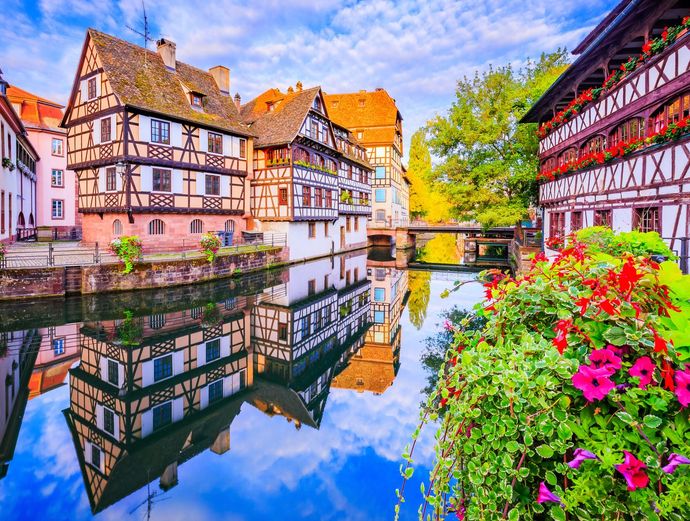
La Petite France is the old waterside quarter of Strasbourg, where the River Ill splits into channels around half-timbered houses, mills and locks on the edge of the city's historic center. People come to wander its lanes and footbridges, admire the houses reflected in the water and see one of the most picturesque corners of Alsace.For centuries this was the district of tanners, millers and fishermen, who depended on the fast-flowing river for their trades. Its curious name comes from a hospice built here in the late Middle Ages for people with syphilis, which German speakers then called the French disease, and the label stuck to the whole quarter. The tanners dried their hides in open lofts beneath the steep roofs, and the Maison des Tanneurs, one of the finest of their houses, still stands at the water's edge. The river also served the city's defense: the Ponts Couverts, bridges guarded by medieval towers, once carried wooden roofs, and in the 17th century the Barrage Vauban was built upstream so that the land south of the city could be flooded against an attacking army.The quarter's charm lies in its details: carved beams and flower boxes on houses that lean over the water, and swing bridges that pivot aside to let boats into the locks. Beyond the rooftops rises the spire of the cathedral, and the whole of the Grande Île, Petite France included, is a World Heritage site.Petite France shows how a district built for hard, smelly work became a favorite subject for painters and photographers, its old workshops turned into homes, restaurants and small hotels. A guide can tell the story of Strasbourg's defenses, from the medieval towers to Vauban's dam, and explain how the city changed hands between France and Germany over the centuries.
More #248
Lake Constance
If you are looking for things to do in Germany we have 5 Tours and Activities to Experience Lake Constance. Check out our verified traveler reviews and photos of Lake Constance tours and other things to do in Germany, and book securely when you find the perfect one. Learn the best ways to see famous Lake Constance and explore the most popular things to do in Germany.
More #249
Lake Misurina (Lago di Misurina)
Lake Misurina (Lago di Misurina) is a mountain lake in the Dolomites of northern Italy, close to Cortina d'Ampezzo in the far north of the Veneto. The largest natural lake in the Cadore area, it is loved for the jagged peaks mirrored in its calm water and for the easy path that circles it.The lake sits in a high mountain basin, fed and drained by the Ansiei stream, and it is surprisingly shallow, no more than about 5 meters deep. Meadows and conifer woods frame the shore, softening the rock walls beyond. To the south rises the long ridge of the Sorapiss, the spires of the Cadini di Misurina stand to the east, and Monte Cristallo closes the view to the west, so a short stroll brings a changing panorama of famous Dolomite summits.Like many places in the Dolomites, the lake has its legend, and it is a sad one. The story goes that the giant King Sorapiss doted on his willful daughter, Misurina, and agreed to become a mountain so she could win a magic mirror from the Queen of Monte Cristallo. When the girl slipped from his stony shoulders and fell, his tears filled the basin, and she is said to lie beneath the water still. Look across to the Sorapiss from the northern shore and the tale is easy to picture.The lake also has a place in sporting history. When the Winter Olympics came to Cortina d'Ampezzo in the middle of the 20th century, the speed skating races were held on its frozen surface, the last time Olympic skaters competed on natural ice. The mountain air is prized too: the grand hotel on the shore houses the only center in Italy devoted to treating asthma in children. The Italian singer Claudio Baglioni even wrote a song about the lake.
More #250
Lake Mummelsee
If you are looking for things to do in Germany we have 12 Tours and Activities to Experience Lake Mummelsee. Check out our verified traveler reviews and photos of Lake Mummelsee tours and other things to do in Germany, and book securely when you find the perfect one. Learn the best ways to see famous Lake Mummelsee and explore the most popular things to do in Germany.
More #251
Lake Titisee
If you are looking for things to do in Germany we have 8 Tours and Activities to Experience Lake Titisee. Check out our verified traveler reviews and photos of Lake Titisee tours and other things to do in Germany, and book securely when you find the perfect one. Learn the best ways to see famous Lake Titisee and explore the most popular things to do in Germany.
More #252
Lake Zurich (Zürichsee)
Lake Zurich, the Zürichsee, is a long, curving lake that reaches southeast from the city of Zurich between gentle green hills, with the Alps on the horizon on clear days. People come to stroll its shores, cruise past lakeside villages, vineyards and villas, and enjoy the calm that sits right at the edge of the country's largest city.The lake was carved by the Rhine-Linth glacier during the last ice age. Its main river, the Linth, enters at the eastern end through a channel dug in the early 19th century, while its outflow, the Limmat, runs through central Zurich on its way to the Aare and, eventually, the Rhine. People settled these shores very early: the remains of prehistoric pile dwellings lie underwater at several spots along the banks, part of a group of Alpine lake villages listed as a UNESCO World Heritage Site.Near Rapperswil, a causeway called the Seedamm carries road and rail across the narrowest point and divides the main lake from the quieter Obersee to the east, with a long wooden footbridge for walkers alongside. Rapperswil itself is a medieval town crowned by a castle, and nearby lie the small islands of Ufenau and Lützelau, where the humanist knight Ulrich von Hutten found refuge and died in the 16th century. The sunny eastern shore of the lower lake is nicknamed the Gold Coast for its wealthy villages and grand homes.Out on the water, the skyline of Zurich's church spires gives way to terraced vineyards, lakeside villas and small harbors, with the snowy peaks of central Switzerland rising beyond the far end. The water is clean enough that it is treated to supply the city's drinking water. In the coldest winters of the past the whole lake has frozen solid, an event locals call the Seegfrörni, and crowds poured out to walk across the ice. A guide adds the stories behind the towns you pass.
More #253
Lanxess Arena
Lanxess Arena is a large indoor arena in the Deutz district of Cologne, on the east bank of the Rhine. People go for concerts, ice hockey, handball and big esports finals, and its huge steel arch makes it an easy landmark to spot from across the river.It opened under the name Kölnarena and later took its present name from a sponsor. The architect Peter Böhm designed it around a steel arch rising more than 70 meters, which carries the roof and gives the building its unmistakable outline. From the far bank, the arch curves over the rooftops of Deutz like a giant handle. Inside, the bowl holds about 20,000 people for concerts, which gives a sold-out night real scale and energy.The arena is home to the Kölner Haie, the city's ice hockey team, and a game night offers a lively taste of local sporting passion. Beyond hockey, the program covers handball and basketball, concerts, comedy, musicals and esports. Handball carries special weight here, since the sport has a devoted following across Germany. Comedy nights and touring musicals draw a different crowd again, so the hall can feel like a new place from one week to the next. Counter-Strike fans know it as The Cathedral, a nickname that speaks to its standing as a great stage for competitive gaming.An evening here shows a modern side of a city better known for its Gothic cathedral and Roman roots. Its setting adds to the occasion, since Deutz has a riverside promenade with wide views across the water to the old town and the twin spires of the cathedral. A behind-the-scenes visit, when one is available, reveals the engineering of the arch and the work of switching the hall from one kind of event to the next.
More #254
Leaning Tower of Pisa
The Leaning Tower of Pisa is the freestanding bell tower of Pisa Cathedral, standing in the walled Piazza dei Miracoli in the Tuscan city of Pisa, Italy. Known around the world for its tilt, the white marble tower draws travelers to see the lean for themselves, climb its spiral stairs and take in the cathedral square around it.Work on the tower began in the 12th century, when Pisa was a wealthy maritime republic eager to display its power. The builders had only reached the third story when the tower began to sink into the soft, waterlogged ground on one side. Wars and money troubles then halted construction for close to a century, giving the soil time to settle and probably saving the tower from collapse. When building resumed, the masons tried to compensate by making the upper stories taller on the lower side, which is why the tower actually has a slight curve.The bell chamber was finally added in the 14th century, and the lean kept growing for hundreds of years afterward. By the late 20th century engineers feared it might fall, and the tower was closed for years while they carefully drew soil from beneath the higher side. The work reduced the tilt and stabilized the structure without erasing the lean that made it famous.Up close, the tower is a cylinder of stacked arcades, each ringed with slender columns, with seven bells hanging at the top. It shares the square with the cathedral, the round baptistery and the monumental cemetery, together a UNESCO World Heritage Site. Legend says Galileo, a native of Pisa, dropped weights from the top to test his ideas about falling bodies. A guide can show you the carvings, inscriptions and building quirks that most visitors walk straight past.
More #255
LEGOLAND® Discovery Centre Oberhausen
LEGOLAND® Discovery Centre Oberhausen is an indoor LEGO attraction for families inside the Westfield Centro shopping and leisure complex in Oberhausen, within easy reach of Düsseldorf. Children come to build, race and play among more than 4 million bricks, ride through a royal adventure, explore a pirate zone and see the Ruhr region recreated in miniature.The center began life in neighboring Duisburg and later moved to Centro, the big retail and entertainment district that grew up on former industrial land in Oberhausen. Inside, about 10 themed areas and rides are packed into one compact space, designed above all for younger children and the adults who come with them. Bricks are everywhere, in the models, the scenery and the piles waiting to be turned into something new.Miniland is the centerpiece for many families. Here, landmarks of the Ruhr area are rebuilt in LEGO bricks at small scale, rewarding a close look at the clever details. Elsewhere, the royal adventure ride takes riders on a quest through a brick kingdom, the racing zone lets kids build their own cars and put them to the test, and a magic carousel turns gently for the smallest visitors. A pirate play area offers room to climb and burn off energy, and the 4D cinema adds physical effects to short LEGO films.Part of the charm is that the visit never stays passive for long. Children move from riding to building to playing, and many leave with ideas for creations of their own at home. A cafe and a LEGO shop round out the center, and on selected evenings Adult Night events welcome grown-up fans who want to build and play without children in tow. For parents, the brick versions of local landmarks offer a playful introduction to the Ruhr region beyond the mall.
MoreDiscover Germany

Luxury & Special Occasions
Prices from $3
Tours & Sightseeing
Prices from $3
Cultural & Theme Tours
Prices from $3
Walking & Biking Tours
Prices from $3
Private & Custom Tours
Prices from $3
Food, Wine & Nightlife
Prices from $7
Day Trips & Excursions
Prices from $3
Holiday & Seasonal Tours
Prices from $3
Outdoor Activities
Prices from $3
Cruises, Sailing & Water Tours
Prices from $22
Shore Excursions
Prices from $26
Sightseeing Tickets & Passes
Prices from $5
Marienplatz
Prices from $3
Cologne Cathedral (Kölner Dom)
Prices from $3
Reichstag
Prices from $3
Odeonsplatz
Prices from $3
Brandenburg Gate (Brandenburger Tor)
Prices from $3
Memorial to the Murdered Jews of Europe (Holocaust Memorial)
Prices from $3
Dachau Concentration Camp Memorial Site
Prices from $44
Führerbunker
Prices from $4
Soviet War Memorial Tiergarten
Prices from $4
Topography of Terror
Prices from $4
Victuals Market (Viktualienmarkt)
Prices from $3
Cathedral of Our Blessed Lady (Frauenkirche)
Prices from $3


Germany Event Calendar
View all events
Christmas activities in Germany
Fri, Dec 25, 2026
Hanukkah in Germany
Dec 4–12, 2026
New Year’s Eve in Germany
Thu, Dec 31, 2026
Christmas Eve in Germany
Thu, Dec 24, 2026
New Year’s Day long weekend in Germany
Jan 1–3, 2027
Valentine's Day in Germany
Sun, Feb 14, 2027
Easter in Germany
Sun, Mar 28, 2027
Good Friday in Germany
Fri, Mar 26, 2027