Basel attractions
More things to do in the city
 #16
Lake Brienz (Brienzersee)
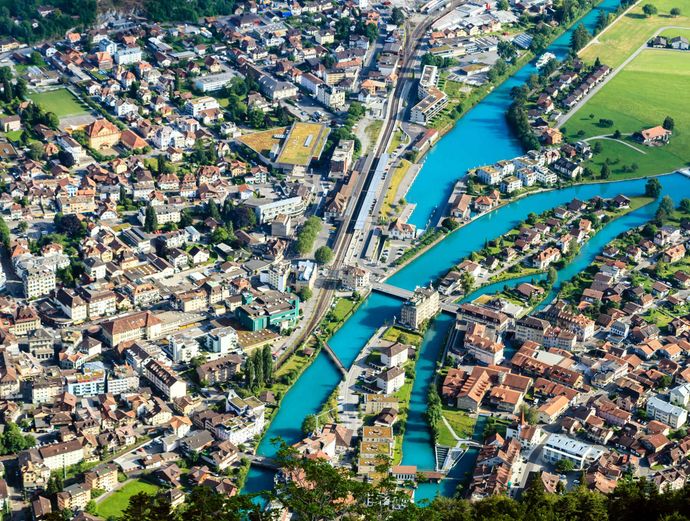
Lake Brienz is a slender Alpine lake in the Bernese Oberland, stretching east from Interlaken toward the village of Brienz. Its water glows a vivid turquoise against steep wooded mountainsides, and visitors come for boat trips, quiet lakeside villages, the woodcarving tradition of Brienz and the falls at Giessbach.The lake was carved by glaciers and is fed mainly by the Aare, which flows down from the glaciers near the Grimsel Pass, enters at Brienz and leaves at the western end to wind through Interlaken into Lake Thun. The Lütschine, carrying water from the valleys of Grindelwald and Lauterbrunnen, flows in near Bönigen. Fine rock flour carried by the meltwater hangs in the water and scatters the sunlight, which gives the lake its milky turquoise color.Across the water from Brienz, the Giessbach Falls tumble down the mountainside in a long staircase of cascades through the forest. In the 19th century a grand hotel rose beside them to receive the first wave of Alpine tourists, and its little funicular railway, among the oldest in Europe, has been hauling guests up from the lake ever since. A path leads behind one of the cascades, so you can look out through a curtain of falling water.Brienz itself is known across Switzerland for woodcarving, with a school that has trained carvers for generations, and for the steam cog railway that climbs to the summit of the Brienzer Rothorn. Nearby, the Ballenberg open-air museum gathers historic farmhouses from all over the country. On the southern shore, the small village of Iseltwald sits on a little peninsula, and its jetty became famous after appearing in a Korean television drama. A guide can name the peaks around the lake and share stories of the old lake steamers.
More #17
Lake Lucerne (Vierwaldstättersee)
If you are looking for things to do in Basel we have 88 Tours and Activities to Experience Lake Lucerne (Vierwaldstättersee). Check out our verified traveler reviews and photos of Lake Lucerne (Vierwaldstättersee) tours and other things to do in Basel, and book securely when you find the perfect one. Learn the best ways to see famous Lake Lucerne (Vierwaldstättersee) and explore the most popular things to do in Basel.
More #18
Lake Thun (Thunersee)
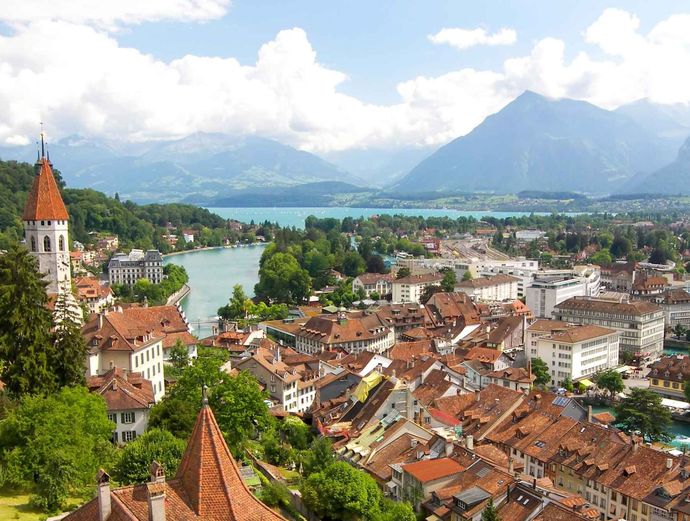
Lake Thun is a long Alpine lake in the Bernese Oberland of Switzerland, running between the medieval town of Thun and the resort of Interlaken beneath a ring of mountains. Its blue-green water, shoreline castles and views of snowy peaks draw people for boat trips, lakeside villages and walks along the water.The lake was shaped by glaciers during the last Ice Age and is fed by the Aare, which flows in from Lake Brienz through Interlaken. In the early 18th century engineers channeled the lively Kander River into the lake to keep the farmland around Thun dry, and the sediment it carried built a wide delta near Spiez. The shores have been settled since prehistoric times, and medieval lords raised strongholds along them to control trade and travel.Those castles are a big part of the appeal. Thun Castle, with its corner turrets, crowns the hill above the old town. Oberhofen Castle seems to rise straight from the water, its slender lake tower a favorite of photographers, while Spiez Castle guards a sheltered bay beside sloping vineyards. Schadau and Hünegg add 19th-century romance with their parkland gardens and lavish interiors.Above the north shore, the St. Beatus Caves wind deep into the cliffs, tied to the legend of an Irish monk who drove out a dragon and lived there as a hermit. Across the water rises the near-perfect pyramid of the Niesen, and on clear days the Eiger, Mönch and Jungfrau line the horizon. Historic paddle steamers still sail the lake, their polished brass and churning wheels a pleasure in themselves. A guide can link the castles, caves and villages into a single story of the lake and the families who ruled it.
More #19
Lake Titisee
If you are looking for things to do in Basel we have 8 Tours and Activities to Experience Lake Titisee. Check out our verified traveler reviews and photos of Lake Titisee tours and other things to do in Basel, and book securely when you find the perfect one. Learn the best ways to see famous Lake Titisee and explore the most popular things to do in Basel.
More #20
Lake Walen (Walensee)
Lake Walen, or the Walensee, is a long, deep lake in eastern Switzerland, set between the cantons of St. Gallen and Glarus with sheer mountain walls rising from its shores. People come to cruise its green-blue water, walk the lakeside paths and look up at the jagged Churfirsten peaks lining the northern side.The lake fills a narrow valley between the Appenzell Alps to the north and the Glarus Alps to the south, stretching from Weesen at its western tip to Walenstadt in the east. It plunges to more than 150 meters at its deepest point. Its name recalls an old frontier: in the early Middle Ages the lake marked the line between Germanic Alemanni to the west and Romansh-speaking people to the east, whom their neighbors called the Walhaz. In the early 19th century engineers tamed the Linth river, sending it into the lake and out again by canal toward Lake Zurich.The north shore is the dramatic side. The seven summits of the Churfirsten stand in a row like the teeth of a saw, their steep faces dropping toward the lake in pale limestone cliffs, and the Seerenbach Falls tumble down the rock nearby. Below them sits Quinten, a tiny village with no road, where vineyards climb the slope in a mild pocket of climate sheltered by the cliffs. The south shore is gentler, with the villages of Murg, Unterterzen and Mühlehorn strung along the water and the bulk of the Mürtschenstock rising behind them. From a boat in mid-lake you can take in both shores at once and see how abruptly the mountains meet the water.Lake Walen suits travelers who like their scenery quiet and on a grand scale, with paths, piers and small harbors rather than big resorts. A guide on the water or the trail can point out each Churfirsten peak by name and share the stories of the villages along the shore.
More #21
Lake Zurich (Zürichsee)
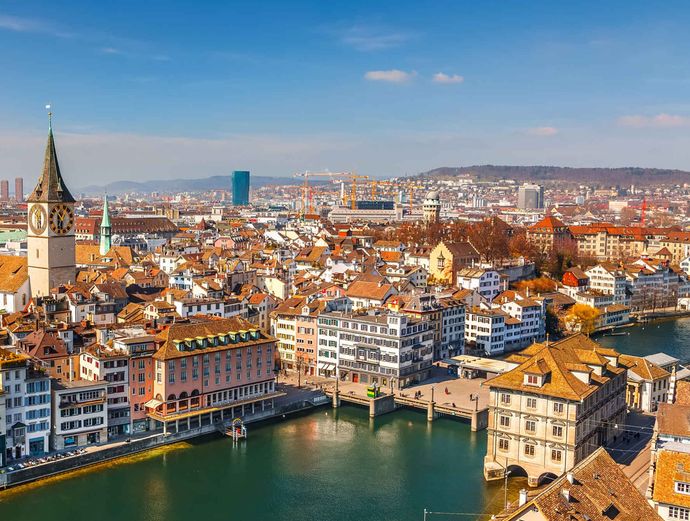
Lake Zurich, the Zürichsee, is a long, curving lake that reaches southeast from the city of Zurich between gentle green hills, with the Alps on the horizon on clear days. People come to stroll its shores, cruise past lakeside villages, vineyards and villas, and enjoy the calm that sits right at the edge of the country's largest city.The lake was carved by the Rhine-Linth glacier during the last ice age. Its main river, the Linth, enters at the eastern end through a channel dug in the early 19th century, while its outflow, the Limmat, runs through central Zurich on its way to the Aare and, eventually, the Rhine. People settled these shores very early: the remains of prehistoric pile dwellings lie underwater at several spots along the banks, part of a group of Alpine lake villages listed as a UNESCO World Heritage Site.Near Rapperswil, a causeway called the Seedamm carries road and rail across the narrowest point and divides the main lake from the quieter Obersee to the east, with a long wooden footbridge for walkers alongside. Rapperswil itself is a medieval town crowned by a castle, and nearby lie the small islands of Ufenau and Lützelau, where the humanist knight Ulrich von Hutten found refuge and died in the 16th century. The sunny eastern shore of the lower lake is nicknamed the Gold Coast for its wealthy villages and grand homes.Out on the water, the skyline of Zurich's church spires gives way to terraced vineyards, lakeside villas and small harbors, with the snowy peaks of central Switzerland rising beyond the far end. The water is clean enough that it is treated to supply the city's drinking water. In the coldest winters of the past the whole lake has frozen solid, an event locals call the Seegfrörni, and crowds poured out to walk across the ice. A guide adds the stories behind the towns you pass.
More #22
Lindt & Sprüngli Chocolate Shop
The Lindt & Sprüngli Chocolate Shop in Kilchberg is the flagship store at the Swiss chocolate maker's home on the shore of Lake Zurich. It sits within the Lindt Home of Chocolate, beside the company's factory and a museum about chocolate, and people come to shop, taste and learn how Swiss chocolate won its reputation around the world.The company brings together two old Swiss names. The Sprüngli family ran a confectionery in Zurich in the 19th century and moved into making chocolate, while in Bern Rodolphe Lindt developed conching, a slow mixing process that gave chocolate its smooth, melting texture. The two businesses joined forces late in that century, and Kilchberg became the home of the combined firm, where chocolate is still produced next door.The building that holds the shop was designed as a showcase for that history. At the center of its bright, tall atrium stands a towering chocolate fountain, with liquid chocolate pouring from a giant golden whisk into a bowl below. The shop is one of the largest Lindt stores anywhere, with long shelves of bars, pralines and seasonal gifts, and counters where you can fill a bag with your own mix of truffles in every color of wrapper.Beyond the shop, the museum follows cocoa from the farms where it grows to the factory, with rooms on the history of chocolate, the rise of the Swiss chocolatiers and the science of flavor, and a view of a working production line. Displays on packaging and advertising show how the brand presented itself over the generations. Many visitors leave with a new sense of how much care goes into a single bar. A guide can explain what separates one cocoa bean from another, which changes how you taste everything on the shelves.
More #23
Lion Monument (Löwendenkmal)
The Lion Monument in Lucerne is a dying lion carved into a sandstone cliff, a memorial to the Swiss Guards who fell in Paris during the French Revolution. It is among the best-known sights in Switzerland, admired for the sorrow the sculptor managed to draw from stone.In the late 18th century, revolutionaries stormed the Tuileries Palace, where the Swiss Guards served the French king, and hundreds of the guards died in the fighting or were killed after they surrendered. Karl Pfyffer von Altishofen, an officer of the regiment who was on leave in Lucerne at the time, later gathered funds for a memorial to his fallen comrades. The Danish sculptor Bertel Thorvaldsen created the design, and the stonemason Lukas Ahorn cut it into the wall of an old sandstone quarry in the early 19th century. Not everyone approved, as some Swiss objected to honoring men who had died for a foreign monarch.The lion, about ten meters long, lies with a broken spear in its side, one paw sheltering a shield with the fleur-de-lis of the French monarchy, and beside it rests a shield bearing the Swiss cross. Above it, the Latin words Helvetiorum Fidei ac Virtuti honor the loyalty and courage of the Swiss. Mark Twain judged it the saddest and most affecting carving in the world. Look closely at the face, which shows exhaustion more than rage, and at the way the body sags against the rock.Next door, the Glacier Garden shows deep potholes carved into the rock by ice-age meltwater, a reminder of a far older chapter in Lucerne's story. A guide can set the lion within the long history of Swiss soldiers serving foreign rulers, a tradition that lives on in the Swiss Guard at the Vatican.
More #24
Lucerne (Luzern)
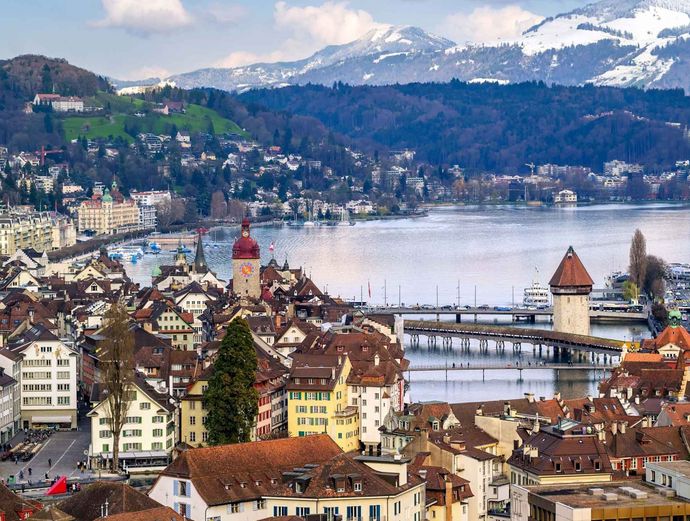
Lucerne is a lakeside city in central Switzerland, built where the Reuss River flows out of Lake Lucerne beneath a ring of mountains. Travelers come for its covered wooden bridges, a well-kept medieval old town and the way water, peaks and painted houses all fit into one small, walkable place.The town grew up around a Benedictine monastery and gained real importance once a trade route over the Gotthard Pass opened in the Middle Ages, putting Lucerne on the road between northern Europe and Italy. It joined the early Swiss Confederation in the 14th century and remained a Catholic stronghold through the Reformation, which explains its many church towers. The Hofkirche, with its slender twin spires, and the pale Jesuit Church on the riverbank are two of the finest. In the 19th century steamships and grand hotels turned Lucerne into one of the first great resort towns in Europe, and writers, royals and composers followed.The Chapel Bridge is the city's emblem, a timber walkway angled across the river with painted triangular panels under its roof showing scenes from local history and legend. A fire badly damaged it late in the 20th century, and much of what you walk on was rebuilt. Downstream, the smaller Spreuer Bridge carries a darker cycle of paintings on the Dance of Death. In the old town squares, house fronts are covered in murals, and the Musegg Wall still runs along the hill above with its row of watchtowers. The Lion Monument, a dying lion cut into a sandstone cliff, honors Swiss Guards killed defending the French king during the Revolution.Lucerne also has strong museums, including the large Swiss Museum of Transport and a private collection rich in Picasso and Paul Klee. A guide is good at finding the stories hidden in the bridge panels and facade paintings that most people pass without noticing.
More #25
Lucerne Old Town
If you are looking for things to do in Basel we have 34 Tours and Activities to Experience Lucerne Old Town. Check out our verified traveler reviews and photos of Lucerne Old Town tours and other things to do in Basel, and book securely when you find the perfect one. Learn the best ways to see famous Lucerne Old Town and explore the most popular things to do in Basel.
More #26
Mountaineers’ Cemetery
If you are looking for things to do in Basel we have 7 Tours and Activities to Experience Mountaineers’ Cemetery. Check out our verified traveler reviews and photos of Mountaineers’ Cemetery tours and other things to do in Basel, and book securely when you find the perfect one. Learn the best ways to see famous Mountaineers’ Cemetery and explore the most popular things to do in Basel.
More #27
Mt. Pilatus
Mt. Pilatus is the craggy mountain that rises above Lucerne in Central Switzerland, with its highest point, the Tomlishorn, at more than 2,100 meters. People go up for the wide views over Lake Lucerne and the Alps, the summit walks and the ride on what is described as the steepest cogwheel railway in the world.The mountain has long attracted stories. One legend held that the body of Pontius Pilate was buried in a small lake on its slopes and that disturbing it would bring foul weather, so climbing was once restricted. Others told of dragons living in its caves, and the dragon remains the mountain's emblem. The name may also come from a Latin word for capped, a fitting description of a peak that often wears a cap of cloud. Tourism took hold in the 19th century, and the cogwheel line from Alpnachstad opened in the late 19th century, an engineering feat that still uses a special rack design to climb gradients that would defeat an ordinary train. Gondolas and an aerial cableway from Kriens, including the cable car called the Dragon Ride, later added a second way up.At the top, the Pilatus Kulm area has viewing terraces, a historic hotel and restaurants clustered around the stations. Short paths lead to the Esel, a rocky peak just above the station with a broad panorama, and along the ridge toward the Tomlishorn, where on a clear day the view runs from the lakes of Central Switzerland to snowcapped ranges in the distance. Tunnels and galleries in the rock lead to lookouts, and alpine choughs often wheel around the terraces. The ride itself is part of the appeal, whether the train edges up through forest and rock or the cabins glide over meadows.Pilatus is often part of a classic round trip by boat, rail and cable car. A guide adds the legends and the engineering story along the way.
More #28
Mt. Titlis
Mt. Titlis is a glacier-capped peak above the village of Engelberg in central Switzerland, and one of the easiest places in the Alps to stand among year-round snow. Travelers come for the ride up, the views across a sea of summits and the attractions built into the ice and rock near the top.The mountain rises to more than 3,200 meters on the border between the cantons of Obwalden and Bern, in the Uri Alps. Men from Engelberg probably made the first climb to the summit in the 18th century, in an age when few people climbed mountains for pleasure. A cable car reached the upper station at Klein Titlis more than half a century ago, opening the high glacier to people who had never worn crampons. On clear days the summit looks out across the Bernese Alps and, to the north, toward the lakes of central Switzerland.The final stretch is made in the Rotair, the first cable car in the world whose cabin turns a full circle as it climbs, so every passenger sees the glacier, the crevasses and the cliffs below. At the top, the Cliff Walk, opened early in the 21st century, is billed as the highest suspension bridge in Europe, a narrow span strung along a sheer rock face above a drop that makes many people grip the rails.Inside the glacier, an illuminated cave leads through tunnels of blue-white ice, and in summer the snowfield outside becomes a playground for tubing and sledding. The Titlis Glacier covering the northern side has shrunk sharply over the past century, which gives a visit an added weight. Down in the valley, Engelberg's Benedictine monastery has stood since the Middle Ages, and the village grew up around it. A guide can name the peaks on the horizon and explain how the ice has changed.
More #29
Pilatus Railways (Pilatus Bahnen)
The Pilatus Railway is the cogwheel line that climbs from Alpnachstad, on the shore of Lake Alpnach, to the summit of Mount Pilatus above Lucerne. It is known as the steepest cogwheel railway in the world, and people ride it for the climb itself and for the wide views over Central Switzerland waiting at the top.The line opened in the late 19th century, when Swiss engineers were finding ways to bring trains high into the mountains. The slope of Pilatus was too sheer for an ordinary rack, so the engineer Eduard Locher designed his own system, with two horizontal cogwheels gripping a central rack from either side so the train stays locked to the track. No other railway adopted the design, and it still carries every train up the mountain. The first cars ran on steam, electric railcars took over in the first half of the 20th century, and their red bodies have become part of the mountain's look.The route starts among meadows and forest, then crosses bare rock and slips through short tunnels cut into the cliffs while the lake drops away below. At the top, Pilatus Kulm has two hotels, open terraces and short paths to the neighboring peaks. The Dragon Path is a gallery tunneled through the rock with windows looking straight out over the drop, and on clear days the view runs across Lake Lucerne, the Swiss Plateau and a long line of snowy Alpine summits.Pilatus has always been a mountain of stories. Medieval locals believed dragons lived in its caves, and an old legend held that the restless ghost of Pontius Pilate haunted a small lake on its slopes, which may explain the name. A guide can point out the peaks one by one and fill in the legends that the summit signs only hint at.
More #30
Rhine Falls (Rheinfall)
The Rhine Falls, or Rheinfall, is a broad, roaring waterfall on the High Rhine at Neuhausen am Rheinfall in northern Switzerland, just outside Schaffhausen. Counted among the most powerful waterfalls in Europe, it draws visitors who want to feel the spray, hear the thunder and watch the whole river crash over a wide rock ledge.The falls are young in geological terms. They formed in the last ice age, when glaciers and their debris pushed the Rhine out of its old bed and onto a new course across a band of hard limestone. Softer gravel wore away, but the limestone held, creating the step the river still pours over. A few large rocks stand in the middle of the falls, worn by the current yet still in place, and the tallest, topped with a Swiss flag, has become the symbol of the site.People have been drawn here for centuries. Above the south bank stands Laufen Castle, a medieval stronghold with paths and balconies leading down close to the water, while on the north side the little Schlössli Wörth sits beside the calmer basin below the falls. In the age of Romanticism, writers and painters came to capture the scene, among them Goethe and the English painter J. M. W. Turner, who painted the falls more than once. Their pictures and descriptions helped make the falls a regular stop on the European grand tour.Just upstream, a stone railway bridge from the 19th century crosses the river, and trains rumble over it within sight of the cascade. The falls are also a favorite gathering place on Switzerland's national day, when fireworks over the water draw large crowds. A guide can explain the geology and the old stories that cling to this stretch of the river.
More #31
Titlis Cliff Walk
The Titlis Cliff Walk is a narrow suspension bridge strung along the rock face just below the summit of Mount Titlis, high above the resort town of Engelberg in Central Switzerland. Billed as the highest suspension bridge in Europe, it offers a short, thrilling crossing over a deep drop, with glaciers and Alpine peaks in view on every side.Mount Titlis towers over the Engelberg valley, a place known first for its Benedictine monastery, founded in the Middle Ages, and later for mountain tourism. Cableways began carrying visitors up the slopes early in the 20th century, and the bridge was built to mark a hundred years of mountain transport on Titlis. Engineers anchored it to the cliffs so that it hangs out over open air, linking the summit station with a lookout on the far side of a rocky gap.Getting there is part of the experience. The final stage of the ride uses the Rotair, the first revolving cable car in the world, whose cabin turns slowly as it climbs so that everyone on board sees the whole panorama of ice, rock and valley. At the top, snow lies on the ground even in the warm months.Out on the bridge, the walkway hangs from steel cables and moves gently underfoot, especially when the wind picks up. Looking down, you see the glacier spilling away far below, and on clear days the view stretches across a sea of peaks toward the Bernese Alps. The crossing ends at a passage leading into the glacier cave, a tunnel cut into the ice where the walls glow blue. Nearby, a chairlift floats over crevasses on the glacier, and a snow park offers tubing and sledding. A guide fills in the stories of the monastery, the early mountain railways and the peaks on the skyline.
More #32
Zermatt Mountain Railways (Zermatt Bergbahen)
If you are looking for things to do in Basel we have 5 Tours and Activities to Experience Zermatt Mountain Railways (Zermatt Bergbahen). Check out our verified traveler reviews and photos of Zermatt Mountain Railways (Zermatt Bergbahen) tours and other things to do in Basel, and book securely when you find the perfect one. Learn the best ways to see famous Zermatt Mountain Railways (Zermatt Bergbahen) and explore the most popular things to do in Basel.
More #33
Zurich Old Town (Altstadt)
Zurich Old Town, the Altstadt, is the historic center of Switzerland's largest city, spread across both banks of the Limmat River where it leaves Lake Zurich. Travelers come for its twin-towered minster, painted guild houses and steep lanes, where Roman beginnings, medieval trade and the Reformation have all left their mark.The story begins on the Lindenhof, a small hill on the left bank where the Romans kept a customs post and later a fort, and their name for the settlement, Turicum, lives on in Zurich. In the Middle Ages the town grew rich on trade and came to be governed by its craft guilds, whose handsome meeting houses still stand along the Limmat. Early in the 16th century the priest Huldrych Zwingli began the Swiss Reformation from the pulpit of the Grossmünster, stripping the churches of images and shaping the sober, hardworking spirit the city is still known for.The Grossmünster's twin towers mark the skyline, and legend credits Charlemagne with founding the church over the graves of Felix and Regula, the city's patron saints. Across the river, the Fraumünster, founded for a convent of noblewomen in the 9th century, glows with stained-glass windows by Marc Chagall, and nearby St. Peter's has one of the largest church clock faces in Europe. On the right bank, the Niederdorf is a tangle of lanes full of small shops and bars, and its Spiegelgasse housed both Lenin during his exile and the Cabaret Voltaire, where the Dada art movement was born.Look up as you walk, since lanes such as Augustinergasse are lined with painted wooden oriel windows, and many houses carry names and signs from centuries past. Beside the water, the Baroque town hall stands on foundations in the river itself. From the bridges the view runs up the Limmat to the lake and the distant Alps.
MoreDiscover Basel

Cruises, Sailing & Water Tours
Prices from $292
Cultural & Theme Tours
Prices from $4
Day Trips & Excursions
Prices from $108
Food, Wine & Nightlife
Prices from $30
Holiday & Seasonal Tours
Prices from $34
Luxury & Special Occasions
Prices from $6
Outdoor Activities
Prices from $6
Private & Custom Tours
Prices from $6
Shore Excursions
Prices from $24
Tours & Sightseeing
Prices from $4
Transfers & Ground Transport
Prices from $38
Walking & Biking Tours
Prices from $4
Aare Gorge
Prices from $333
Aare River
Prices from $1,644
Appenzell
Prices from $645
Basel Minster (Basler Münster)
Prices from $6
Chapel Bridge (Kapellbrucke)
Prices from $337
Château du Haut-Koenigsbourg
Prices from $730
Culture and Congress Centre (KKL)
Prices from $337
Engelberg
Prices from $531
Gornergrat Railway (Gornergrat Bahn)
Prices from $639
Grimsel Pass
Prices from $1,644
Hofkirche
Prices from $337
Jungfrau
Prices from $767


Basel Event Calendar
View all events
Christmas activities in Basel
Fri, Dec 25, 2026
Hanukkah in Basel
Dec 4–12, 2026
New Year’s Eve in Basel
Thu, Dec 31, 2026
Christmas Eve in Basel
Thu, Dec 24, 2026
New Year’s Day long weekend in Basel
Jan 1–3, 2027
Valentine's Day in Basel
Sun, Feb 14, 2027
Easter in Basel
Sun, Mar 28, 2027
Good Friday in Basel
Fri, Mar 26, 2027