Frequently Asked Questions
The answers provided below are based on answers previously given to customers' questions.
#1The Academy is a working institution, and the interior is not usually open to the public, so most visitors admire the building from outside. A stop for photos and a look at the facade takes about 15 to 30 minutes. Statues of Athena and Apollo stand on tall columns by the entrance, and seated figures of Socrates and Plato flank the stairs. The exterior is reachable from Panepistimiou Avenue without steps, which suits wheelchairs and strollers. The University and the National Library stand right next door, so it pairs well with a short walk along the street.
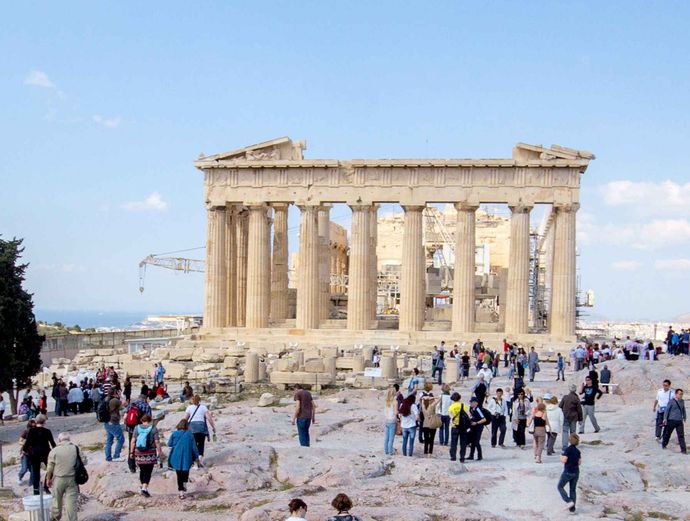
#2High-heeled shoes are prohibited at the Acropolis because they damage the marble, and fines and removal from the site are possible. Wear sturdy flat shoes, as the original marble paths are worn and can be slippery. Entry is by timed slot under a cap of 20,000 visitors a day, and walk-ups may be turned away or told to wait. A glass lift on the north slope serves visitors with disabilities, but it was out of service for repairs in 2025, so check its status before you go. Authorities recommend a hat, sun protection and lightweight clothing in summer.
#3The museum shows finds from the Acropolis slopes across three levels, with the Parthenon sculptures in a glass-walled hall on the top floor. Parts of the floors are glass, so you can see excavated ancient streets and houses below your feet. Bags are screened at the entrance, so travel light. A cafe and a shop are on the middle level if you want a break. Plan on about two hours, or longer if you like to read the labels.
#4Plan on about two hours to see the Temple of Hephaestus, the Stoa of Attalos museum and the scattered ruins. Shade is limited, so bring a hat, sun protection and water in the warmer months. Paths are uneven with gravel, slopes and steps, so wear sturdy shoes. The Stoa of Attalos museum is the most accessible part, with ramps, a lift and accessible toilets, while the Temple of Hephaestus is reached by steps. The site closes on a few public holidays, and the last entry is shortly before closing.
#5The arch is a single marble gateway, so most visitors spend only 10 to 20 minutes looking at it and taking photos. It stands beside busy Amalias Avenue, so watch for traffic when you cross to get a closer view. The shade is limited here, so bring water and a hat in summer. It pairs well with the nearby Temple of Olympian Zeus.
#6The canal is usually a short stop, with the main views from the high bridges and the viewpoint at the Isthmia end. The cut is about 6 km long and only about 25 m wide, with rock walls rising roughly 90 m. The submersible bridges sink only when a ship passes, so how much you see depends on the day's traffic. There are tavernas and cafes close to the bridges for food and drinks, but little shade, so bring sun protection.
#7The Erechtheion is reached through the Acropolis, so plan it as part of a wider visit of about two to three hours. Paths are uneven rock and worn stone, so wear sturdy shoes with good grip. The site is only partly accessible, and the lift for visitors with reduced mobility runs with trained staff and stops in strong wind or heavy weather. The six figures on the Caryatid Porch are copies, with most of the originals kept in the Acropolis Museum. Bring water and sun protection, since shade on the rock is limited.
#8
#9
#10
#11Sunday is the big flea market day, when sellers set out antiques and used goods; on other days the shops keep normal retail hours. Arrive early on Sunday, because the lanes become very crowded from late morning and cafe tables fill quickly. Carry only the cash and card you need and keep valuables secure, especially in the metro station and in dense crowds. The square sits next to the Roman Agora and Hadrian's Library, so it is easy to add an ancient site to a shopping stop.
#12The summit is 277 meters above sea level, so allow one to two hours for the ride, the views and a walk around the top. The funicular runs inside a tunnel and the ride takes about three minutes. Walking up means steps and uneven paths, so wear sturdy shoes and bring water in warm weather. The Chapel of St. George is an active church, so dress modestly if you go inside. A restaurant and an open-air theatre are near the top, so you can plan a meal or an evening around the visit.
#13National History Museum (Ethnikó Istorikó Mouseío)
#14The building at Panepistimiou 32 is the Vallianeio Megaron, a neoclassical marble landmark designed by Theophil Hansen, and many visitors come mainly for the architecture. It is one of the three neoclassical buildings known as the Trilogy, with the Academy of Athens and the original university building nearby. The Vallianeio now holds the newspaper collection and an information point for library services. The main library has moved to the Stavros Niarchos Foundation Cultural Center in Kallithea, so check which site you want before setting out. A short visit is enough, and the building pairs well with a walk past its two neighbors.
#15The Odeon seats about 5,000 people on stone and marble tiers, so wear shoes with good grip. It suits history lovers, music fans and anyone building an Acropolis area day around the sights nearby. A non-slip wooden ramp runs from the artists' entrance to the first row of seats, and there is an accessible restroom. Performances are held after dark in the open air, so bring a light layer for the evening.
The answers provided below are based on answers previously given to customers' questions.