Frequently Asked Questions
The answers provided below are based on answers previously given to customers' questions.
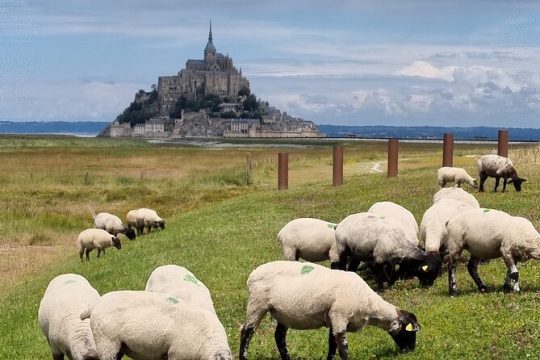
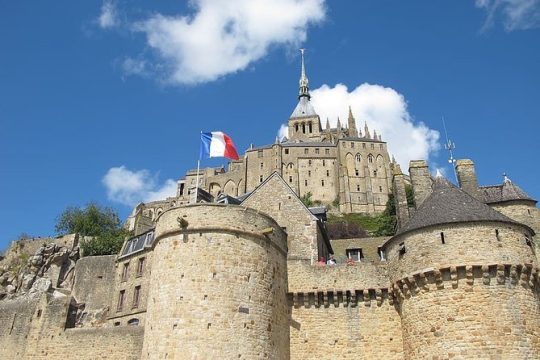
Mont-St-Michel rises from the tidal flats on the border of Normandy and Brittany, a granite island crowned by a Gothic abbey and ringed by medieval walls. It is one of the most recognizable sights in France, and it anchors a corner of Normandy that also holds the D-Day landing beaches. Tours from here and from the nearby ports often pair the two: a morning in the abbey's halls and cloister, or a long day along the coast where Allied troops came ashore. Guides are highly rated, and many tours are private, so you can travel at your own pace.
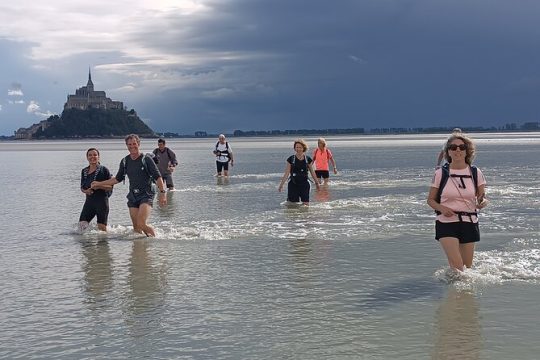
The island is reached by a footbridge across the bay, and from there a single main street climbs past old houses, shops and restaurants to the abbey at the top. The village below the abbey is busy by midday, so arriving early pays off. Inside, you walk through the church, the refectory and the cloister that seems to hang in the sky above the sand. The tides here are among the strongest in Europe, and at low tide guided walks cross the flats on foot. Make the crossing with a guide, who knows the sands and the timing of the tides.
The beaches of the Allied landings are the other great draw, and the tours that cover them are serious, moving days. American sectors include Utah Beach and Omaha Beach, the cliffs of Pointe du Hoc that Rangers scaled under fire, and Sainte-Mere-Eglise, where paratroopers landed and the Airborne Museum tells their story. The Normandy American Cemetery and Memorial sits above Omaha Beach in rows of white crosses. Further east, the Juno Beach Centre and the Bény-sur-Mer Canadian War Cemetery honor Canada's role, and the remains of the Mulberry Harbour still lie offshore at Arromanches. The Bayeux War Cemetery is the largest British cemetery of the war in France.
A knowledgeable guide makes these sites readable, linking the ground to the stories of the men who fought there. Private tours let families focus on a particular unit or relative, and many guides will help trace a name on a memorial or headstone.
Cherbourg is a regular cruise stop, and about a third of the tours here are built for passengers, with port transfers and shore excursions timed to the ship. These return in good time for sailing, which takes the worry out of a long day ashore.
This is a destination for long outings. About half of tours are full-day trips, and nearly all depart in the morning, so expect early starts. A smaller share run two to four hours, usually the abbey on its own. Pickup is offered on about a quarter of tours, helpful if you are staying in Bayeux or arriving by ship.
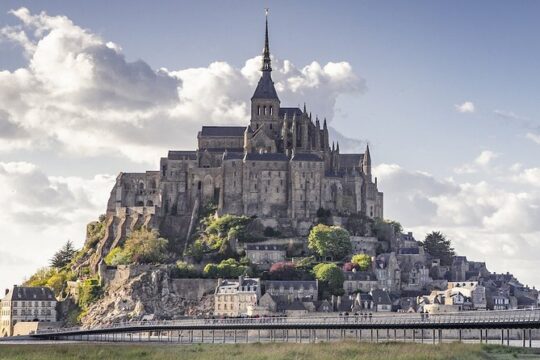
#1Mont Saint-Michel is a rocky tidal island off the coast of Normandy in northern France, crowned by a medieval abbey and wrapped in a small walled village. Rising from the wide sands of its bay, it is one of the most recognizable sights in Europe, and travelers come for the abbey, the village lanes and the views.According to tradition, the story begins early in the eighth century, when the Archangel Michael appeared to Aubert, Bishop of Avranches, and asked him to build a sanctuary on the rock. A small church came first, and in the tenth century Benedictine monks settled here. Over the following centuries they built higher and higher, stacking churches, halls and cloisters on the granite until the abbey seemed to grow out of the mount itself.The island was also a fortress. During the Hundred Years' War its ramparts held out against English attacks, and the mount became a symbol of French resistance. After the French Revolution the monks were driven out and the abbey became a prison until the 19th century, when writers and public campaigns helped restore it as a monument. Together with its bay it is listed as a UNESCO World Heritage Site.A single main street winds up through the village, lined with old houses, small museums and the parish church of Saint-Pierre. At the top, the abbey church crowns the rock, and its spire carries a gilded statue of Saint Michael. Next to it stands the Gothic cluster of buildings known as La Merveille, the marvel, with a cloister of slender columns that seems to hang in the air and a refectory filled with soft light. From the ramparts the bay stretches toward Brittany and Normandy. A guide can share the legends and history that the walls alone keep silent.
More
#2The Airborne Museum in Sainte-Mère-Église, a small Normandy town, is devoted to the American soldiers who parachuted and glided in during the dark hours before the D-Day beach landings. Visitors come to see a real wartime glider and transport plane and to relive that night through displays that put them in the boots of the paratroopers.The town's fame rests partly on a single image. During the drop, the parachute of John Steele, an American paratrooper, snagged on the church tower, leaving him dangling above the square as fighting broke out below. That same night a house near the square was on fire, and townspeople fighting the blaze watched soldiers drift down through the glow, a scene retold in the film The Longest Day. By dawn the town was in American hands, and it is often called one of the first in France to be liberated.The museum opened two decades after D-Day, funded by donations from residents and veterans, and its first building, shaped like a parachute, stands on the site of that burning house. Inside rests a Waco glider, said to be the only original one in France, of the type that carried troops into Normandy. A second hall, also shaped like a parachute, holds a Douglas C-47 transport plane that took part in the airdrops. An American veteran, Philippe Jutras, later served as its volunteer curator for three decades and helped turn it into one of Normandy's leading historical sites.The newest building, devoted to Operation Neptune, seats visitors aboard a C-47 for the jump and then leads them through the street fighting, the flooded marshes, the bridges and the hedgerows. The collection of more than 10,000 items includes gear used by the airborne generals and John Steele's own medals. A guide can add the personal accounts of the men who landed here, which give the objects their human weight.
More
#3Most people see the embroidery on their own with commentary, following it from one end to the other. A guided walking tour of Bayeux adds the cathedral that kept it for centuries and the old town streets. Many visitors combine the tapestry with a guided day trip to the Normandy landing beaches and war museums, which are close by. The tapestry is actually an embroidery, nearly 70 meters long, so allow time to follow the story scene by scene. Some form of commentary helps a lot, since the tale of the Norman conquest runs through dozens of scenes. The museum is at 13 bis rue de Nesmond in Bayeux, and its opening arrangements can change, so check before you plan around it. Bayeux is small and walkable, so the cathedral and old streets fit into the same day.
More
#4Many visitors walk the cemetery on their own, reading the headstones and then crossing to the memorial that lists those with no known grave. A guided Normandy tour adds a lot here, because a guide can explain the Normandy campaign, point out individual stories among the graves and link the visit to the landing beaches, Arromanches and other nearby sites in one day. This is an active place of remembrance, so dress respectfully and keep your voice low as you walk between the headstones. Allow about an hour for the cemetery and for the Bayeux Memorial, which stands directly across the road. You cannot park in front of the cemetery, so use the large car park at the Battle of Normandy museum, about 300 meters away. Wheelchair access is possible through the main entrance and through a second entrance from the street to the left of the cemetery. The cemetery holds mainly Commonwealth graves from the Normandy campaign, along with several hundred German and other graves.
More
#5Bény-sur-Mer Canadian War Cemetery is a military cemetery in the Normandy countryside near Reviers, inland from Juno Beach and between Bayeux and Caen. It is the resting place of Canadian soldiers who died in the D-Day landings and the fighting that followed, and visitors come to pay their respects in a calm, carefully tended setting.On the morning of D-Day, the 3rd Canadian Infantry Division came ashore at Juno Beach, one of the five Allied landing beaches, and pushed inland under heavy fire. On D-Day alone, Canadian losses came to almost a thousand casualties, about 340 of them killed. In the weeks that followed, the division fought bitter battles to hold and widen the bridgehead on the way to Caen. Most of the men buried here fell in those first weeks, and the cemetery holds more than 2,000 headstones, along with the graves of a small number of airmen.The cemetery was laid out after the war by the Commonwealth War Graves Commission, with rows of white headstones set in lawns and flower beds and framed by pines and maples, the maples a quiet nod to Canada. At the entrance, registry buildings on either side have raised platforms that look out over the whole cemetery. A Cross of Sacrifice and a Stone of Remembrance stand among the graves, as in other large Commonwealth war cemeteries.Walking the rows, you read the names, ages and regimental badges of young men from every part of Canada, many with personal inscriptions chosen by their families. Among them lie several pairs of brothers. The people of Reviers and their mayor take a special interest in the cemetery, keeping faith with the men buried in their countryside. A guide can share the stories behind particular graves and explain how each regiment fought its way inland.
More
#6On your own, you can walk the harbor, old town and Cite de la Mer in a day. Guided options add context, such as walking tours of the old town and port history. Cherbourg also sits near the D-Day beaches, so a guided day trip with a local expert who explains the landings is a popular way to connect the town with the Cotentin coast and the wider Normandy story. Cherbourg is a working port town, and the old town, harbor and Cite de la Mer are all within walking distance of each other. The Cite de la Mer sits in a former transatlantic terminal and holds an aquarium, a Titanic exhibit and the large submarine Le Redoutable. The Cite de la Mer has a free car park and restaurants on site that are open every day. Markets are held on Thursday and Saturday mornings at Place de Gaulle and on Sunday mornings on Avenue de Normandie. Sights outside the center, such as the Ravalet chateau gardens, are easier to reach by car.
More
#7If you are looking for things to do in Mont-St-Michel we have 2 Tours and Activities to Experience D-Day Experience & Dead Man's Corner Museum. Check out our verified traveler reviews and photos of D-Day Experience & Dead Man's Corner Museum tours and other things to do in Mont-St-Michel, and book securely when you find the perfect one. Learn the best ways to see famous D-Day Experience & Dead Man's Corner Museum and explore the most popular things to do in Mont-St-Michel.
More
#8The Juno Beach Centre is a museum of Canada's part in the Second World War, standing on the seafront at Courseulles-sur-Mer in Normandy, where Canadian troops landed on D-Day. Visitors come to learn how a nation far from Europe joined the fight, and to see the beach and German defenses that its soldiers faced that morning.The center exists because of the veterans themselves. Garth Webb, who had landed in Normandy with the Canadian forces, led a campaign to give Canada its own museum on the D-Day beaches, and volunteers and donors across the country helped raise the money to build it beside the shore where his comrades fought. The angular building is said to echo the shape of a maple leaf, and outside stands an inukshuk, a traditional Inuit stone figure built by Peter Irniq.Inside, the galleries trace Canada's war from the lean years before it began, through the mobilization of a small population and the work of the home front, to the landings and the long campaign across Europe that ended in liberation. Personal stories run through the displays, keeping the focus on the men and women who served. Outside, Juno Park preserves remains of the Atlantic Wall, the chain of German bunkers and gun positions built to stop an invasion from the sea.Beyond the museum, the beach itself carries the story. From the dunes you can picture the steel obstacles, the rising tide and the open sand the assault waves had to cross under fire, and the little harbor town behind you was freed by Canadian soldiers on the day of the landings. A guide who leads you through the old bunkers can explain how the German positions worked and what the Canadians met when the ramps of their landing craft went down.
More
#9Le Havre Cruise Port is the cruise terminal of Le Havre, a major port city in Normandy where the Seine meets the English Channel. Passengers arrive at the doorway to a city rebuilt in bold concrete after the Second World War, now a UNESCO World Heritage Site, and to the Normandy coast beyond.Le Havre was founded in the 16th century by King Francis I as a new royal port, and it grew into one of France's busiest harbors. Its center was almost wiped out by bombing in the Second World War, and the architect Auguste Perret led the rebuilding. Perret used reinforced concrete and a regular grid to create wide avenues, open squares and buildings with clean, classical lines, and UNESCO later honored the result as a landmark of postwar planning.The Church of Saint Joseph, whose slender concrete tower glows inside with thousands of pieces of colored glass, rises over the center and serves as a memorial to the bombing's victims. Near the water, the MuMa art museum holds a major Impressionist collection, fitting for the city whose harbor Claude Monet painted in Impression, Sunrise, the work that gave the movement its name. Le Volcan, a cultural center designed by Oscar Niemeyer, adds sweeping white curves to the grid.Beyond the city lie the chalk cliffs of the Alabaster Coast and the old harbor towns that drew painters to this shore. The port itself is one of the largest in France, and giant container ships moving through the harbor are part of the city's character. A long pebble beach lines the western edge of the center, giving this working port a seaside side many visitors do not expect. A guide can explain Perret's ideas, which may look severe at first but reward a closer look.
More
#10Many visitors stroll the seafront and look out at the caissons on their own, then visit the D-Day museum and the 360-degree cinema. A guided tour explains how the floating harbor was built, towed across the Channel and assembled in days, which makes the remains much more meaningful. Full-day guided itineraries often combine Arromanches with the landing beaches and nearby cemeteries. The remains of the artificial harbor can be viewed from the beach and the seafront promenade. Plan about an hour for the viewpoints, or half a day if you add the museum and the 360-degree cinema. Tide times matter, because you can only walk out to the nearest concrete caisson when the tide is low. The beach is sand and shingle, so wear shoes with grip, and check the tide before you walk out. The town of Arromanches has cafes and restaurants along the seafront.
More
#11You can walk the grounds on your own and use the visitor center for background on the landings. A guided tour adds the human stories behind the graves and the Wall of the Missing. Many tours combine the cemetery with Omaha Beach, Pointe du Hoc and other landing sites in one day. Small-group and private tours usually start in Bayeux, and full-day trips run from Paris. This is a place of remembrance, so keep your voice low and follow the staff's guidance on respectful behavior. The grounds are large and mostly outdoors, so wear comfortable shoes and clothing that suits the weather. A staff member in the visitor center answers questions and helps relatives find graves and names on the memorial. The path from the cemetery down to the beach is closed, but public beach access is available nearby.
More
#12If you are looking for things to do in Mont-St-Michel we have 1 Tours and Activities to Experience Normandy Victory Museum. Check out our verified traveler reviews and photos of Normandy Victory Museum tours and other things to do in Mont-St-Michel, and book securely when you find the perfect one. Learn the best ways to see famous Normandy Victory Museum and explore the most popular things to do in Mont-St-Michel.
More
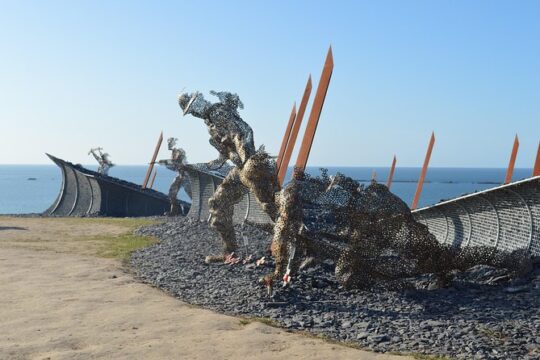
#13Omaha Beach is the stretch of Normandy coast near Bayeux where American troops came ashore on D-Day, the start of the Allied invasion of France during the Second World War. It is a wide sandy shore below grassy bluffs, and people come to understand the landings and honor the soldiers who died here.Omaha was the code name for one of five landing beaches along this coast. On the morning of the invasion, units of the American 1st and 29th Infantry Divisions waded in under heavy fire from German positions on the high ground. Rough seas, missed targets and well built defenses made it the costliest of the beaches, and for hours the outcome hung in doubt. Small groups of soldiers finally fought their way up the draws, the narrow valleys that cut through the bluffs, and by nightfall a foothold had been won.The shoreline links the villages of Vierville-sur-Mer, Saint-Laurent-sur-Mer and Colleville-sur-Mer. Concrete bunkers and gun emplacements still sit in the hillsides, and memorials to individual units stand near the sand. On the beach at Saint-Laurent, a tall steel sculpture called Les Braves rises from the shore in tribute to the men who landed. Above it all, the Normandy American Cemetery holds row upon row of white marble crosses and Stars of David facing the sea, with a memorial colonnade, a bronze statue of a young soldier reaching skyward and a garden wall carved with the names of the missing. Its visitor center tells the story through letters, objects and personal accounts.Walking the beach at low tide, it is hard to imagine the noise and chaos of that morning, which is part of its power. A guide can trace the routes up the bluffs and share the stories of the men who fought there.
More
#14Pegasus Bridge is the canal bridge near Ranville and Bénouville, between Caen and the sea, that British glider troops seized in the opening minutes of D-Day. The original bridge, a museum on the airborne landings and the little café that faced the fighting draw visitors interested in the Normandy campaign and the night it began.The plan was bold. The Allies needed the bridges over the Caen Canal and the nearby Orne River intact, both to protect the eastern edge of the beach landings and to let reinforcements cross. Shortly after midnight, gliders carrying men of the Oxfordshire and Buckinghamshire Light Infantry under Major John Howard came down in the dark just yards from the canal bridge. The troops stormed across, overwhelmed the guards and took both crossings within minutes, in what became the first action of the invasion.Lieutenant Den Brotheridge, who led the first platoon over, was fatally wounded and is remembered as one of the first Allied soldiers killed by enemy fire on D-Day. The men held on until paratroopers and then commandos reached them, the commandos famously arriving to the sound of bagpipes. The bridge was later renamed after the winged horse Pegasus, emblem of the British airborne forces, and the Gondrée family's café beside it is honored as one of the first houses in France to be liberated.When the old bridge grew too small for modern traffic in the late 20th century, a wider copy replaced it, and the original was moved to the grounds of the Mémorial Pegasus in Ranville. There you can walk up to the steel span itself, stand beside a full-size replica of a Horsa glider and see uniforms, weapons and personal objects from the operation. Markers in the field show where the gliders came to rest. A guide can add the personal stories of the men who flew in that night.
More
#15Pointe du Hoc is a wind-scoured headland on the Normandy coast where American Rangers scaled sheer cliffs on D-Day to knock out a German gun battery. Kept as a battlefield memorial, it still shows the shell craters and broken bunkers of that morning, and people come to stand where one of the boldest assaults of the landings took place.The Germans had fortified the point as part of the Atlantic Wall, with heavy guns that could reach both Utah and Omaha beaches, and Allied planners counted it among the gravest threats to the invasion. Before dawn, warships and bombers pounded the headland. Then Army Rangers under Lieutenant Colonel James Earl Rudder landed at the foot of the cliff and climbed ropes that rockets had carried up from their landing craft, while defenders shot and dropped grenades from above.At the top they found the gun positions empty. The guns had been moved inland, and patrols tracked them down in a sunken lane and wrecked them with thermite grenades. The Rangers then held the point against counterattacks for two days, cut off and short of ammunition, until relief arrived from Omaha Beach. Their losses were heavy, and the ground they defended was left much as the battle shaped it.Walking the site today means crossing a landscape of deep bomb craters, now softened by grass, and climbing over shattered concrete. Some bunkers can be entered, and a German observation post at the cliff edge carries the Ranger Monument, a tall granite pylon, with tablets honoring the men who made the climb. From the rim you look straight down at the narrow beach and out across the Channel. A guide can trace the assault step by step and point out where the ropes came over the edge.
MoreA day at Mont-St-Michel starts with the walk across the bay and a steady climb up one narrow lane of shops and stone houses to the abbey church and its cloister. Many travelers book a long private day that adds the D-Day coast, with Omaha Beach, Pointe du Hoc and the Normandy American Cemetery and Memorial.
Evening is the island's quiet side, when the day crowds leave and the light settles over the ramparts and sands.
It suits couples, families and history lovers, and private outings make it easy to set your own pace.
Summer brings long light, the warmest weather and the biggest crowds, and the lane up to the abbey is packed by late morning. Go early or late in the day.
Spring and early fall are calmer and often mild, good for walking the ramparts and the beaches. The highest tides, which turn the mount back into an island, tend to arrive around the equinoxes.
Winter is cool, damp and windy, but the island is quiet and the low sun over the bay can be lovely. Pack a warm, waterproof layer for these months.

The answers provided below are based on answers previously given to customers' questions.