Save Today Black Friday 13HRS 56MIN 10SEC Up to 20% off gift cards BLACK FRIDAY
GIFT CARD SAVINGS
$100 – $249SAVE 5% $250 – $499SAVE 10% $500 – $999SAVE 15% $1,000+SAVE 20% Shop gift cards Discount applied automatically at checkout. Each card keeps its full value.
Save Today Black Friday 13HRS 56MIN 10SEC
UP TO 20% OFF GIFT CARDS
$100–$249(save 5%) $250–$499(save 10%) $500–$999(save 15%) $1,000+(save 20%)
Shop gift cards Discount applied automatically at checkout. Each card keeps its full value.
Luzon

Cool things to do in Luzon

Welcome to Luzon

Luzon is the largest island of the Philippines and home to Manila, the capital, as well as volcanoes, waterfalls and rolling countryside within reach of the city. The outings you can book here combine old Spanish-era streets with day trips into the provinces to the south. About half are full days and others fill a morning or several hours, nearly all starting early and many including pickup from your hotel. Every trip is listed as suitable for children, so families can share the history lessons and the boat rides alike.

Manila's walled city

Intramuros is the old walled heart of Manila, laid out by the Spanish centuries ago and still lined with stone ramparts, cobbled lanes and horse-drawn carriages. Fort Santiago, at its northern tip by the Pasig River, holds a shrine to the national hero José Rizal and quiet gardens within its walls. Nearby, San Agustin Church and Museum is the oldest stone church in the country, with a painted ceiling and a cloister full of religious art. Casa Manila recreates the home of a wealthy family from the colonial period, with carved furniture and tiled floors. Some outings explore the area by bicycle, an easy way to cover the old streets in a few hours.

Parks, the bay and glass art

Beyond the walls, Rizal Park and Shrine is a broad green space where locals stroll, jog and gather, with a monument at its center. Roxas Boulevard runs along Manila Bay and is known for its sunsets over the water. Art lovers can visit Museo Orlina, devoted to the glass sculpture of a celebrated Filipino artist, which sits outside the city in Tagaytay. Museum tickets and passes make it simpler to fit several of these stops into a day.

Volcanoes and waterfalls in the south

Taal Volcano is one of the most striking sights within a day of Manila, a volcano sitting in a lake that fills an even older crater. Trips usually take you to the ridge at Tagaytay for the view, and conditions on the volcano itself can change, so follow local guidance on what is open. Pagsanjan Falls is reached by boat up a river gorge lined with cliffs and greenery, ending at a tall waterfall. Villa Escudero Plantations offers a slower day of coconut groves, a museum, cultural shows and a famous lunch served at the foot of a small waterfall, where you eat with the water running around your feet.

Planning your days

Because the bigger trips take a full day and city traffic can be slow, give each one its own day and keep evenings simple. Before booking, check:

  • Pickup time and how long the drive takes
  • Whether entry fees, boat rides or meals are included
  • Clothing that will get wet at the falls
  • Current access rules around the volcano

Over a thousand travelers have reviewed these outings, with most giving warm ratings for knowledgeable guides and well-run days. Pair a history day in Manila with a countryside trip, and you will see two very different sides of the island.

Read more
Top 10 attractions in Luzon
Casa Manila#1
4.8 (550)

Casa Manila

Casa Manila is a museum house in Intramuros, the old walled city of Manila, recreating the home of a well-to-do Filipino family during the final century of Spanish rule. Its furnished rooms, from a grand reception hall to a family chapel and a period kitchen, offer an intimate look at colonial home life.Intramuros was the seat of Spanish power in the Philippines for more than three centuries, but much of it was destroyed in the fighting at the end of the Second World War. Casa Manila belongs to a later effort to bring back the old city's character. Rather than restoring a surviving house, the builders created a reconstruction, modeled on a 19th-century residence that once stood on Calle Jaboneros, a street named for its soap makers, and filled it with period furniture and objects.The house follows the bahay na bato tradition, the classic town house of the colonial Philippines, with a sturdy stone ground floor and lighter wooden floors above, a design suited to earthquakes and tropical heat. Wide windows fitted with translucent capiz shell panes slide open to catch the breeze. You enter through a courtyard, pass a mezzanine office where the family's business was handled, and climb to the living quarters above.The main hall is the showpiece, with European furniture, sparkling chandeliers and a square grand piano that would have anchored evenings of music and conversation. Beyond it lie a private family chapel, bedrooms, a formal dining room and a kitchen equipped with the tools of a colonial household. Every room hints at how wealth, faith and hospitality shaped daily life for the families at the top of Manila society. Just across the street, San Agustin Church, the oldest stone church in the Philippines, completes the picture of the world they moved in.

More
Fort Santiago#2
4.8 (970)

Fort Santiago

Fort Santiago is a Spanish-era citadel in Intramuros, the old walled city of Manila, guarding the mouth of the Pasig River. Visitors come to walk its walls and gardens, peer into its dungeons and visit the shrine to José Rizal, the national hero who was imprisoned here before his execution.The fort was built by the Spanish governor Miguel López de Legazpi for the newly founded city and named after Saint James, Santiago in Spanish, the patron saint of Spain. Its stone walls stand about 22 feet high and run for about 620 meters, enclosing bastions, barracks, a chapel, a powder magazine and dungeons, with a moat outside. The British held it briefly, and under American rule the moats were drained and the grounds used as a golf course. In the Second World War, the fort was heavily damaged during the Battle of Manila, one of the most destructive urban battles of the conflict.Its most moving chapter belongs to José Rizal, the writer and reformer whose novels challenged Spanish rule in the Philippines. He spent his final days in a cell here, where he wrote his famous farewell poem, and a trail of bronze footprints follows his route out of the fort. The Rizal Shrine museum gathers his memorabilia, bringing the man behind the national symbol into sharper view. For many Filipinos, a visit here is a pilgrimage as much as a history lesson.The restored walls and gardens make a peaceful retreat in the old city, a striking contrast with the violence the site has seen. The main gate, carved with a relief of Saint James on horseback, makes a dramatic entrance, and the ramparts look out over the river. Few places in the Philippines hold so much of the nation's story within a single set of walls.

More
Intramuros#3
4.7 (970)

Intramuros

If you are looking for things to do in Luzon we have 2 Tours and Activities to Experience Intramuros. Check out our verified traveler reviews and photos of Intramuros tours and other things to do in Luzon, and book securely when you find the perfect one. Learn the best ways to see famous Intramuros and explore the most popular things to do in Luzon.

More
Museo Orlina#4
4.1 (50)

Museo Orlina

If you are looking for things to do in Luzon we have 1 Tours and Activities to Experience Museo Orlina. Check out our verified traveler reviews and photos of Museo Orlina tours and other things to do in Luzon, and book securely when you find the perfect one. Learn the best ways to see famous Museo Orlina and explore the most popular things to do in Luzon.

More
Pagsanjan Falls#5
4.7 (32)

Pagsanjan Falls

If you are looking for things to do in Luzon we have 1 Tours and Activities to Experience Pagsanjan Falls. Check out our verified traveler reviews and photos of Pagsanjan Falls tours and other things to do in Luzon, and book securely when you find the perfect one. Learn the best ways to see famous Pagsanjan Falls and explore the most popular things to do in Luzon.

More
Rizal Park and Shrine#6
4.7 (420)

Rizal Park and Shrine

If you are looking for things to do in Luzon we have 1 Tours and Activities to Experience Rizal Park and Shrine. Check out our verified traveler reviews and photos of Rizal Park and Shrine tours and other things to do in Luzon, and book securely when you find the perfect one. Learn the best ways to see famous Rizal Park and Shrine and explore the most popular things to do in Luzon.

More
Roxas Boulevard#7
4.6 (420)

Roxas Boulevard

If you are looking for things to do in Luzon we have 1 Tours and Activities to Experience Roxas Boulevard. Check out our verified traveler reviews and photos of Roxas Boulevard tours and other things to do in Luzon, and book securely when you find the perfect one. Learn the best ways to see famous Roxas Boulevard and explore the most popular things to do in Luzon.

More
San Agustin Church and Museum#8
4.8 (970)

San Agustin Church and Museum

San Agustin Church is a Baroque stone church in Intramuros, the old walled city of Manila, run by the Order of Saint Augustine and described as the oldest stone church in the Philippines. Visitors come for its painted ceiling, its carved interior and the museum in the monastery beside it, where famous Filipinos and Spaniards lie in the crypts.The Augustinian friars first built here in wood, but their early churches were lost to fire, and they turned to stone. The new church, designed by Juan Macias and raised from hewn adobe blocks in the Baroque style, has outlasted earthquakes and wars that leveled much of the old city around it. The neighboring monastery was not so lucky: destroyed in the Second World War, it was rebuilt as a museum. UNESCO includes the church among the Baroque Churches of the Philippines.Inside, trompe-l'oeil painting makes the flat ceiling appear richly carved, a trick of the eye that rewards anyone who stops to look up. The Baroque pulpit carries a carved pineapple, a tropical touch in a European style, and the choir holds a pipe organ and carved seats inlaid with ivory.The museum in the rebuilt monastery gathers religious art from the long history of the order in the islands. Beneath the convent, crypts hold figures from across Philippine history, among them Miguel López de Legazpi, the conquistador who founded Spanish Manila, and the painter Juan Luna, whose vast canvas Spoliarium ranks among the nation's treasures. The church's survival through fire, earthquake and war gives a visit real weight, since few buildings in Manila link the present so directly to the early Spanish era. Walking from the sunlit streets of Intramuros into its dim, cool nave feels like crossing several centuries in a few steps.

More
Taal Volcano#9
4.6 (50)

Taal Volcano

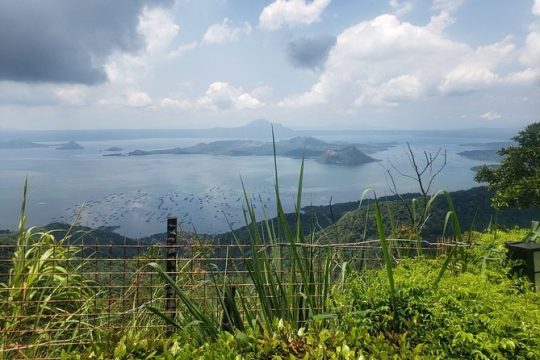
Taal Volcano is one of the most active volcanoes in the Philippines, set in Batangas province about 50 kilometers south of Manila. Its island rises from near the center of Taal Lake, a flooded caldera, and visitors come for the remarkable sight of a volcano inside a lake, seen from the ridges and shores around it.What looks like a single mountain is part of a much larger system. The lake fills a vast caldera shaped by ancient eruptions, and Volcano Island, near its center, covers more than 20 square kilometers dotted with dozens of craters and cones. On the island sits a crater lake of its own, and in it stands a small rocky islet called Vulcan Point, a curious nesting of island, lake, island and lake that geography fans love.Taal has a long and restless record, with many eruptions written into local history, and it is among the most closely watched volcanoes in the country. It is protected as a National Geological Monument and a national park, and the national volcano agency treats the island as a Permanent Danger Zone, so the volcano is admired from a respectful distance. That distance is part of the experience: from above, the whole story of the landscape lies open at once.The most popular viewpoints line the Tagaytay ridge, which follows the northern rim of the caldera high above the lake. From there the volcano island looks almost like a model, ringed by blue water, with the green slopes of the caldera wall falling away below. The cooler air and wide outlook have made Tagaytay a favorite escape from Manila, while lakeside towns such as Talisay offer a closer, water-level view of the island. A guide can explain how the caldera formed and how communities around the lake have lived with the volcano for generations.

More
Villa Escudero Plantations#10
4.7 (17)

Villa Escudero Plantations

Villa Escudero is a working coconut plantation and resort in Tiaong, Quezon, within a day trip of Manila on the island of Luzon. Visitors come for a taste of old provincial life: a museum of family treasures, carabao cart rides, bamboo rafts on a lagoon, lunch beside a waterfall and a lively show of Filipino music and dance.The estate belongs to the Escudero family, who founded it as a sugar cane plantation and later turned to coconut, the crop that still covers much of its land. It spreads over hundreds of hectares across the provinces of Laguna and Quezon. The family also had an inventive streak, building the first working hydroelectric plant in the Philippines at Labasin Dam. The plantation opened to visitors in the late 20th century, sharing its heritage with guests from Manila and beyond.The museum is a highlight, set in a pink building modeled on a Spanish colonial church. Inside, the family's collections fill its galleries with religious artifacts, porcelain, antique furniture and historical relics gathered over generations. The sheer variety is part of the charm, offering a window into the tastes of a landed Filipino family and into the country's layered colonial past. It can feel less like a formal museum than a family's attic opened to the public, with surprises around each corner.Beyond the museum, the estate becomes a gentle adventure. A carabao, the water buffalo that is the national animal of the Philippines, pulls visitors in carts through the coconut groves, and bamboo rafts drift across the lagoon. The best-known moment comes at lunch, served at tables set right at the foot of the falls below Labasin Dam. A live show of traditional Filipino dance and music rounds out the day. A guide adds stories of the family and of rural life on a Philippine plantation.

More

Good to know Luzon

Luzon trips swing between busy Metro Manila and the slower green countryside a few hours south. Most visitors base themselves in the capital, spend a morning in Intramuros or at Fort Santiago, and book guided days out to the falls and plantations.

Those longer outings mean early starts and plenty of road time, so evenings tend to be simple, with dinner near the hotel or a walk by the bay.

The island suits families, history fans and first-time visitors who would rather leave the driving and logistics to a guide.

December through February is the most pleasant time, with cool mornings and clear skies for walking the old city. These weeks are popular, so book day trips a few days ahead.

March to May stays dry but turns hot and sticky. Head out early, and save the hottest hours for museums, churches and shady courtyards.

From June to November the rains arrive, often as heavy afternoon downpours, and a longer wet spell can push plans back a day or two. Waterfalls run fullest then, though roads and boats are steadier in the dry months.

  • Most international flights land at Ninoy Aquino International Airport in Metro Manila, the main gateway.
  • Taxis and app-based rides are easiest in the city, and elevated rail lines skip some traffic.
  • Many day trips include hotel pickup, which spares you the long, congested drives out of the capital.
  • Allow extra time for anything with a fixed start, since traffic on the main roads is often slow.
  • Carry small bills, because change is hard to find once you leave the city.
  • Pack an umbrella, insect repellent and water sandals.
Luzon
Peak season Dec – Apr
Local Currency Philippine Peso (₱)
Weather now
Time Zone PST (-8)
Attractions 10
Tours 6
Reviews 1,069

Frequently Asked Questions

The answers provided below are based on answers previously given to customers' questions.

Activity name

Discover Luzon