Extended Today Black Friday 02HRS 25MIN 51SEC Up to 20% off gift cards BLACK FRIDAY
GIFT CARD SAVINGS
$100 – $249SAVE 5% $250 – $499SAVE 10% $500 – $999SAVE 15% $1,000+SAVE 20% Shop gift cards Discount applied automatically at checkout. Each card keeps its full value.
Black Friday
Extended Today Black Friday 02HRS 25MIN 51SEC
UP TO 20% OFF GIFT CARDS
$100–$249(save 5%) $250–$499(save 10%) $500–$999(save 15%) $1,000+(save 20%)
Shop gift cards Discount applied automatically at checkout. Each card keeps its full value.
Florence

Cool things to do in Florence

Welcome to Florence

Florence packs the Renaissance into a walkable riverside city, and the tours here reflect that: a vast choice of guided walks, museum visits, food outings and day trips into the Tuscan countryside. More than half can be booked privately, so you can see the Uffizi Galleries or the Accademia Gallery with a guide who focuses on what interests you. Most start in the morning, when the streets are cooler and the lines shorter, and lengths range from quick walks to full days in the hills or out to Pisa. Ratings average close to five stars over a huge number of reviews, so standards are high across the board.

Art, cathedrals and the historic core

The Florence Duomo fills Piazza del Duomo with Brunelleschi's great dome, its baptistery and bell tower, and it anchors almost every city walk. From there routes run through Piazza della Repubblica to Piazza della Signoria, where the Palazzo Vecchio rises over an open-air gallery of statues, then down to the jewelers' shops of the Ponte Vecchio on the Arno. Inside, the Uffizi Galleries hold masterpieces by Botticelli, Leonardo and Raphael, and the Accademia Gallery is home to Michelangelo's Statue of David. A guide helps you read the art and decide which rooms deserve your time.

Across the river to the Oltrarno

South of the Arno, the Pitti Palace houses more collections and opens onto the Boboli Gardens, a calmer place to spend a morning. Climb or ride up to Piazzale Michelangelo for the classic view back across the rooftops to the dome, which glows in late light. The Oltrarno's artisan workshops and smaller streets also suit evening food walks, and nearly a third of the tours here run after dark. Couples often save this side of the river for a slow last evening with dinner and a glass of Chianti.

Wine, Pisa and Tuscan day trips

About a quarter of the tours are full days. Popular directions include the Chianti hills for wine tasting at countryside estates, and west to the Leaning Tower of Pisa, with other Tuscan towns also within a day's drive. These days involve a fair amount of driving, so a small-group minivan or private driver makes them more comfortable. Wine tasting outings are best for adults, while families may prefer a shorter trip to Pisa with time to climb or simply photograph the tower. A handful of multi-day trips go further for travelers who want to see more of Italy.

Practical tips for Florence

  • Reserve timed museum entry for the Uffizi and the Accademia well ahead.
  • Cover shoulders and knees for visits inside the Duomo and other churches.
  • Check whether priority entry is included, as only a few tours offer it.
  • Read accessibility notes, since about a fifth of tours are wheelchair accessible.

More than half of the tours suit children, and short walks of two hours or less keep younger travelers engaged without wearing them out. Pick one big museum per day and fill the gaps with piazzas, gelato and the river.

Read more
Top 15 attractions in Florence
Accademia Gallery (Galleria dell'Accademia)#1
4.6 (38,388)

Accademia Gallery (Galleria dell'Accademia)

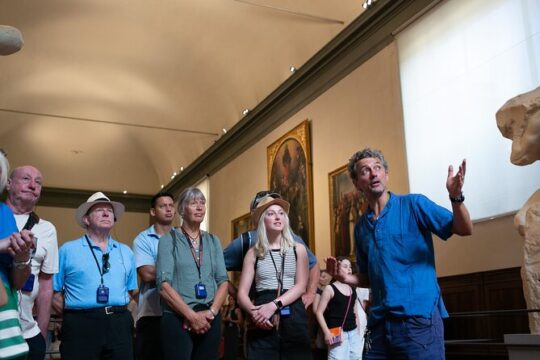
Reserved entry times are the usual way to see the gallery, since walk-up lines can be long. A guided tour takes you straight to Michelangelo's David and explains the unfinished Prisoners and the Florentine paintings around it, which makes a short visit richer. Small-group and private art tours often combine the gallery with the Duomo and Piazza San Marco on foot, so one morning covers several major sights. Allow one to two hours, or about 45 minutes if you only follow the core route to Michelangelo's David. There is no cloakroom, and large backpacks, helmets and luggage are not allowed inside. A metal detector at the entrance means a short security check when you arrive. Last entry is about half an hour before closing, so do not arrive late in the day. Besides David, the gallery holds Michelangelo's unfinished Prisoners, Florentine paintings and a collection of musical instruments.

More
Michelangelo's Statue of David (Il Davide di Michelangelo)#2
4.6 (38,388)

Michelangelo's Statue of David (Il Davide di Michelangelo)

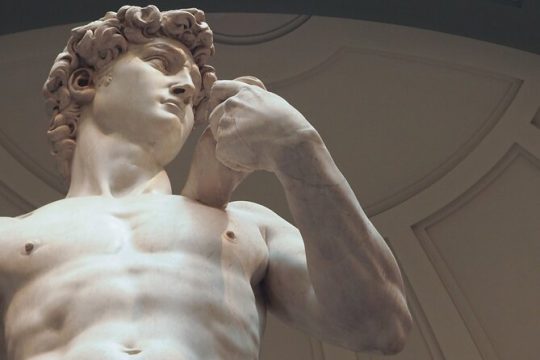
Michelangelo's David is the famous marble statue of the young biblical hero, displayed in the Galleria dell'Accademia in Florence. People travel from all over the world to stand before it, because few works of art capture the human body, and the spirit of the Renaissance, with such force and confidence.The story starts with a giant block of Carrara marble that had sat neglected for decades in the cathedral workshop after earlier sculptors gave up on it. In the early 16th century the young Michelangelo, then in his mid-twenties, took on the challenge and spent about three years carving it. When it was finished, Florentine leaders chose not to raise it high on the cathedral as planned. Instead they set it outside the Palazzo Vecchio, the seat of government, where it became a symbol of the small republic standing up to more powerful enemies. It stood in the open air for centuries until, in the 19th century, it was moved indoors to protect it, and a copy took its place on the square.Michelangelo shows David before the battle with Goliath rather than after it. He stands relaxed, weight on one leg, sling over his shoulder, but his brow is tense and his eyes are fixed on his enemy. Look closely at the veins in his hands, the twist of the torso and the slightly oversized head and hands, which were meant to read well from below. The statue stands under a skylit dome at the end of a long hall. Lining that hall are the Prisoners, rough figures that seem to struggle out of the stone, left unfinished for a pope's tomb. The gallery also holds gold-ground altarpieces, a room of plaster models and a collection of historic musical instruments.A guide explains how Michelangelo worked the stone and why the figure meant so much to the city.

More
Florence Duomo (Cattedrale di Santa Maria dei Fiori)#3
4.7 (31,622)

Florence Duomo (Cattedrale di Santa Maria dei Fiori)

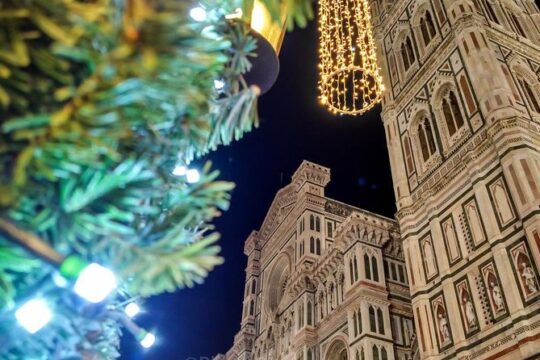
You can wander the piazza and step inside the cathedral on your own, but the dome, bell tower and baptistery each have separate entry, and timed slots for the dome are common. A guided visit helps you make sense of the complex's layers, and many tours combine the cathedral, baptistery and museum with the dome climb or add a walk through the historic center. Early morning entries tend to be calmer. Shoulders and knees must be covered for everyone, and hats and flip-flops are turned away at the door. Bulky bags and luggage are not allowed inside, so travel light. The cathedral is closed to visitors on Sundays and during religious celebrations. The dome, bell tower, baptistery and museum each have their own hours, separate from the cathedral. Allow extra time if you add the dome, bell tower or baptistery to your visit.

More
San Miniato al Monte#4
4.7 (9,313)

San Miniato al Monte

Many visitors walk up from Piazzale Michelangelo on their own and stay for the quiet view over Florence. A guided walking tour adds the story of the saint who, by legend, carried his own head uphill, and explains the marble facade, the mosaics and the Renaissance chapel. Some tours combine the church with Piazzale Michelangelo and a stroll back down into the Oltrarno. Shoulders and knees should be covered, as at other churches in Florence. Expect steep stairs and slopes on the walk up from Piazzale Michelangelo, so wear comfortable shoes. Highlights inside include the patterned marble floor, the apse mosaic, the crypt and the Chapel of the Cardinal of Portugal. It is an active church run by monks, who sell honey, herbal teas and liqueurs from a shop beside it.

More
Ponte Vecchio#5
4.8 (30,176)

Ponte Vecchio

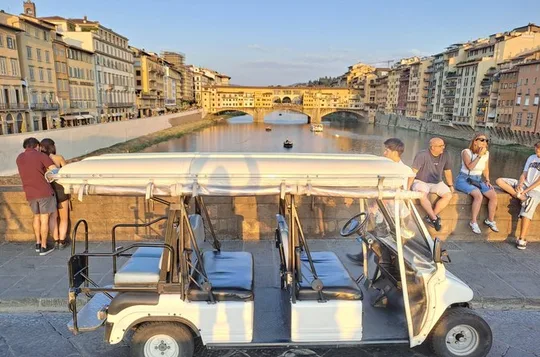
You can cross the bridge on your own in minutes, but a guided walking tour explains the goldsmith shops, the Medici history and the walkway above them. Many guided walks link the bridge with Piazza della Signoria, the Uffizi area and the Duomo. Others continue across the river to Palazzo Pitti and the Santo Spirito neighborhood, which makes a full half day. Vehicles are barred from the bridge, so you cross on foot, and the middle of the span is often crowded. Crossing takes only a few minutes, but allow about half an hour to browse the shops and look at the river. The shops are mostly jewelers and gold sellers, so the bridge suits window shopping more than a long stop. It links the Piazza della Signoria side with the Palazzo Pitti side, so it fits easily into a walk between the two.

More
Piazzale Michelangelo#6
4.7 (15,648)

Piazzale Michelangelo

You can walk up from the river, take a city bus or ride a taxi. A guided walking tour of the Oltrarno brings you through the artisan streets and up the stairs to the viewpoint, with context on the landmarks laid out below you. Evening tours time the visit for sunset and city lights, and some combine the square with the church of San Miniato al Monte just uphill. The square sits on a hill, and the climb on foot is steep, so allow extra time and wear comfortable shoes. A bronze copy of David stands in the center of the square, with a loggia on the terrace behind it. Tour buses stop here for photos, so the square can get very crowded. For sunset, arrive about an hour early to find a seat on the steps. Taxis are an option if you have limited mobility.

More
Ponte Santa Trinita#7
4.6 (6,465)

Ponte Santa Trinita

Crossing on your own takes minutes, but a guided walk gives the bridge its context: the Renaissance design, the Medici commission and the wartime rebuild. Walking tours of the historic center and the Oltrarno often cross here and pass the Santa Trinita church, Piazza Santa Trinita and Via de' Tornabuoni. A sunset stroll or a river-view tour fits well with a visit to Ponte Vecchio. This is a bridge you walk across rather than a ticketed site, and a visit can take as little as 15 to 30 minutes. Statues of the four Seasons stand at the ends of the bridge, which is built of local stone in three flat elliptical arches. The bridge looks toward Ponte Vecchio, which makes it a popular spot for photos of the Arno. It was destroyed in World War II and rebuilt as it was, with much of the original stone recovered. The bridge lies at the edge of the historic center, where private car traffic is restricted, so plan to arrive on foot.

More
Piazza della Signoria#8
4.8 (30,860)

Piazza della Signoria

You can wander the square freely, but a guided walk helps you read the sculptures, the Neptune fountain and the plaque marking Savonarola's execution. Guided visits of Palazzo Vecchio take you through its interior, decorated by Vasari, and timed entry helps on busy days. Walking tours often join the piazza with the Uffizi, the Duomo and Ponte Vecchio. The square is a restricted traffic zone reserved for pedestrians, so you can wander freely among the statues. The statue of David in front of Palazzo Vecchio is a copy, and the original is in the Accademia Gallery. The Loggia dei Lanzi is an open-arched sculpture gallery at the edge of the square, with works by Cellini and Giambologna. A historic café on the square's edge offers a place to sit and look at the palace.

More
Uffizi Galleries (Gallerie degli Uffizi)#9
4.7 (27,488)

Uffizi Galleries (Gallerie degli Uffizi)

The Uffizi Galleries in Florence hold one of the finest collections of Renaissance art anywhere, set in a grand palace beside Piazza della Signoria and the Arno River. Art lovers come to see Botticelli, Leonardo, Michelangelo, Raphael, Titian and Caravaggio, many of them gathered by the Medici family over centuries.The building was designed in the 16th century by Giorgio Vasari for Cosimo I de' Medici, Duke of Florence, to serve as the offices of the city's magistrates and guilds, which is where the name comes from. Vasari also built an elevated corridor that runs from the offices over the Ponte Vecchio to the Pitti Palace, so the duke could cross the city unseen. Cosimo's son Francesco I turned the top floor into a gallery for the family's treasures, including the octagonal Tribuna, a jewel box of a room. In the 18th century the last of the Medici line, Anna Maria Luisa, left the whole collection to Florence on condition that it never leave the city. Late in the 20th century a bomb exploded beside the building, damaging rooms and paintings, and the gallery was carefully repaired.Long corridors with painted ceilings and rows of ancient Roman statues link the rooms. Early highlights include altarpieces by Giotto and Cimabue, and the double portrait of the Duke and Duchess of Urbino by Piero della Francesca. The Botticelli rooms hold The Birth of Venus and Primavera, both rich in myth and symbolism. Leonardo's Annunciation hangs nearby, and Michelangelo's Doni Tondo is his only finished panel painting in Florence. Further on come Raphael, Titian's Venus of Urbino and the dramatic works of Caravaggio, including his painted shield with the head of Medusa. From the windows of the corridors, you look out over the river and the Ponte Vecchio.A guide helps you read the symbols and stories packed into the paintings.

More
Leaning Tower of Pisa#10
4.7 (53,489)

Leaning Tower of Pisa

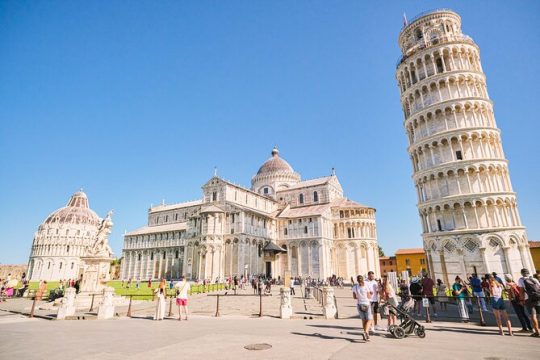
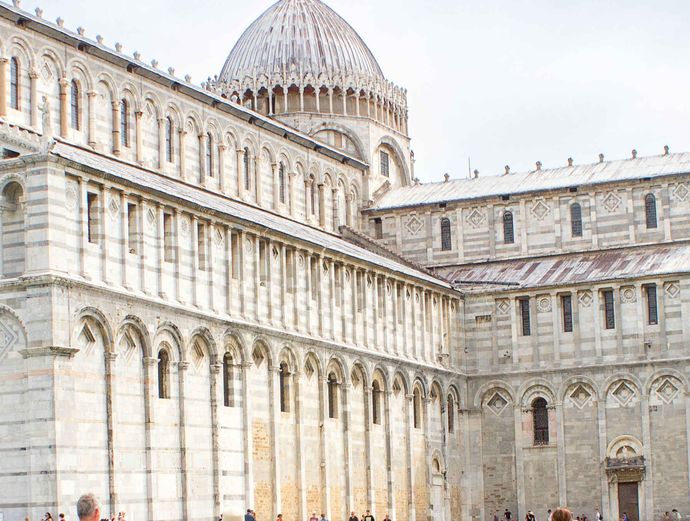
The Leaning Tower of Pisa is the freestanding bell tower of Pisa Cathedral, standing in the walled Piazza dei Miracoli in the Tuscan city of Pisa, Italy. Known around the world for its tilt, the white marble tower draws travelers to see the lean for themselves, climb its spiral stairs and take in the cathedral square around it.Work on the tower began in the 12th century, when Pisa was a wealthy maritime republic eager to display its power. The builders had only reached the third story when the tower began to sink into the soft, waterlogged ground on one side. Wars and money troubles then halted construction for close to a century, giving the soil time to settle and probably saving the tower from collapse. When building resumed, the masons tried to compensate by making the upper stories taller on the lower side, which is why the tower actually has a slight curve.The bell chamber was finally added in the 14th century, and the lean kept growing for hundreds of years afterward. By the late 20th century engineers feared it might fall, and the tower was closed for years while they carefully drew soil from beneath the higher side. The work reduced the tilt and stabilized the structure without erasing the lean that made it famous.Up close, the tower is a cylinder of stacked arcades, each ringed with slender columns, with seven bells hanging at the top. It shares the square with the cathedral, the round baptistery and the monumental cemetery, together a UNESCO World Heritage Site. Legend says Galileo, a native of Pisa, dropped weights from the top to test his ideas about falling bodies. A guide can show you the carvings, inscriptions and building quirks that most visitors walk straight past.

More
Piazza dei Miracoli#11
4.7 (49,813)

Piazza dei Miracoli

Piazza dei Miracoli is the walled green square in Pisa that holds the Leaning Tower, the cathedral, the baptistery and the monumental cemetery, a medieval ensemble listed as a World Heritage Site. People come to see the tower's famous tilt up close and to find that the buildings around it are just as remarkable.The square grew out of Pisa's golden age as a sea power, when the city spent its trading wealth and the spoils of a raid on Palermo on a grand religious center. Work on the cathedral began in the 11th century under the architect Buscheto, and over the next two centuries the round baptistery, the bell tower and the cloistered cemetery followed, all faced in white marble with bands of darker stone. The poet Gabriele D'Annunzio later called the lawn a meadow of miracles, and the name stuck.The bell tower began to lean while it was still being built, because the soft, wet ground beneath it gave way on one side. Construction stopped and started for nearly two centuries, and the builders tried to correct the tilt by making the upper floors taller on the sinking side. Engineers around the turn of the 21st century finally stabilized it by drawing soil out from under the high side. Legend also links the square to Galileo, a son of Pisa, who is said to have dropped weights from the tower and studied a swinging lamp in the cathedral.Inside the cathedral, look for the carved pulpit by Giovanni Pisano and the bronze doors, while the baptistery, the largest in Italy, has a pulpit by his father Nicola and an echo that guards show off by singing. The Camposanto keeps medieval frescoes, among them a vivid Triumph of Death, restored after a fire during the Second World War. A guide can explain how each building reflects the ambitions of the medieval republic.

More
Auditorium Santo Stefano al Ponte Vecchio#12
4.2 (573)

Auditorium Santo Stefano al Ponte Vecchio

The Auditorium Santo Stefano al Ponte Vecchio is a former church a few steps from the Ponte Vecchio in Florence that now serves as a concert hall. Its Romanesque walls and fine acoustics make it a memorable setting for classical music, opera and chamber concerts in the old heart of the city.Santo Stefano al Ponte dates to the 11th and 12th centuries, and its exterior was reworked in the 14th century. Of the original facade of colored marble, only the marble work framing the main portal survives, a hint of how bright the front once looked. Literary history was made here too: in the 14th century, Giovanni Boccaccio is recorded as lecturing on Dante's Divine Comedy inside these walls. It is a rare link between one building and two founding figures of Italian literature.The interior changed greatly in the 17th century, when the three aisles were opened into one broad hall, with a crypt and a choir added. Look for the staircase by Bernardo Buontalenti, architect to the Medici court, and the altar attributed to Giambologna, the sculptor whose statues grace the nearby Piazza della Signoria. Once the church was deconsecrated, that single hall proved well suited to music, and the building found a second life as an auditorium known for its acoustics.Hearing a string quartet or an aria under this old roof shows a quieter Florence than the crowds on the bridge outside. The sound fills the hall, soft light picks out the stone and carved details, and the long life of the building feels close at hand. A local guide can add the story of the streets around the Ponte Vecchio, much of which was destroyed in the Second World War and then rebuilt.

More
Dante House Museum (Museo Casa di Dante)#13
5.0 (1,141)

Dante House Museum (Museo Casa di Dante)

You can visit on your own and move through the rooms at your pace, using the displays to follow Dante's life and the city of his time. A guided visit adds context on the poet, the families of medieval Florence and the stories behind the exhibits, and it suits groups and families. The museum sits in the old center, so it combines well with a walking tour of Dante's Florence, the Duomo and nearby medieval streets. The museum suits adults and older children curious about Dante and medieval Florence, and it is a short visit that pairs easily with other sights nearby. Rooms use video mapping, immersive displays and virtual reality to bring Dante's life and his journey through the afterlife to the screen. The entrance has a slightly raised threshold and a lift serves most floors, but the loggia cannot be reached by wheelchair. The ticket office closes 30 minutes before the museum does, so arrive with time to spare.

More
Piazza della Repubblica#14
4.8 (8,201)

Piazza della Repubblica

If you are looking for things to do in Florence we have 20 Tours and Activities to Experience Piazza della Repubblica. Check out our verified traveler reviews and photos of Piazza della Repubblica tours and other things to do in Florence, and book securely when you find the perfect one. Learn the best ways to see famous Piazza della Repubblica and explore the most popular things to do in Florence.

More
Florence Baptistery (Battistero di San Giovanni)#15
4.9 (7,574)

Florence Baptistery (Battistero di San Giovanni)

The Florence Baptistery, the Battistero di San Giovanni, is the striking octagonal church of green and white marble that stands in front of the cathedral in the heart of Florence. It is one of the city's oldest buildings, and visitors come for its glittering mosaic ceiling and its gilded bronze doors, which helped launch the Renaissance.Dedicated to John the Baptist, the city's patron saint, the Baptistery took its present form in the 11th and 12th centuries, and medieval Florentines believed it had once been a Roman temple to Mars. Generations of Florentines were baptized here, including the poet Dante, who wrote fondly of his beautiful San Giovanni. Its crisp geometric facing of colored marble, framed by pilasters and arches, is a classic of the Florentine Romanesque style.The doors tell the story of Florentine art. Andrea Pisano cast the south doors in the 14th century. Then, at the start of the 15th century, the city held a competition for a second pair, and the young goldsmith Lorenzo Ghiberti beat Filippo Brunelleschi, who went on to build the cathedral's dome. Ghiberti spent decades on the north doors and then on the east doors facing the cathedral, whose gilded panels of Old Testament scenes use perspective so masterfully that Michelangelo is said to have called them the Gates of Paradise.Inside, the dome glows with gold-ground mosaics from the 13th century, the work of Venetian and Florentine craftsmen. A towering figure of Christ presides over the Last Judgment, with the saved rising toward heaven on one side and a monstrous devil devouring sinners on the other, while bands of scenes tell the stories of Creation, Joseph, Christ and John the Baptist. Against one wall stands the tomb of the antipope John XXIII, carved by Donatello and Michelozzo. A guide helps decode the crowded imagery overhead.

More

Good to know Florence

Florence is best seen on foot, since most of its great art sits within an easy walk of the Duomo. Mornings usually go to a gallery or guided walk, and many travelers save one full day for the Tuscan hills and vineyards.

Afternoons slow down with a long lunch and a wander across the river into the quieter Oltrarno. Evenings turn to food and wine outings and a late dinner in a trattoria.

The city suits art lovers, couples and families who like slow, rich days with plenty to look at.

April, May, September and October are the easiest months for walking, with mild days and soft light on the stone streets. The galleries stay busy, so reserve museum times before you travel.

July and August are hot and crowded, and the paving holds the heat well into the evening. Start early, rest indoors at midday and head out again once it cools.

Fall brings the grape and olive harvests to the Tuscan countryside, a good time for wine outings. Winter is cool and damp but calmer, so museum lines are shorter and trattorias feel cozy.

  • Many travelers fly into Pisa or take the fast train to Santa Maria Novella, near the center.
  • Regular traffic is kept out of much of the old center, so walking is easiest and taxis cover longer hops.
  • Book the Uffizi and Accademia early, and pick tickets with free cancellation.
  • Bring a light scarf, because churches ask visitors to cover shoulders and knees.
  • Wear shoes with grippy soles for the uneven stone.
  • Refill a bottle at public fountains and spend the midday heat over a long lunch.
Florence
Peak season Jun – Aug
Local Currency Euro (€)
Weather now
Language(s) Italian
Time Zone CET (+1)
Country Code +39
Attractions 149
Tours & Tickets 1,759
Verified reviews 220,388

Frequently Asked Questions

The answers provided below are based on answers previously given to customers' questions.

Activity name

Discover Florence