Cambridge attractions
More things to do in the city
 #16
Freedom Trail
The Freedom Trail is a walking route through the center of Boston, marked by a line of red brick and paint in the sidewalk, that links the city's key sites from the American Revolution. People follow it to see the churches, meeting halls, burying grounds and ships where the story of American independence took shape.The idea came in the middle of the 20th century from a local journalist, William Schofield, who suggested joining Boston's scattered historic landmarks into a single path that visitors could follow. The city took up the plan, and the line has guided walkers ever since, starting on Boston Common, the oldest public park in the country, and ending across the river in Charlestown.Along the way, the route gathers the city's colonial past. The Massachusetts State House, with its golden dome, looks over the Common. The Granary Burying Ground holds the graves of Samuel Adams, John Hancock and Paul Revere. At the Old South Meeting House, colonists gathered before the Boston Tea Party, and outside the Old State House, a ring of stones marks the site of the Boston Massacre. Faneuil Hall was a market and meeting place where speakers rallied crowds against British taxes and rule.The North End holds Paul Revere's House, the oldest house in downtown Boston, and the Old North Church, where lanterns were hung in the steeple to warn that British troops were on the move. In Charlestown, the USS Constitution, the oldest commissioned warship still afloat, is moored at the Navy Yard, and the Bunker Hill Monument rises over the site of an early battle of the war. A guide can bring the patriots and the arguments of their time to life.
More #17
Hammond Castle Museum
Hammond Castle Museum is a medieval-style castle on a rocky cliff in the Magnolia area of Gloucester, Massachusetts, looking out over Gloucester Harbor and the Atlantic. Built by the inventor John Hays Hammond Jr. as his home, laboratory and museum, it draws visitors for its eccentric architecture, its art collection and its sea views.Hammond was a pioneer of remote control, holding many patents for radio guidance and related inventions, and he poured his fortune and imagination into this house. He built it in the 20th century in the style of a medieval castle, mixing architectural elements from the 15th, 16th and 18th centuries. He also used the building as a laboratory, testing ideas in rooms that sat beside his collections. The result is part home, part workshop and part stage set, a building meant to impress and to hold his collection.That collection fills the rooms with Roman, medieval and Renaissance artifacts, and carved stone and marble pieces are set into walls and courtyards, which is why the castle is also described as a lapidarium. The Great Hall is the showpiece, a soaring room built to house the large pipe organ Hammond designed and built himself. With its high ceiling and stone walls, the room was made for music.The castle's setting adds to its drama. From the terraces, the view reaches across the harbor toward Norman's Woe, the reef made famous by Longfellow's poem The Wreck of the Hesperus, which also gives the castle's street its name. The house is listed on the National Register of Historic Places and ranks among the more unusual homes in New England. A guide can share stories of Hammond's experiments and the quirks he built into the house, which bring the rooms back to life.
More #18
House of the Seven Gables
The House of the Seven Gables is a dark timber mansion on the Salem waterfront that inspired Nathaniel Hawthorne's novel of the same name. Dating from the 17th century, it is one of the oldest surviving wooden mansions in New England, and readers and history lovers come to see its rooms, its secret staircase and its seaside gardens.The house was built for Captain John Turner, a prosperous merchant whose family grew rich from Salem's sea trade, and it was enlarged over the generations with extra wings and the steep gables that gave it fame. Later it passed to the Ingersoll family. Hawthorne's cousin Susanna Ingersoll lived here, and his visits to her are said to have sparked the brooding tale of the Pyncheon family and their cursed home. In the early 20th century the philanthropist Caroline Emmerton bought the house, restored it with the help of an architect, and opened it to visitors so that its income could support her settlement work with immigrant families in Salem, a mission the organization still carries on.Inside, the low ceilings, wide floorboards and period furniture recall the lives of the families who lived here across the centuries. The most famous feature is a narrow secret staircase that winds up inside the great central chimney, added during the restoration and now a highlight for every visitor. Other rooms connect directly to scenes from the novel, including the parlor and the cent shop. The grounds hold more historic buildings moved here to save them, among them the modest house where Hawthorne was born, along with other early homes. Gardens of flowers and herbs run down toward Salem Harbor, with open views across the water where merchant ships once came and went.The interpreters who lead visitors through the house are especially good at drawing out its links between real history and Hawthorne's fiction.
More #19
Old Burying Point (Charter Street Cemetery)
You can explore on your own with a map from the welcome center, but a guided walking tour brings the carved stones and the people buried here to life, from early settlers to members of the witch trial court. Many Salem walking tours combine the cemetery with the Witch Trials Memorial next door and nearby historic houses and museums. Most visitors spend 20 to 40 minutes reading the carved stones, which include winged skulls and other early New England designs. Keep to the paths, do not lean on or climb on the tombs, and do not make gravestone rubbings. The grounds are small and the old stones sit on uneven ground, so wheelchair and stroller access can be difficult. No food or drink service is available on site, but Salem's downtown restaurants are a short walk away. The adjacent welcome center has displays and maps, and it keeps its own hours.
More #20
Pickering Wharf
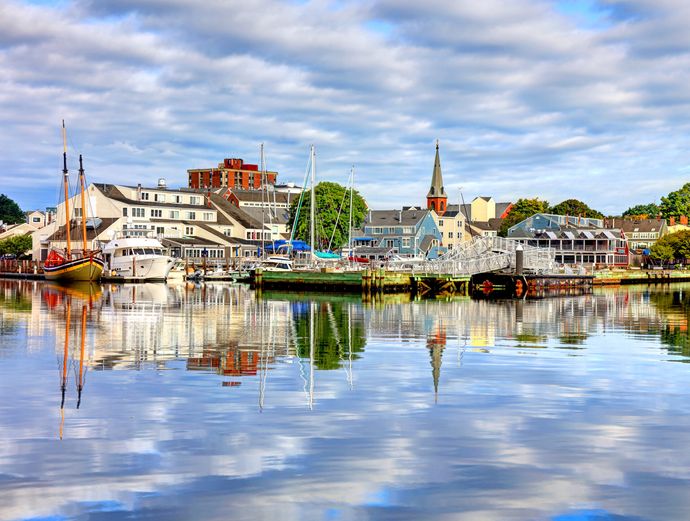
If you are looking for things to do in Cambridge we have 1 Tours and Activities to Experience Pickering Wharf. Check out our verified traveler reviews and photos of Pickering Wharf tours and other things to do in Cambridge, and book securely when you find the perfect one. Learn the best ways to see famous Pickering Wharf and explore the most popular things to do in Cambridge.
More #21
Salem Witch Museum
The Salem Witch Museum is a history museum on Washington Square in downtown Salem, Massachusetts, facing Salem Common. It tells the story of the witch trials that swept the area in the late 17th century, and people come for its dramatic retelling of how fear and accusation turned neighbors against one another.The museum occupies a striking Gothic Revival building with pointed-arch doorways, tall arched windows and corner buttresses topped with battlements. New York architect Minard Lafever designed it in the middle of the 19th century as a meeting house for Salem's East Church. After the congregation merged with another, the building passed through other hands, including a stint as an auto museum, and fires over the years cost its octagonal towers some of their height. The museum opened inside after renovation work in the late 20th century.The heart of a visit is a darkened hall ringed with thirteen life-size stage sets. As each scene lights up in turn, figures and narration follow the crisis from the first strange fits and frantic accusations to the trials, the crowded jails and the executions. A second exhibit widens the lens, looking at what the word witch has meant over the centuries, from the witch hunts of Europe to the familiar figure of popular culture, and at how fear of an outsider can be turned against a whole group of people.The museum also played a part in how Salem remembers its past. It helped bring about the memorial to the victims of the trials beside the old burying ground, and it worked with local business leaders to start the autumn festival that fills the city each Halloween season. It treats the story as a lesson in what happens when fear outruns reason, not as a fright show. A walk with a guide afterward links what you have seen to the streets, old houses and memorials connected with the story.
More #22
Salem Witch Trials Memorial
The Salem Witch Trials Memorial is a quiet stone enclosure in downtown Salem, Massachusetts, honoring the men and women put to death during the witch hysteria of the late 17th century. Visitors come to read the names on its granite benches and to reflect on what happens when fear overrules justice.The trials began when a group of girls in Salem Village fell into strange fits and accused neighbors of bewitching them. Within months the jails were crowded with the accused, and a special court sent many to the gallows on the strength of rumor and so-called spectral evidence. One elderly man, Giles Corey, was pressed to death under heavy stones for refusing to enter a plea. The colony later admitted the injustice, but the memory stayed raw for centuries.The memorial was dedicated three centuries after the trials by the Nobel Peace Prize laureate Elie Wiesel, a Holocaust survivor. Its design, chosen through an international competition, is spare and deliberate. A low stone wall surrounds a patch of grass and locust trees, and from the wall project simple granite benches, each carved with a victim's name, the manner of death and when it happened.Details reward a slow look. The stone threshold at the entrance carries the words of the accused protesting their innocence, and the lines are cut off mid-sentence by the wall, a silent comment on a community that refused to listen. The locust trees were chosen because they are among the last to leaf out in spring and the first to drop their leaves. Right beside it lies the Old Burying Point, one of the oldest cemeteries in the country, where one of the trial judges is buried. A guide can connect the names on the benches to the places where their stories unfolded.
MoreDiscover Cambridge

Tours & Sightseeing
Prices from $7
Walking & Biking Tours
Prices from $6
Cultural & Theme Tours
Prices from $6
Luxury & Special Occasions
Prices from $6
Day Trips & Excursions
Prices from $190
Food, Wine & Nightlife
Prices from $60
Private & Custom Tours
Prices from $6
Shore Excursions
Prices from $125
Transfers & Ground Transport
Prices from $125


Harvard Square
Prices from $7
John Harvard Statue
Prices from $6
Harvard University
Prices from $8
Harvard Museum of Natural History
Prices from $7
Massachusetts Institute of Technology (MIT)
Prices from $23
Charles River
Prices from $23
Kendall Square
Prices from $23
Back Bay
Prices from $578
Beacon Hill
Prices from $578
Bewitched Statue
Prices from $190
Boston Common
Prices from $578
Boston North End
Prices from $578
Hanukkah in Cambridge
Dec 4–12, 2026
New Year’s Eve in Cambridge
Thu, Dec 31, 2026
New Year’s Day long weekend in Cambridge
Jan 1–3, 2027
MLK Day in Cambridge
Jan 16–18, 2027
Senior-friendly tours Cambridge
13 tours & activities
Cambridge Foodie Tours
6 tours & activities
Family-friendly Cambridge Tours
10 tours & activities
The best tours and activities for culture lovers in Cambridge
8 tours & activities
Things to do in Cambridge this summer
10 tours & activities

 From $3